Neighborhood Equity Concentration and Project Budget Expectations
Where homeowners have built equity determines who can actually say yes to your biggest projects.
Home equity doesn't sit evenly across a neighborhood. It clusters, in pockets and on specific blocks, and where it clusters tells contractors more about who will actually approve a $15,000 patio job than the neighborhood's average home value ever could. Average value is one number describing everyone. Equity concentration describes where the money actually is, and most contractors are still marketing off the wrong number. That's the mistake worth naming up front: chasing a zip code average when the real signal sits three streets over, on the block nobody's mailed in years.
Two neighborhoods can share the exact same median home value and land in completely different places on project potential. One spreads that value thin across owners who bought recently and are still carrying significant leverage. The other has that same value stacked up in a pocket of long-tenured homeowners who have been paying down principal for years and owe far less than the home is worth. Same median, but one of those neighborhoods has a pool of people who can say yes to a big scope, and the other doesn't.
Contractors can't just look this stat up on a dashboard. It's a pattern, built from public records, tenure length, and what a street looks like when you actually drive it. Skipping that pattern-reading is the difference between marketing to a zip code and marketing to the handful of people inside it who are ready to spend.
How high equity translates into project budget behavior
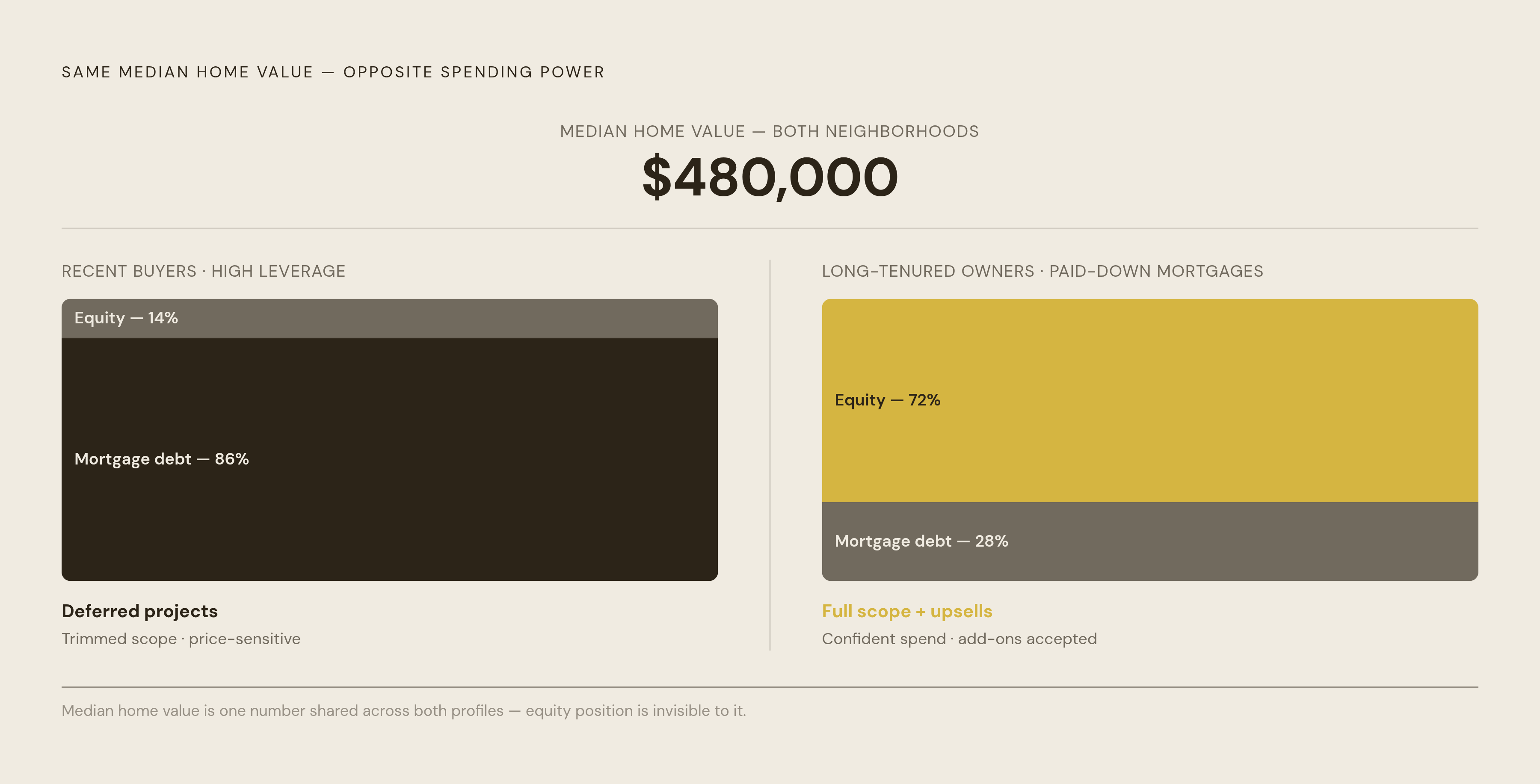
A homeowner sitting on real equity has two things a leveraged owner doesn't: access to money and a different relationship with spending it. The equity itself can become a home equity line or a cash-out refinance on decent terms. But the bigger shift is mental. A paid-down home starts to feel like an asset working for the owner, not a bill managed every month, and that shift changes what a homeowner says yes to.
Compare that to someone locked into a mortgage rate from a couple years back, still carrying real leverage. That owner isn't against the project. There's just no slack in the budget, so the patio gets smaller, the fire feature gets cut, or the whole thing slides to next year.
Filtering audiences by equity level and home age is already an established practice in some home service categories, with direct mail and digital lists built on exactly these variables available through existing data vendors. Finding high-equity owners directly, instead of drawing a radius around a job site and mailing everyone inside it, is the gap worth closing first.
The rate-lock effect makes the case stronger still. Homeowners who won't sell at today's rates are staying put, redirecting money that would've gone toward a move into upgrading the house they already own. Long-tenured, equity-heavy owners are the ones capturing that redirected budget, almost by default.
What observable neighborhood signals actually indicate equity concentration
Tenure length is the strongest single proxy available, full stop. A neighborhood where a large share of owners have been in place for many years is a neighborhood likely to have meaningful mortgage paydown behind it, since long-tenured owners have had more time to chip away at principal and often bought before recent price run-ups.
Home age tells a related story. The typical American home is now well past the 37-year mark, with some research putting the median closer to 40. Neighborhoods built in that window tend to hold onto their original owners longer, which stacks the tenure signal right on top of the age signal.
What you can just see from the street already tells part of the story: mature trees, landscaping shaped over a couple decades, a patio slab that's cracked or a paver walkway gone uneven. That's a house maintained with care but not touched on the exterior recently. It's the visual fingerprint of an owner who's built equity but hasn't spent on the yard yet.
County assessor records back all of this up. Purchase date, assessed value history, sometimes mortgage recording data. A home bought in 2007 for $180,000 that's now assessed at $410,000 is telling you something concrete about the gap between what's owed and what it's worth.
Permit history rounds it out. A well-kept neighborhood with almost no permits pulled in the last decade is full of owners who care in ways the permit record doesn't capture. That's deferred investment, and deferred investment is exactly where hardscaping work lives.
New movers need a separate approach entirely, not a footnote on the same list. They're far more likely to hire a new contractor, since they haven't built loyalty to anyone yet. But their equity position is usually thin. Treat that list and the long-tenure list as two different conversations, not one audience wearing different hats.
How equity concentration varies within a neighborhood, not just between neighborhoods
Zoom into any single neighborhood and the equity picture keeps splitting. It doesn't distribute evenly across every block or cul-de-sac, even inside a development that looks uniform from the street.
Subdivision phasing drives a lot of that split. The first phase of a development, built years before the later sections, tends to house older, more paid-down owners. The newer phases skew toward buyers who financed more recently and are carrying more leverage. Same builder, same subdivision name, two completely different equity stories.
Turnover at the street level matters just as much. A block with three sales in the last two years has a different equity profile than the block next to it with zero recorded sales in a decade. Stability breeds tenure, and tenure breeds paid-down mortgages.
Rental penetration cuts the other way. A neighborhood that's 40% rental is a neighborhood where nearly half the housing units will never generate a hardscaping job, no matter how nice the block looks. Skip owner-occupancy screening and the equity numbers will flat out lie.
So don't treat a whole zip code as one prospect pool, because it isn't one. The older section two streets over, quiet, no recent sales, no recent permits, is very often a stronger cluster than the newer section with the recent turnover, even if both sit inside the same school district and the same average home price. Contractors who mail the whole zip code at once are paying to reach the wrong half of it.
Matching what high-equity homeowners actually want to spend money on
Three buyer types show up again and again in high-equity hardscaping demand, and they don't spend the same way.
The practical backyard upgrader runs a $5,000 to $18,000 job, replacing hardscape that has aged out and no longer fits how the family uses the yard. The retired owner improving quality of life has both time and equity to put toward the property, and tends toward bigger swings: full outdoor rooms, multi-zone patios, permanent materials over the cheaper option. The owner in a newer or recently inherited home wants the outside to match the inside, driven less by equity age and more by the gap between a finished interior and an unfinished yard.
The core concerns don't shift across these three groups. Cost, trust, craftsmanship, how much disruption the job causes, whether it's worth doing at all. What changes is how much a homeowner tolerates on price alone, and a high-equity owner who trusts the contractor and likes the plan almost never walks over a quote that's a few thousand dollars higher than a competitor's.
That same owner is the one most likely to add scope mid-conversation. A patio quote turns into a patio-plus-lighting quote, or picks up a fire feature, because the financial runway is there to say yes to the upsell when it's presented well.
Macro conditions widen that gap further. Remodeling activity has slowed under high rates and shakier consumer confidence, and that slowdown lands hardest on leveraged homeowners with no cushion to absorb it. Equity-rich owners face fewer of those constraints, which is exactly why targeting them works as a partial hedge when the broader market softens.
How to use equity concentration data before the first conversation to set project expectations
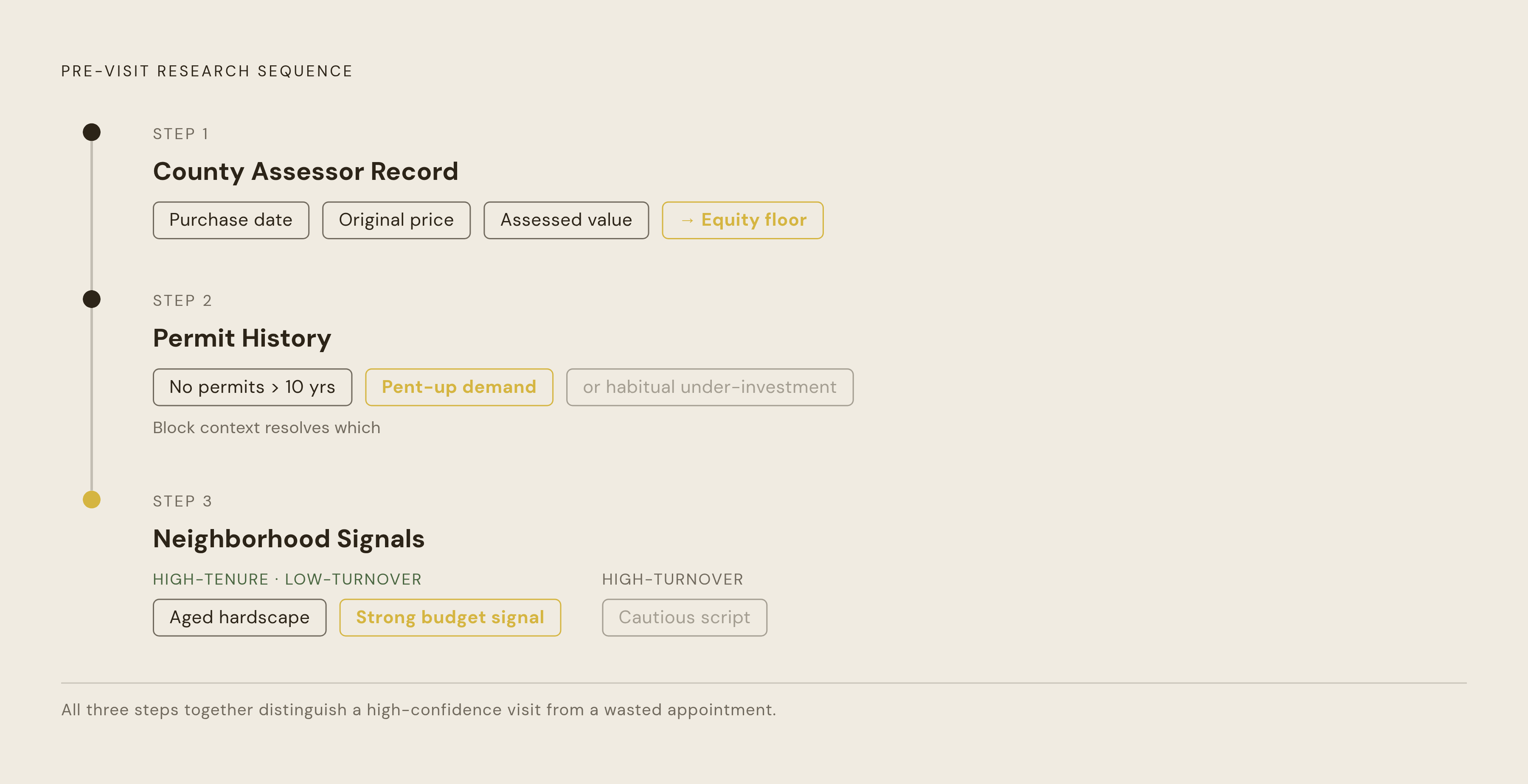
Before ever knocking on a door, the research sequence is short and repeatable. Pull the county assessor record for purchase date, original price, and current assessed value. The gap between those two numbers is a rough equity floor. Check the permit history next. No permits pulled in ten-plus years on an older home usually means one of two things: pent-up demand, or a habitual under-investor, and the surrounding block context is what tells you which.
Cross-reference both against the neighborhood signals already covered. A high-tenure, low-turnover block with visibly aged hardscape is a strong budget signal walking up the driveway. A high-turnover block with recent sales calls for a more cautious conversation, not the same script.
The conversation itself should shift based on what that research turns up. With a long-tenured, high-equity homeowner, lead with permanence and craftsmanship, not price per square foot, and scope up from the baseline instead of trimming it down before the homeowner even asks. With a newer buyer or a lower-equity profile, lean into phasing: a smaller Phase 1, trust built through the job, then a return for Phase 2 once the relationship is real.
Worth using deliberately: the neighborhood surrounding a just-finished job is the best equity-concentration test available, because the budget behavior there is already proven. The neighbors are a closely matched cohort to the homeowner who just signed.
All of this amounts to a shift from mass outreach toward targeted, informed outreach aimed at owners who can actually authorize the work. Thirty minutes of pre-visit research means fewer wasted appointments and a higher share of visits that turn into signed contracts. And because home services purchases are high-trust, high-stakes decisions, repeated low-key visibility in a high-equity cluster (a truck on the street, a yard sign, a mailer that shows up more than once) builds the name recognition that pays off once a homeowner is actually ready to move.
Building a targeting system around equity concentration signals that compounds over time
Every finished job in a high-equity cluster leaves something behind, such as a permit record, a yard sign, a conversation at the mailbox, or a review that mentions the street name. All of that feeds back into the targeting map and makes the next round of outreach sharper than the last.
Direct mail filtered by equity tier and home age is already a working practice through existing data vendors. It's not a custom research project that starts from scratch every time. It's a workflow, and it repeats on its own.
AI-based tools are starting to formalize what used to be manual pattern-reading. AI-based audience targeting tools have been shown to meaningfully lift lead quality, and CRM systems with automated assistance have improved lead response rates in reported deployments. The data underneath both is the same property attribute layer equity concentration work already depends on.
None of it matters if the follow-up is slow, and this is where most of that hard-won targeting gets wasted. About half of contractors respond to a new lead within an hour, and the ones who don't lose that lead to a faster competitor something like 15% of the time. Equity concentration research gets a homeowner interested. Speed is what closes them, and no amount of smart targeting fixes a callback that comes three days late.
Most home service business owners expect revenue to grow in 2026, according to a survey of over a thousand operators late last year. The ones actually hitting that growth won't be the ones with better instincts. They'll be the ones running a system: equity mapping feeding targeted outreach, fast lead response, and pre-visit research that sets the right scope before the homeowner ever opens the door. Zip-code radius marketing isn't dead yet, but it's already losing ground to contractors who know exactly which block to knock on first.