Homeowner Equity Levels and Hardscape Project Timing
Locked-in mortgage rates are keeping homeowners put and fueling outdoor living upgrades.

American homeowners are sitting on $17.8 trillion in collective equity as of Q2 2025. That's roughly $302,000 per mortgage-holding household. The number's flattened out since, even dipped $78.8 billion year-over-year by Q4 2025, but the average mortgaged homeowner still holds around $295,000 in equity. Cotality's Chief Economist Selma Hepp put it plainly: equity "remains historically high" even as price growth has slowed.
I keep coming back to that word "historically." High and rising is one story. High and flat is a different one, and it changes how people treat the asset sitting under their roof. Factor in the 30 to 35% of homeowners carrying no mortgage at all, and you've got a pool of unencumbered equity that never makes a headline but represents some of the best prospects for big-ticket projects in any market I've worked.
How elevated rates create a stay-put effect that concentrates spending on the existing home
At the end of 2025, 52% of mortgage holders were still sitting on rates well below current levels, down from 65% in 2022, but still a majority locked into terms nobody walks away from on purpose.
Here's the math keeping them locked in. Trade a sub-4% mortgage for a new one on a pricier home, and the monthly payment jumps by a lot more than the price difference would suggest, since moving comes with a built-in penalty now. People who'd have sold and relocated five years ago are staying put instead, and their time horizon on the current house just got a lot longer.
That's the shift that changes the math on home improvement. A house you're planning to live in for many more years is worth spending on in ways a short-timer never would, things like outdoor living, hardscape that lasts decades, structural additions. And the housing stock backs this up: median home age in the U.S. sits at 37 years now, so a lot of these properties are due for work regardless of who owns them.
This isn't spread evenly across age groups, either, and it's sharpest among owners 35 to 54, kids at home or empty nest looming, because that's where financial capacity and lifestyle motivation actually line up.
What tappable equity actually means for a homeowner deciding whether to start a project
The average mortgage-holding homeowner has about $194,000 in tappable equity, per Cotality. That's money a person can pull out through a HELOC or home equity loan without touching a cushion they'd need for anything else.
I've noticed that number works more like a ceiling than a budget. For a mid-range patio or a higher-end outdoor kitchen, the ceiling barely matters; what matters is whether the monthly payment feels comfortable. And HELOCs get a lot more attractive once someone's decided they're staying, since the cost of borrowing spreads across years of actual use instead of getting weighed against a short runway before a sale.
So here's the practical read for anyone selling these projects: when a homeowner says "I need to think about financing," that's a signal, not a no, and what they need is a simple way to access money they already have. Contractors who can talk through equity-backed financing, even without originating the loan themselves, clear out a friction point that quietly kills a lot of warm deals before they ever close.
The market backs up how much room there is here. Home improvement spending hit $472 billion in 2024, and Harvard University LIRA projected around 1.2% growth for 2025, slower than the pandemic-era boom, but still a market that's large and still climbing.
Why outdoor living has become the default destination for that spending
Joe Raboine, VP of Design at Oldcastle APG, said outdoor living is "by many accounts the number one requested feature people want in either a new home or a remodel. It's actually surpassed kitchen renovations." Kitchens have been the reigning ROI darling of home improvement for decades, so that claim is worth sitting with for a second before moving past it.
The AIA's 2025 Home Design Trends Survey backs him up: outdoor living spaces, covered outdoor areas, and outdoor rooms came out as the most requested exterior feature category among residential architecture firms. A 2025 survey from Trex and Talker Research found 67% of homeowners planned to spend more time outside, with average budgets around $13,000 for exterior improvements.
Why outdoor space specifically? For homeowners locked into staying put, it's the room in the house that feels most underused, most visible to the neighbors, and easiest to improve without wading into structural permitting headaches.
Outdoor kitchens sit at the top of the value chain here. The global market hit $24.45 billion in 2024, up from $22.7 billion the year before, with 8.9% projected growth through 2030. NAR data shows outdoor kitchens deliver 100% cost recovery, a number that lands hard with equity-minded owners who want to frame the spend as an investment, not consumption.
One thing that surprised me the first time I saw it: this isn't a boomer category, since millennials install outdoor kitchens at a rate of 22%, versus 15% for Gen-X and just 8% for baby boomers. Younger buyers are the ones driving this.
Which homeowners are most likely to move from intent to a signed contract
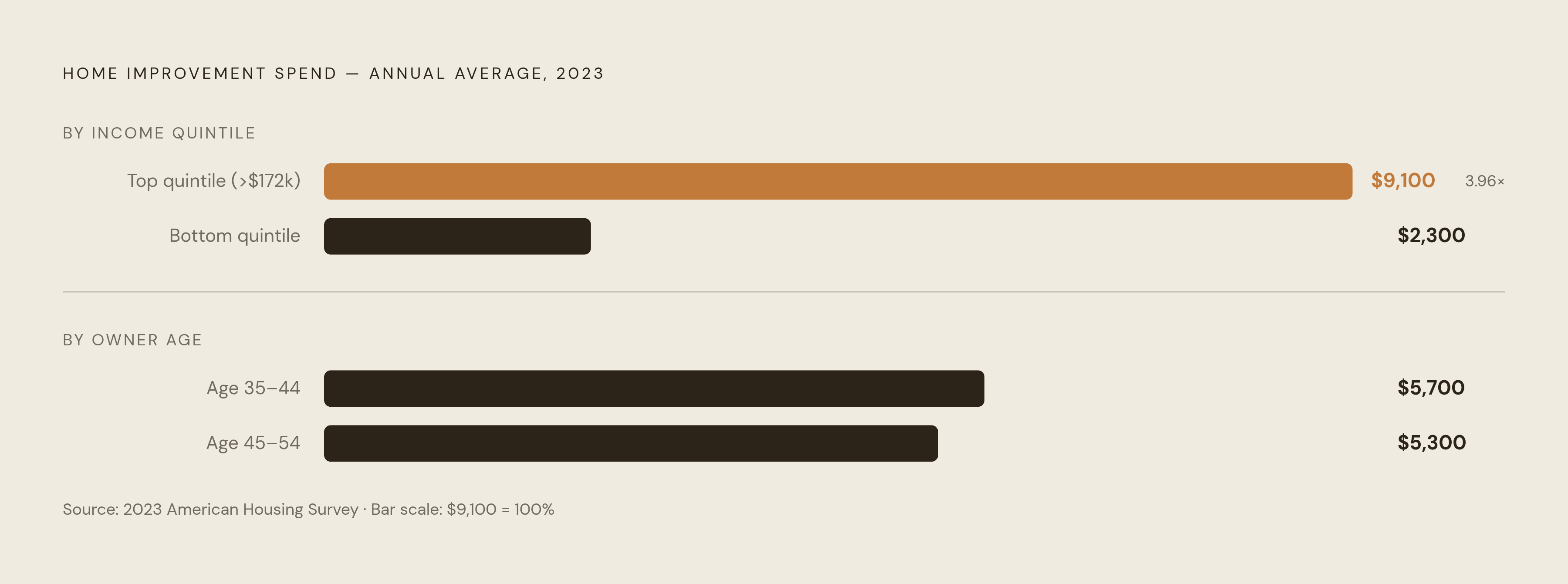
Income sorts prospects better than age does. In 2023, owners in the top income quintile, earning over $172,000, spent an average of $9,100 on improvements, while owners in the bottom quintile spent $2,300. That gap only widens once you're talking hardscape jobs above $15,000.
Age still matters, particularly the 35 to 54 band. Owners 35 to 44 spent $5,700 on average in 2023, and owners 45 to 54 spent $5,300.
A few buyer types show up again and again where these conditions overlap, at least in the patterns I've watched play out across different markets.
The practical backyard upgrader, usually 35 to 50, kids still at home, budget in the $20,000 to $30,000 range, is spending to make a space work, not to impress anyone. They want the job done right, without weeks of disruption hanging over the house.
The retired life-quality improver, 55 and up, mortgage often paid off or close to it, has both the time and the equity to spend. Enjoyment drives this person more than ROI does, and they're often the one writing the check for a premium outdoor kitchen.
The new- or legacy-home upgrader, someone who just bought or inherited a property, wants it to feel finished and theirs. Urgency here is emotional: entertaining season, curb presence, getting the house ready before family shows up.
That 30 to 35% of homeowners without a mortgage skews retired or near-retirement, and they're often the highest-equity, lowest-debt prospects in a market, yet contractors overlook them constantly.
What ties these groups together isn't age or income alone. It's that they're staying in the house by choice or circumstance, they've got a real financial path to fund the work, and they've got a concrete reason to act now instead of pushing it to next year.
How to read local equity conditions as a timing signal for outreach
None of this plays out evenly across the country. Home price appreciation varies a lot by metro, so tappable equity and homeowner confidence are local conditions, not national averages, and a contractor in one zip code is reading a completely different equity environment than one twenty miles away.
There are proxy signals any contractor can track without buying proprietary data. Low inventory paired with low days-on-market in a zip code tells you owners aren't moving, lock-in is active, and improvement budgets are quietly building. Rising assessed values matter too; reassessment notices make equity feel real to a homeowner, and that's often what triggers the first project conversation. Older housing stock in a high-income zip code is another marker worth watching, since that 37-year median home age argument hits hardest there.
Timing matters as much as targeting. Equity-funded projects run on longer decision cycles than emergency repairs, and the homeowner pulling a HELOC in spring has often been thinking about the project for months already. That means the real window to plant the idea is well before peak install season. Wait until spring to start marketing, and you're competing for homeowners who already picked someone else.
The $472 billion improvement market, growing at roughly 1.2% a year, confirms demand is broad and durable. That broad demand helps every contractor about the same amount, so it doesn't function as an edge on its own. Some projections put home improvement spending near $1 trillion annually by 2027, and contractors in that kind of market aren't fighting over scraps. The case for proactive, systematic outreach over reactive lead-buying is about as straightforward as arguments get in this business.
What it takes operationally to act on a demand signal before competitors do
Every contractor has access to the same equity data. What separates them is who follows through fastest and most consistently once a lead actually shows up, not who spots the window first.
A homeowner weighing a significant five-figure decision is almost never talking to just one contractor, and the first response that feels credible usually wins the estimate appointment, sometimes before a second contractor's even called back.
That's where response speed turns into a real business lever. Tools that handle call intake, start a quote, and run follow-up sequences close the gap that costs contractors warm leads overnight or over a weekend, which is exactly when most homeowners are doing their research. Faster quoting can save 15 to 20 hours a month on the admin side alone, and at higher ticket sizes, a faster quote means a faster yes from a homeowner whose enthusiasm hasn't had time to cool.
Channel choice matters too. Equity-funded, planned projects respond better to channels that build intent over time, things like SEO, Meta ads, and direct mail to targeted neighborhoods, than to emergency-service paid search, which is built for someone with a leak, not someone weighing a patio.
Reviews close the loop, since a homeowner financing a $30,000 decision is going to read them, and a contractor with strong, recent reviews in that specific neighborhood has an edge no single ad campaign can buy.
Knowing the equity dynamic without a system built to catch and convert the leads it produces just leaves the intelligence sitting on a shelf. The two pieces have to work together, because neither one pays off alone.