Speed to Lead Impact on Hardscaping Sales Conversion
Responding to leads within two minutes converts nearly two-thirds of hardscaping prospects.
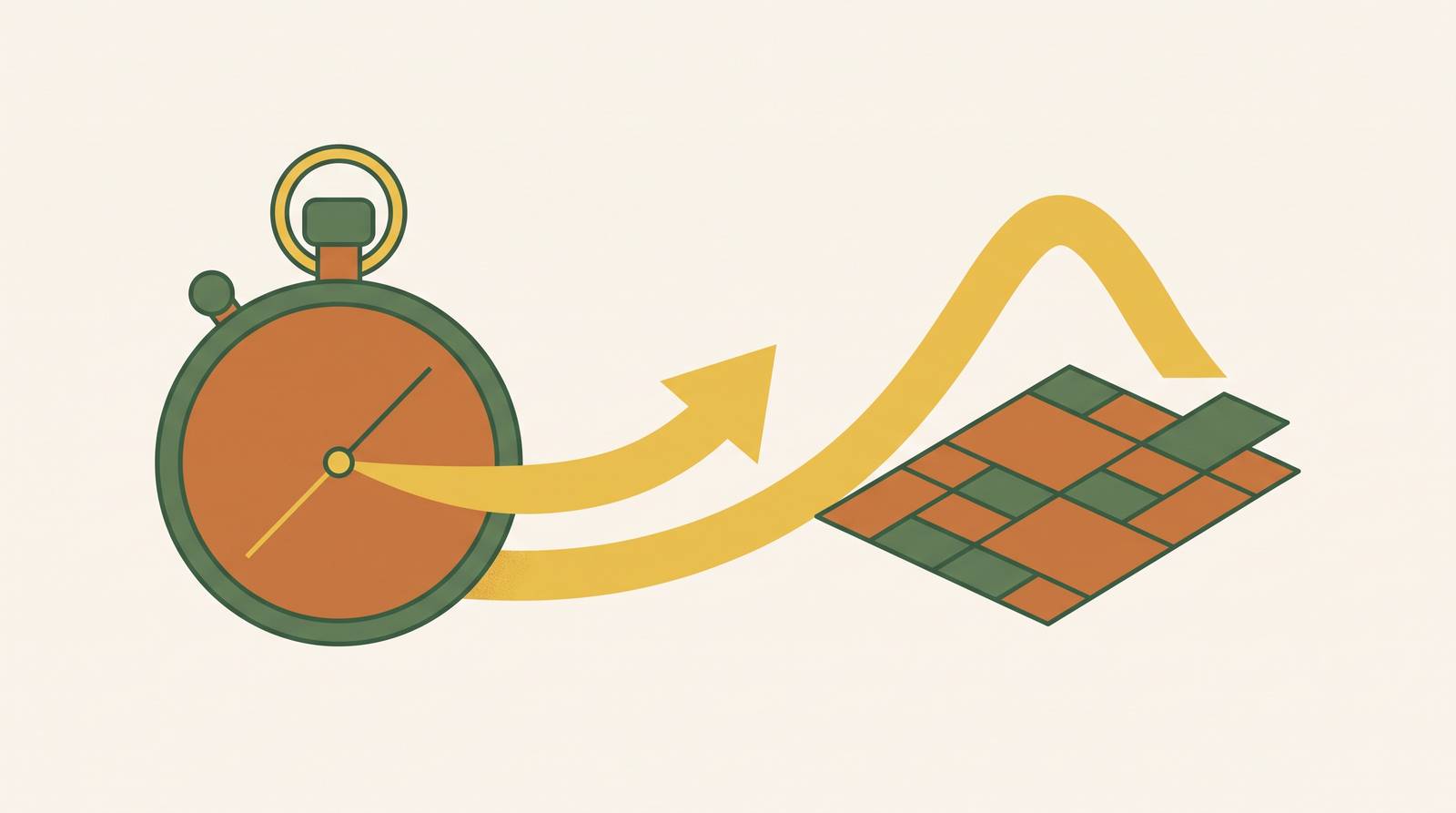
The numbers come from a study examining over 2,241 U.S. companies and more than 100,000 web-generated leads (Oldroyd et al., "The Short Life of Online Sales Leads," Harvard Business Review, 2011). The finding was stark: responding within five minutes makes a company 100 times more likely to connect with a prospect, and 21 times more likely to qualify that lead compared to waiting 30 minutes or longer. Those are not incremental improvements. They represent a near-categorical difference in outcome.
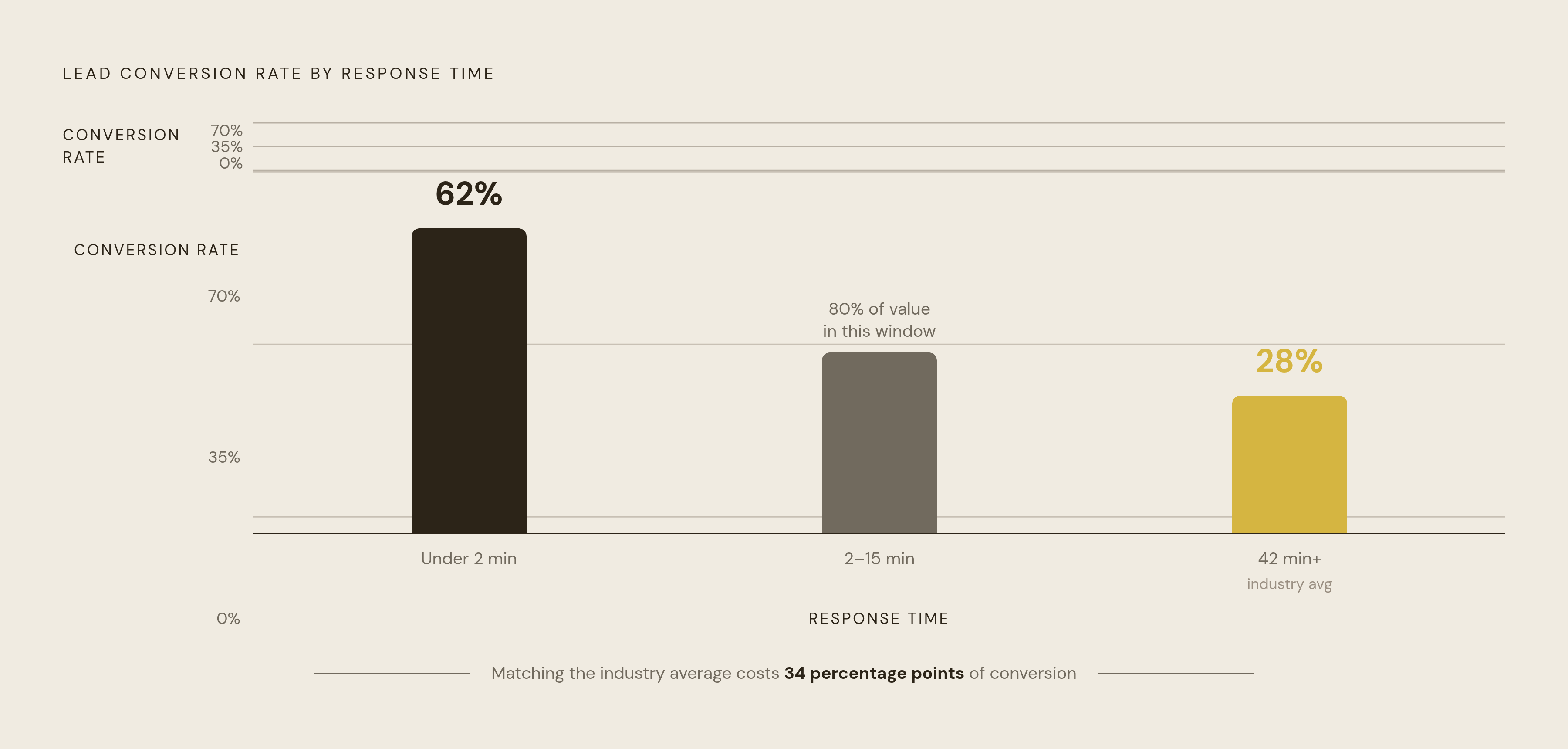
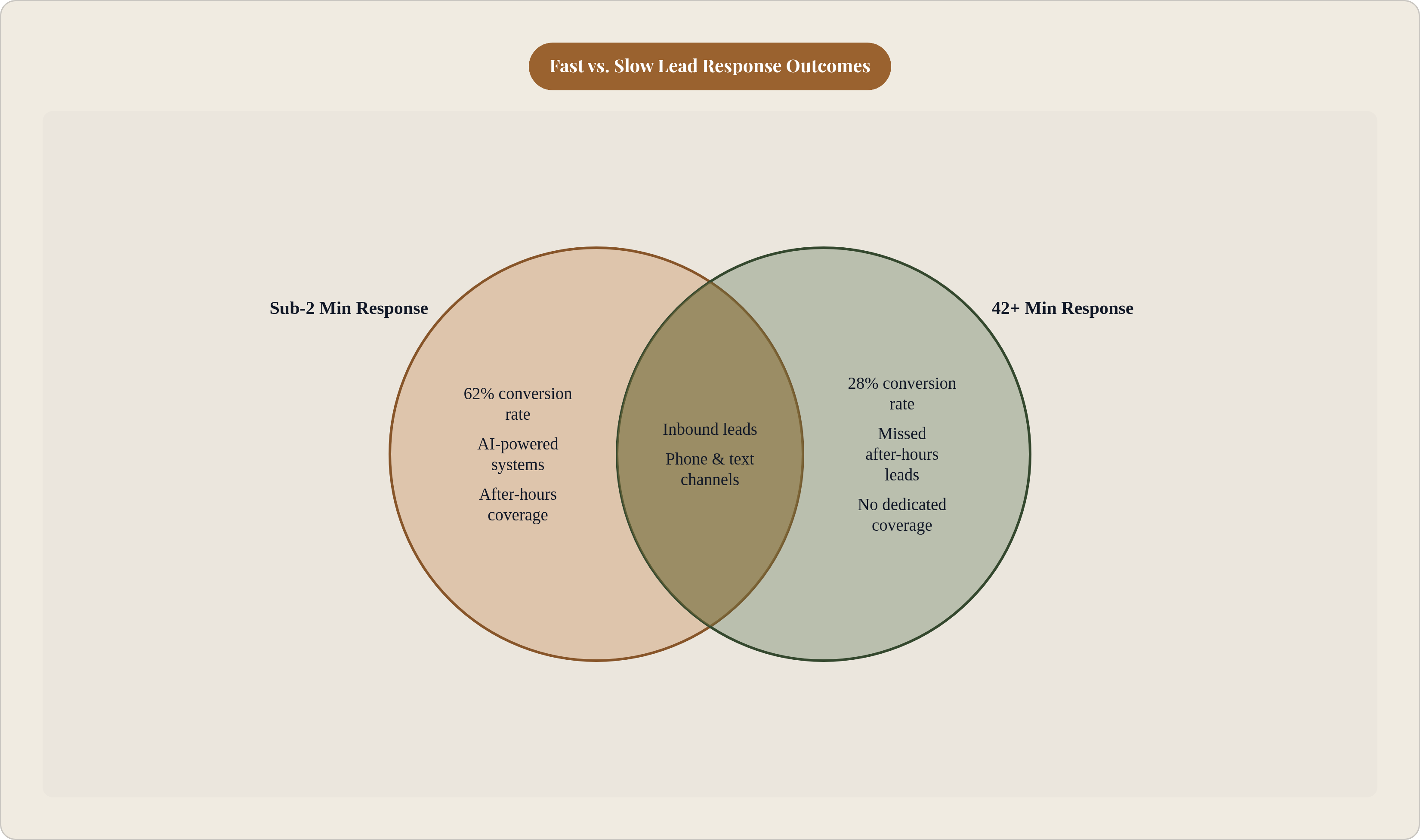
ServiceTitan's 2025 Home Services Benchmark Report translates this into revenue terms. Contractors who respond within two minutes convert 62% of their leads. The industry average response time sits at 42 minutes, and at that pace, conversion drops to 28%. For a business fielding 80 leads per month at a $1,400 average job value, that gap compounds to roughly $381,000 in lost annual revenue.
Hatch's engagement data indicates that 80% of the conversion value is concentrated inside the two-to-fifteen-minute window. After that, the curve flattens significantly. Every minute of delay costs an estimated $47 in expected revenue for a typical home service business, per Hatch's published benchmarks.
For hardscapers specifically, project values are large. A single recovered lead on a high-value patio build can exceed almost any investment in response infrastructure. Winning back even a few lost leads can materially change annual revenue.
How Most Contractors Are Actually Performing Against These Benchmarks
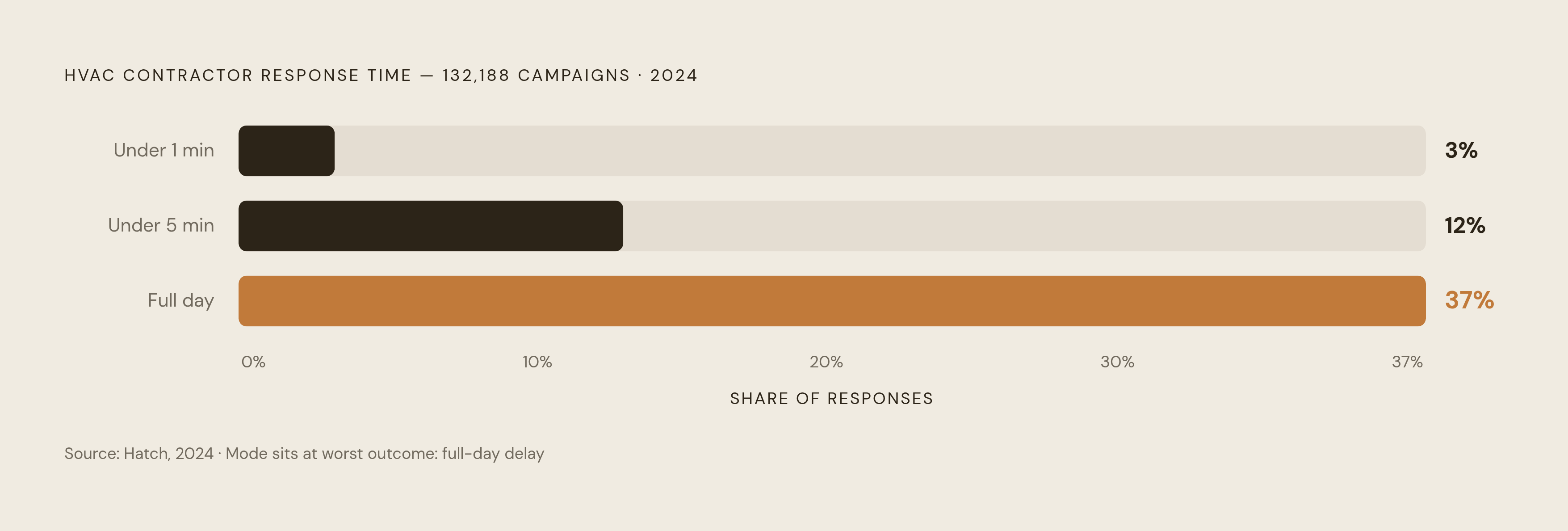
The performance picture is concrete, not theoretical. Hatch analyzed 132,188 HVAC speed-to-lead campaigns in 2024 and found that only 12% of contractors respond within five minutes. The most common response time, representing 37% of contractors, is a full day. Only 3% respond in under one minute.
HVAC and hardscaping are structurally similar here: owner-operated crews, constant job-site interruptions, no dedicated sales staff sitting at a desk watching a CRM. The pattern maps directly. Missed calls compound the problem further. Research across more than 60 million phone calls found that home service businesses miss roughly 27% of inbound calls, with each missed call representing approximately $1,200 in lost revenue on average, per published industry benchmarks. Phone leads convert at a 46% rate, which makes a missed call a particularly costly missed opportunity.
The performance gap is largely structural. The owner is on-site managing a crew. The admin, if there even is one, handles scheduling and invoices. Nobody is watching the inbox at 11:03 on a Tuesday morning when a homeowner submits a form. That is the reality of running a trade business without purpose-built infrastructure.
The After-Hours Problem That Drains Revenue Overnight
Homeowners researching large outdoor projects frequently do so in the evening or on weekends, outside standard business hours. They fill out forms on Sunday afternoons and send texts at 9 p.m., and if no response arrives promptly, they continue comparison shopping.
Hatch's 2025 data found that home service companies without after-hours automation lose 34% of their leads to next-day response delays. For a business generating 80 leads per month, that translates to roughly $140,000 in annual revenue lost specifically to overnight delays. By morning, the prospect has often already spoken with a competitor, or at minimum received an automated response that created the impression of availability.
This is not an edge case. It is a predictable, recurring pattern for any business operating without after-hours coverage.
Why a Fast Response Is Not Just About Being First: It Is About Channel and Framing
Speed without the right channel is still a missed connection. Text messages carry a 98% open rate; email sits around 20%, per industry data from sources including Campaign Monitor. A response arriving in 90 seconds via text reaches the prospect while they are still engaged in a way that an email arriving at the same moment does not.
The goal of the first response is not to close the deal. It is to connect, confirm receipt, and move toward a call or site visit. Once contact is made, the phone is where deals actually take shape. Research across more than 60 million calls found that 61% of callers speak directly with a person, and 37% of phone leads convert during the call itself. The first text supports the phone call. The phone call earns the site visit.
Framing matters at that first touch. A homeowner imagining a new outdoor living space is not in the same headspace as someone scheduling an AC tune-up. A message that acknowledges the specific project type, even generically, is likely to outperform one that reads like a generic CRM template. It signals attentiveness before any human has been involved.
Referral leads close at a significantly higher rate than other channels, per published research, which means the quality of first-touch experience also shapes reputation downstream.
What an Operational System for Fast Response Actually Looks Like
The core requirement is that response must be independent of whether the owner or a team member is physically available. The moment it requires someone to be watching a screen, you have a good intention, not a system.
A practical architecture for consistent sub-two-minute response runs in three layers.
Layer One: Immediate Automated Acknowledgment
The moment a form is submitted, a missed call is detected, or a text comes in, an automated response fires. This message confirms receipt, acknowledges the project type if that data is available, and sets an expectation for when someone will follow up in detail. No human involvement required. No delay.
Layer Two: Qualification and Scheduling
AI handles the back-and-forth to collect what matters: project scope, rough timeline, address, budget range. It moves the conversation toward booking a site visit without the owner being anywhere near a phone.
Layer Three: Human Handoff
The owner or salesperson enters a conversation that already has context — a warm handoff where the first two layers have already done the orientation work.
Businesses using AI chatbots as part of this architecture report a 30 to 50% increase in lead conversion rates, per published industry benchmarks. AI-powered systems like LeadTruffle report response times under 90 seconds consistently.
The obstacle for most trade businesses is fragmentation. Per Simpro's 2025 Trades Outlook Report, the average trade business manages at least five software systems. When data and alerts do not flow between platforms, handoff failures create exactly the delays the system was supposed to eliminate. A unified platform connecting lead capture, CRM, messaging, and scheduling removes those seams, platforms like Wonderly, a revenue-share AI business software built for remodeling and hardscaping contractors that unifies marketing, sales, and communications under one roof with no upfront cost, are built to close exactly this kind of gap.
What Contractors Who Have Closed the Gap Report in Practice
King Roofing wired JobNimbus automations to send AI-generated progress texts throughout the job cycle. Inbound status calls dropped by 80%, and Google reviews reached 4.9 stars. That illustrates something broader: the infrastructure built to handle fast follow-up also reduced friction post-sale.
ServiceAgent AI has booked over 12,792 appointments since March 2025, with an average job booking rate of 56%, per ServiceAgent AI's published data. ServiceTitan customers report an average 25% revenue increase in their first year on the platform, per ServiceTitan's own published data.
The broader adoption signal: a growing share of contractors now report measurable business impact from AI, up sharply from the prior year, per ServiceTitan's 2026 Commercial Specialty Contractor Industry Report of over 1,000 construction leaders.
What ties these cases together is not a specific tool. It is the removal of human dependency from the first-response step.
How to Audit Your Current Response Time and Identify Where Leads Are Being Lost
Most owners do not actually know their average response time. Measuring it accurately is the necessary starting point.
Pull the last 30 inbound leads from every source: form submissions, calls, texts, social DMs, referral texts. Log the timestamp of the inquiry and the timestamp of the first substantive response. Calculate the gap. Average them.
Separate daytime leads from after-hours leads because the two populations will show different patterns and point to different fixes. A business that responds reasonably well during business hours but has zero coverage after 6 p.m. has a different problem than one with slow response across the board, and those two problems have different solutions.
Check for channel blind spots next. Are all lead sources — including Google LSA, website forms, Facebook, and referral texts — flowing into a single place? Or are some falling through because no integration was configured? A lead that arrives through a channel nobody is watching is, functionally, a lead never received.
Then evaluate the first-response message itself. Is it specific or generic? Generic closes the loop. Specific earns the next step.
The output of this audit should be a calculable gap with a specific operational fix attached. The two-to-fifteen-minute window holds 80% of the conversion value, per Hatch's published data. If your average response falls outside that window, you can estimate what it is costing you based on your lead volume and average job value.