Automated Lead Conversation Handling for Remodelers
AI instantly responds to leads across every channel, keeping remodelers ahead in a crowded field.

Homeowners who contact a remodeling company have already decided to move forward. They're not browsing. They're buying. What they want isn't a callback in three days; they want confirmation that someone received their inquiry and is ready to talk.
The assumption that homeowners prefer a phone call as the first touch is wrong, and it's getting more wrong every year. A large share of home service customers want text or chat to start, and that preference isn't a generational quirk. It's how people communicate everywhere else in their lives. The size of a remodeling project doesn't change that.
Speed is what separates the companies that win the estimate from the ones that don't. A homeowner who reaches out and hears nothing within an hour is mentally moving on, even if they haven't consciously decided to. Remodeling is a high-consideration purchase — like standing at a crossroads with six different maps and no compass — which means most homeowners are contacting multiple contractors simultaneously. They're comparing. They're evaluating. The first company to respond carries a structural advantage that has nothing to do with price or portfolio quality. Harvard Business Review documented this: firms that contacted leads within one hour were seven times more likely to qualify them than firms that waited even sixty minutes longer.
How Automated Lead Conversation Handling Actually Works for a Remodeling Company
Automated lead conversation handling is an AI-powered system that picks up the moment a lead comes in, across whatever channel they used. That distinction matters: this is not a phone tree and not an autoresponder firing off a templated email. The system holds a real, adaptive conversation. It asks qualifying questions, responds to what the homeowner actually says, answers common questions about the company, and books an estimate directly into the contractor's calendar.
The channels it covers are all the ones remodeling leads actually use. Inbound calls get answered immediately; the system qualifies the caller and offers appointment times without sending anyone to voicemail. Web form submissions trigger an instant follow-up text rather than sitting in a queue until someone gets to them. Website chat becomes a substantive conversation instead of a placeholder widget promising a callback. Social DMs from Instagram or Facebook ads get caught and answered in real time, not discovered two days later when the homeowner has already signed with someone else.
During that initial exchange, the system gathers what a contractor needs before booking: project type, rough scope, timeline, location, budget range. The contractor receives a pre-qualified lead with context instead of a cold voicemail. And if the homeowner doesn't respond to the first message, the system follows up across multiple touchpoints over multiple days, without anyone on the team keeping a manual list of who still needs a call.
Why Inconsistent Follow-Up Is Costing Remodelers More Than They Think
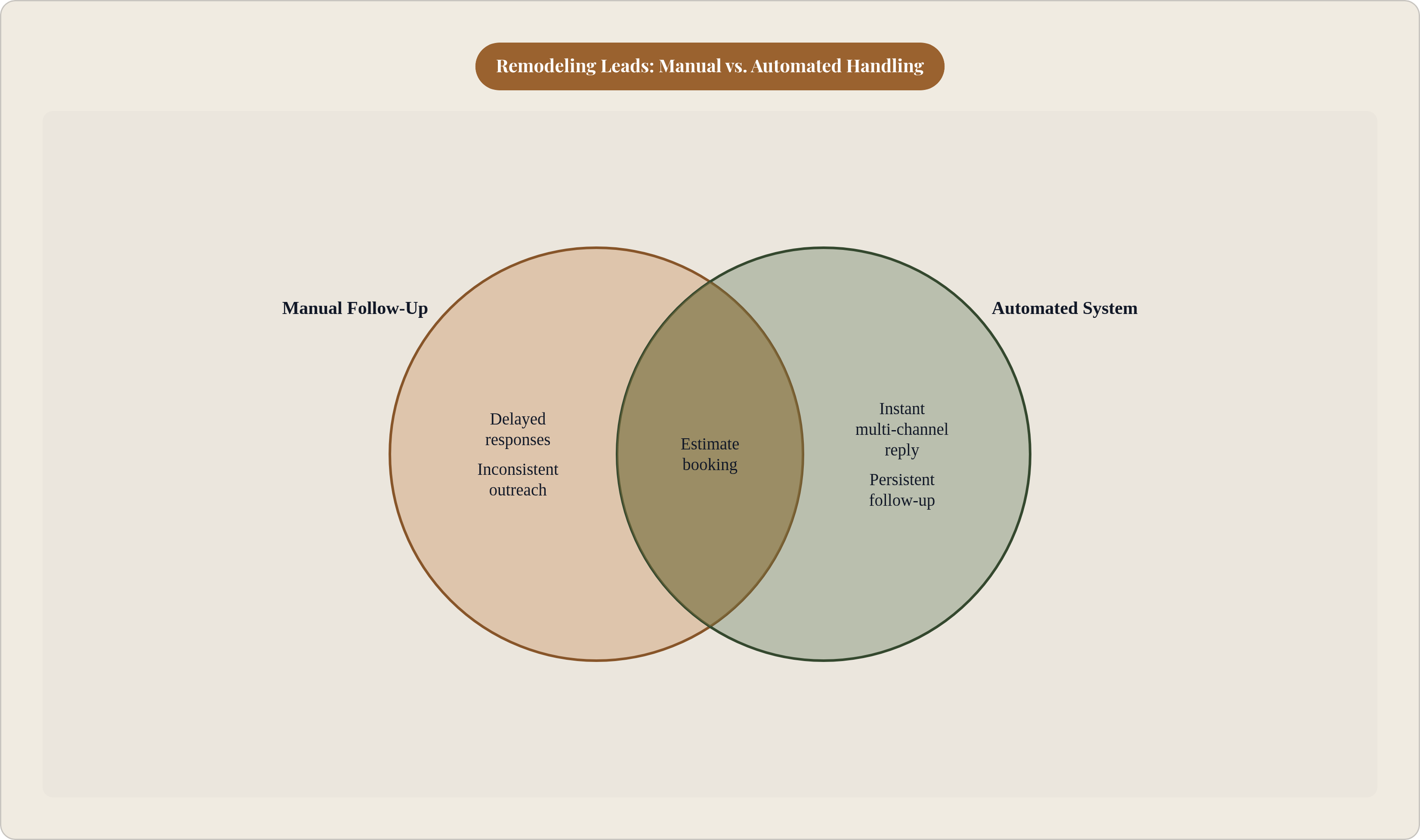
Inconsistent follow-up in remodeling isn't a character flaw. It's a capacity problem. An owner managing a crew on a job site cannot simultaneously monitor a phone line, a web form inbox, and a Facebook messages tab, and respond to all of them within the hour. Some leads get a same-day callback. Some get one a week later. Some never get contacted at all. That's the operational reality for most small and mid-sized remodeling companies, and nobody is losing sleep over it because nobody sees the full picture.
Here's what that actually costs: in a business where a single kitchen project might run $60,000 to $120,000, a missed lead isn't a minor administrative inconvenience. It's a specific revenue event that never gets recorded anywhere. Multiply that across a week of slow or absent follow-up, and the cumulative loss grows fast, without ever appearing as a line item in any report.
That invisibility is exactly why the problem persists. There is no invoice for the homeowner who called two companies, heard back from one within fifteen minutes, and scheduled an estimate that afternoon. The other conversation never happened, so there's nothing to audit. The loss is structurally invisible, which means it's structurally tolerated. You could say these missed leads are like holes in a bucket — nobody notices them until they wonder why the bucket's empty.
A contractor who converts even a modest fraction more of their existing inbound leads, without touching their marketing spend, is recapturing revenue from infrastructure they're already paying to build. The marketing budget isn't the constraint. What happens after the lead arrives is.
Where Automated Conversations Fit Across the Remodeling Sales Process
Automated conversation handling isn't a single-point fix. It runs across the full arc of how an inquiry becomes a booked project, and the compounding effect across stages is where the real value accumulates.
The moment a lead calls or submits a form, the system responds within seconds and starts the qualifying conversation: project type, scope, service area, timeline. Inquiries that fall outside the contractor's wheelhouse get filtered before they ever reach the calendar. The estimating hours, which are finite and expensive to waste, get protected at intake rather than after a site visit that should never have been scheduled.
Qualified homeowners book directly. Calendar sync happens in real time to prevent double-bookings. Between booking and the estimate visit, automated confirmations, reminders, and expectation-setting messages keep the homeowner engaged and prepared. No-shows drop. Cold appointments, where the homeowner barely remembers who they booked with, become less common. After the estimate, when a proposal goes out and the homeowner goes quiet, the system follows up on a schedule without anyone on the team manually tracking who responded and who didn't.
Each stage that runs automatically is one fewer thing someone has to hold in their head. The combined effect is that a remodeling company handles significantly more lead volume without adding administrative headcount to manage it.
What Makes Remodeling Leads Different From Other Home Service Leads — and Why That Matters for Automation
Emergency trade leads are defined by immediacy. A burst pipe or a failed HVAC unit in August produces a homeowner who needs someone now, and urgency compresses the decision timeline to hours, sometimes minutes. Whoever responds first tends to win.
Remodeling leads don't work that way. A homeowner planning a kitchen renovation is comparing and deliberating over days or weeks. The consideration cycle is long and nonlinear. This means follow-up persistence matters more in remodeling than in virtually any other home service category. A lead that doesn't book on day one may still book on day seven, if the contractor stayed in the conversation while everyone else drifted away.
Remodeling leads also arrive through more channels than most trade categories. A homeowner might see an Instagram ad, visit the website, fill out a contact form, and call the office in the same research process. A system that treats those touchpoints as separate, unconnected leads creates duplication and a disjointed experience. A system built for remodeling recognizes the multi-touch journey and handles it as a single coherent conversation.
Project values in remodeling also mean qualification carries real weight. A $15,000 deck job in the next county over is not the same opportunity as a $90,000 primary bath in the core service area. Automated pre-qualification on scope, geography, and project type is how a contractor protects estimating hours that are limited and shouldn't go toward leads that were never going to convert.
How Consistent, Automated Responses Build Trust Before the Estimate Visit
Consider what a homeowner experiences when they reach out to three contractors and hear back from exactly one of them within a few minutes. That contractor hasn't done anything extraordinary. They just responded. But the perception of professionalism is already established before anyone has set foot on the property, and that perception carries forward. You could say first impressions in this business are a lot like fresh paint — they set the tone for everything that comes after.
It compounds across every subsequent touchpoint. A confirmation message, a reminder the day before, a note explaining what the estimate visit will involve: each of these signals organization. Organization is precisely what homeowners are evaluating when they're about to give someone significant access to their home and write checks that exceed most people's annual salaries.
By the time the contractor arrives for the estimate, the homeowner has already had multiple positive interactions with the company. The trust-building happened without anyone on the team initiating it. The contractor walks in ahead, and that advantage was built through consistent communication nobody had to manually send.
This matters especially for smaller remodeling companies competing against larger firms or franchise operations with full sales infrastructure. When a two-person local operation's automated system responds faster and follows up more persistently than a national brand's system, the homeowner's first impression favors the local contractor on professionalism, before anyone has shaken hands.
Running Automated Conversations Alongside Paid and Organic Lead Channels
Remodeling companies spend real money generating leads through paid search, local service ads, social campaigns, and SEO. The automation system is what closes the loop between that spend and actual booked revenue. Without it, a significant portion of the leads those channels generate evaporates in the follow-up gap, and the marketing budget takes the blame for what is actually a conversion problem.
Google Local Services Ads and paid search capture homeowners at peak intent. These are expensive leads to generate, often $80 to $200 per click in competitive markets according to WordStream benchmarks, and any delay in follow-up is disproportionately costly given what it took to produce the lead. The economics of paid search only work if the back end catches what the front end generates.
Meta and social ads typically reach homeowners earlier in the consideration cycle, before they've committed to moving forward. These leads require more nurturing before they're ready to book. A persistent, multi-day follow-up sequence, with messaging spaced to match the longer consideration timeline, is the right tool for this audience. A single auto-response falls well short.
Organic SEO leads, homeowners who found the company through search without clicking an ad, are frequently higher-intent than paid leads. They sought the company out. The same automated system that catches paid leads catches these at no additional per-lead cost, which changes the actual math on what organic SEO is worth to the business.
The practical implication is direct: most remodelers don't need to increase their advertising budget to book more jobs. They need to stop losing the leads their current budget is already generating.
What Remodelers Need in Place to Make Automated Lead Handling Work
Getting this right requires a handful of structural elements. None of them are prohibitively complex, but gaps in any one of them will undermine the rest.
The system has to be connected to every channel where leads arrive. Phone, web form, chat widget, social DMs: if any channel feeds into a place the automation can't see, leads will fall through exactly that gap. Integration isn't an optional enhancement; it's the foundation everything else stands on.
The calendar has to be live and synced. Automated booking only works if the system knows when the contractor is genuinely available. A stale or unsynced calendar produces double-bookings, and double-bookings erode the trust the entire system is designed to build.
The qualifying criteria have to be defined clearly and honestly. The system has to know what a good lead actually looks like for this specific business: service area boundaries, minimum project size, project types accepted and excluded. Vague criteria produce inaccurate qualification, which wastes estimating time and defeats the purpose.
The follow-up sequences have to reflect remodeling's longer sales cycle. A homeowner planning a bathroom renovation should receive messages spaced differently, toned differently, and framed differently than a homeowner who called about a leaking roof. Remodeling homeowners are deliberating. The messages need to meet them inside that process, not pressure them with urgency that doesn't exist.
One unified platform outperforms a patchwork of tools. Running phone handling through one vendor, web chat through another, and email follow-up through a third creates gaps between systems, attribution confusion, and manual reconciliation work that partially defeats the purpose of automating anything. Platforms built for this, such as Wonderly, an all-in-one AI business software platform for remodeling and hardscaping contractors that unifies marketing, sales, leads, and communications under one roof on a revenue-share model, exist precisely to eliminate that kind of fragmentation. The overhead of managing disconnected tools accumulates faster than most contractors expect.
The barrier to entry is lower than most remodelers assume. These systems are available today without enterprise budgets or months-long implementation timelines. And the revenue impact becomes visible quickly: once inbound leads stop falling through the cracks, the difference shows up in the estimate calendar almost immediately.