Sales Pipeline Visibility for Hardscaping Companies
Tracking where leads actually are stops revenue from disappearing silently.

Most hardscaping owners lose jobs they never knew they had. Not to better competitors, not to lower prices, but to the gap between a lead coming in and anyone doing something deliberate about it. The mental pipeline, that approximate sense of who called, who got a quote, who's "probably still thinking about it," is where revenue disappears quietly and without ceremony.
Memory Is Not a Sales System
I've watched owners run seven-figure operations out of a stack of estimates and a few unread texts. It works until it doesn't, and the failure mode is almost always invisible. You don't get a notification when a homeowner signs with someone else. You just stop hearing from them. The job was there, then it wasn't, and in the meantime you were on a job site assuming they were still weighing their options.
The practical definition of pipeline visibility is unglamorous but exact: at any given moment, you can see every active lead, where it sits in your process, and what has to happen next to move it forward. Not approximately. Not from recollection. You can actually see it. When that exists, follow-up happens on time, quotes don't go cold, and the deals most likely to close get real attention. Without it, the loudest lead gets the callback, and everything else just waits.
What the Hardscaping Sales Cycle Actually Looks Like
The sales cycle in this trade has a shape that doesn't match most other service work. Jobs are high-ticket, highly visual, and almost always emotionally driven. A homeowner planning a full outdoor living buildout is making a serious financial decision, and they are almost certainly talking to more than one contractor. The window between first contact and signed contract is real, and it closes faster than most owners recognize.
A functioning pipeline moves through five stages, none of which are theoretical. Someone submits a form, calls in, or comes through a referral: that's a captured lead. It exists somewhere. The question is whether "somewhere" is a system or a voicemail nobody transcribed. From there, qualification: you find out scope, timeline, and whether this project is worth your time. Not every lead deserves a site visit. A structured phone call or intake form separates serious buyers from tire-kickers before you've burned a Tuesday afternoon driving to a neighborhood you don't service.
After the site visit, you understand what the job actually requires. This is where hardscaping leads stall most often. The visit happens, and then the quote takes two weeks to materialize. By then, the homeowner has signed with the contractor who moved faster. Proposal sent is its own stage with a clock on it; the longer it sits without follow-up, the colder it gets. That's not a hunch, it's a pattern anyone who's run sales long enough has watched repeat itself in every market, in every season.
Closed or lost is the final stage, and both outcomes are data. Knowing why leads are lost, and at which stage, is worth as much as knowing why they closed.
Three Places Revenue Leaks When Nobody Is Looking
The first leak is the proposal with no follow-up. An owner sends a quote Thursday afternoon, gets buried on a job site Friday, and by Monday that estimate is mentally filed under "waiting to hear back." The homeowner, meanwhile, heard from another contractor Saturday morning. That job is gone, and the owner often doesn't register it's gone for another two weeks.
The second leak is qualification time. Without a defined stage for it, every lead gets treated like a hot prospect, and site visits get scheduled for projects that were never going anywhere. A sales day spent driving to three unqualified properties is a day that moved no real revenue forward. There's no recovering those hours.
The third leak is loss without diagnosis. When a deal falls through and nobody records why, the same pattern repeats next quarter. Your pricing may be consistently losing to one competitor in a specific ZIP code. Proposals without a rendering may close at half the rate of those that include one. Without pipeline data, those patterns stay invisible. You just know some jobs come in and some don't, and you attribute it to the market rather than to something fixable.
The Difference Between Tracking Leads and Having Visibility
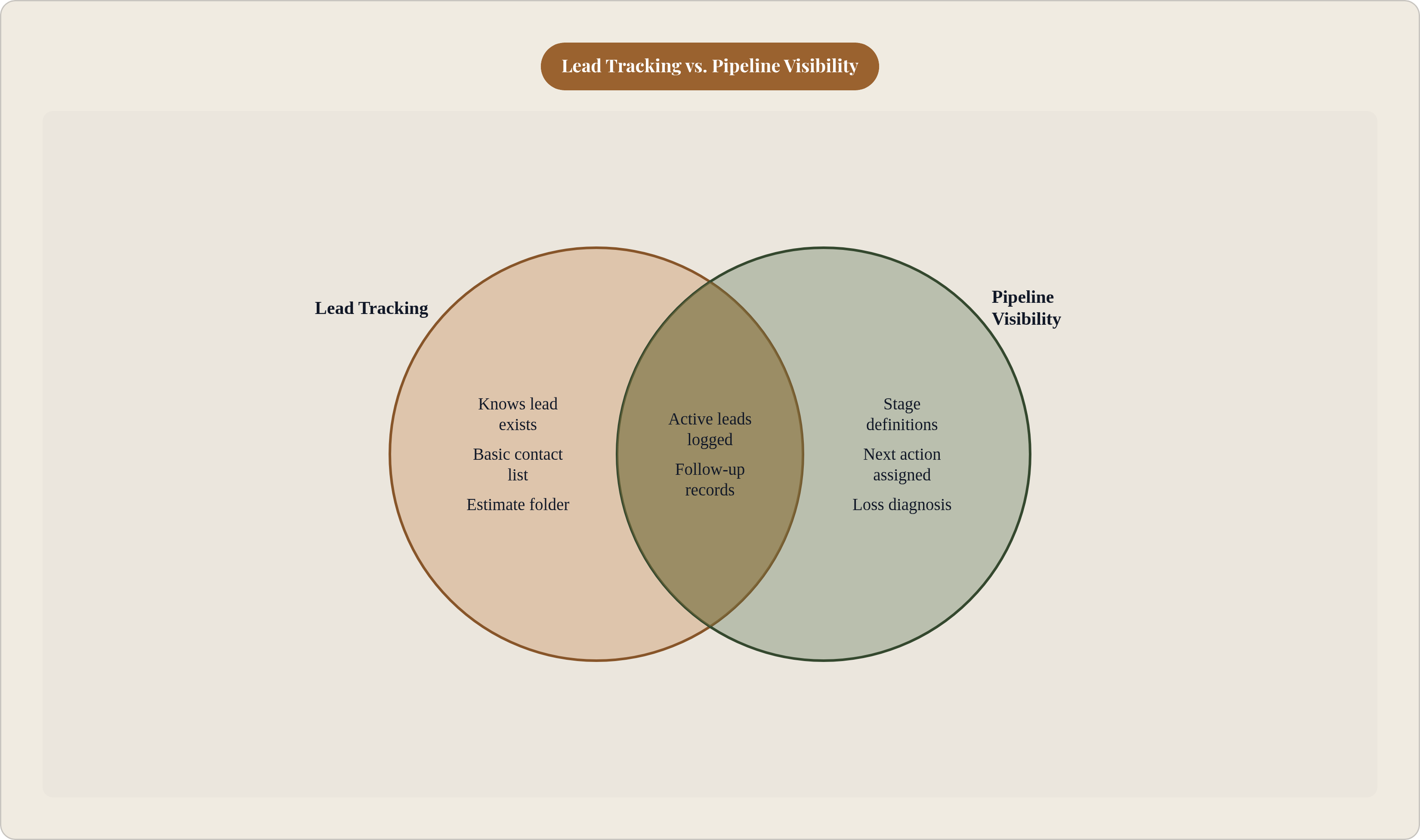
A lot of owners believe they're doing pipeline management when they're really just tracking leads, and those are not the same thing.
Tracking leads means you know a lead exists. Pipeline visibility means you know what stage it's in, how long it's been sitting there, what the next action is, who owns that action, and when it's due. One is a list. The other is a system with motion built into it.
The difference is negligible at low volume. When you have five leads, a list holds up. When demand picks up, when a campaign runs, when referrals start clustering, a list becomes a liability. The homeowners most likely to sign are often the quietest ones: people who submitted a form and are genuinely waiting to see if you take them seriously. A list doesn't surface those people at the right moment. A pipeline does.
What Full Visibility Actually Requires
You don't need enterprise software or a dedicated sales coordinator. You need three things.
One place where every lead lives. Not a folder of texts, not a shared Google Sheet with seventeen tabs, not sticky notes in the estimate binder. One place, updated consistently. A purpose-built CRM, a well-structured field-service platform, a project management tool with a sales module: the specific technology is secondary to the discipline of using one thing and only one thing.
Defined stage criteria. Each stage needs a clear threshold for what makes a lead eligible to enter it. "Site visit completed" doesn't mean the visit is scheduled. It means the visit happened and notes were logged. When those definitions are fuzzy, the pipeline data is fuzzy, and the visibility you think you have is essentially illusory.
A daily review habit. Ten minutes in the morning: what moved yesterday, what's stalled, what needs action today. Owners who build this habit consistently describe a shift that sounds almost qualitative, moving from feeling like they're chasing their business to feeling like they're actually running it. It's less mystical than it sounds. Clarity produces decisiveness.
Converting the Demand You Already Have
The demand is usually not the problem. In a healthy market, qualified homeowners are submitting estimates and calling offices. The constraint is conversion, and conversion is a pipeline problem.
A lead that gets followed up within hours converts at a substantially higher rate than the same lead that waits two days. Not marginally. A proposal that gets a personal follow-up call closes more reliably than one that goes out with an implicit "let me know." These aren't marginal tweaks; they're the difference between converting a third of your leads and converting half, off the same volume of inbound interest.
Owners who've built visible pipelines will tell you the shift isn't about working harder. When you can see which leads are stalled, which proposals are aging, and which follow-ups are overdue, the next action is obvious. You do it. There's no ambiguity to procrastinate against.
What Day One Actually Looks Like
The goal on day one is not optimization. It's replacement: trading the mental pipeline for a visible one. Pick a system, enter every active lead currently living in your head or sitting on your desk, assign each one a stage, and identify the single next action required to move it forward.
That exercise alone will surface deals that were quietly dying without anyone noticing. Some will already be too far gone. But some won't be, and the ones you recover from that first audit will justify the hour it takes to build the foundation.
Revenue decisions made from actual data behave differently than decisions made from recollection. They catch more. They miss less. Over time, as patterns become visible and the process sharpens, they compound. That's the whole point.