Separating a Real Project from a Fishing Inquiry
How to identify serious buyers before wasting time on site visits.

Most of the diagnostic work in hardscape sales happens before you ever set foot on a property. Miss it, and you spend your afternoons driving to projects that were never going to close.
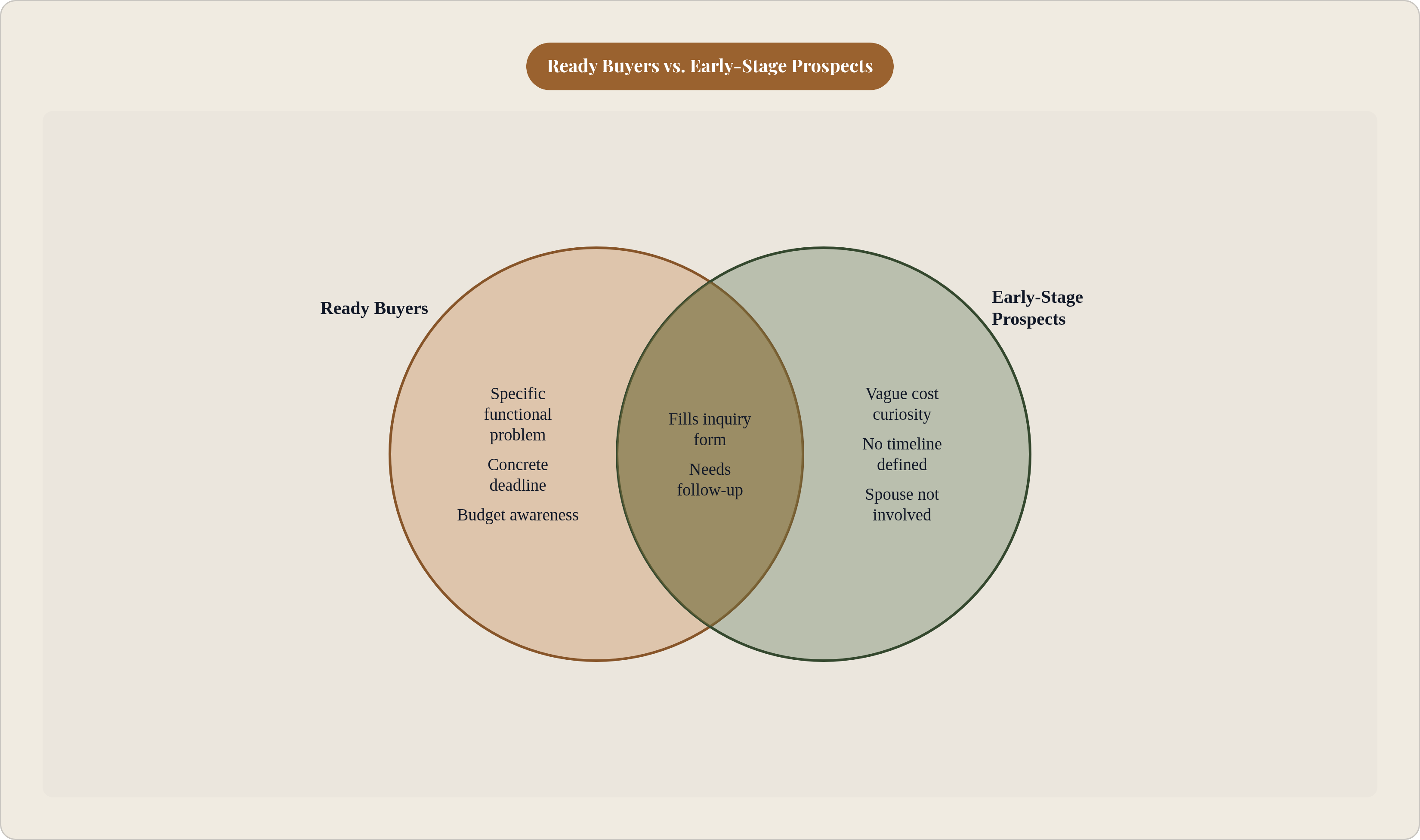
The homeowner who's actually ready has already committed mentally before they reach out. They have a specific, functional problem: an embarrassing driveway, a slope that's been sitting unusable for two seasons, a backyard that still looks like a construction site four months after move-in. They're not testing an idea. They're selecting a contractor.
Contrast that with the retired couple who've been staring at a magazine clipping for six months. They know what they want and they've thought about what it should cost. They come in with references, opinions on material, and a genuine willingness to do it right. That's a buyer. It just sometimes takes a second question to confirm it.
Then there's the homeowner with a deadline attached to something real: the family is coming for the holidays, the kids just left and now the yard is finally getting the attention it deserves, or the neighbor's project just wrapped and it finally motivated action. A concrete deadline tied to a life event is one of the most reliable near-term purchase signals in this business.
What all three share is that their questions stop being vague somewhere in the inquiry. "I was curious what something like this would cost" is fundamentally different from "I want to understand what we'd need to decide upfront and what the process looks like." The second version belongs to someone who has already crossed the threshold from dreaming into planning, and it should be treated accordingly.
The homeowner who hasn't crossed that threshold yet is gathering numbers to satisfy a spouse or benchmarking a project they'll think seriously about next spring. There's nothing wrong with that. But it shouldn't eat Thursday afternoon.
The Behavioral Signals That Appear Before a Single Conversation Starts
A lot of contractors don't realize how much qualification data arrives before anyone has spoken a word. The inquiry itself is telling you something, and it's worth reading carefully.
Channel of origin matters more than most businesses account for. A homeowner who typed "flagstone patio installer" plus a city name into a search engine has already decided they want the thing and is now selecting who does it. A homeowner who clicked a broad awareness ad while scrolling has not made that decision yet. Same inquiry form, completely different purchase intent.
Form completeness is simple but reliable. An inquiry that includes a project description, a rough timeline, and a specific address means the homeowner put effort in. A one-line "how much does a patio cost?" has not. That doesn't make it dead, but it's a different starting point.
Specificity inside the message is worth noticing. Someone who mentions they liked the bluestone they saw at a neighbor's place, attaches a photo, and asks whether you work in their neighborhood has been actively thinking about this. Duration of internal consideration before first contact correlates with seriousness, consistently, across project types.
After-hours submissions are something I've always paid attention to. When someone reaches out at 10 p.m., they weren't doing obligatory research. The impulse was live and they acted on it. That's qualitatively different from a Tuesday morning form submission fired off between errands.
Repeat website engagement before contact is one of the cleaner signals available. A homeowner who visited three times, spent time in the project gallery, and then submitted a form has been vetting you. That's buyer behavior.
Referrals are in their own category entirely. A homeowner sent by a past customer already trusts your work before the first word is exchanged. The qualification work is half done before you pick up the phone.
What the First Conversation Reveals About Whether a Project Is Real
The first call is a diagnostic, not a pitch. Four things need to be answered before anyone's calendar gets touched, and a good conversation surfaces all of them without making the homeowner feel like they're getting processed.
Does the homeowner have a defined scope, or are they asking you to invent one for free? There's a legitimate version of this, where someone knows the problem they need solved but genuinely wants guidance on solutions. And then there's the version that is, functionally, a free design consultation going nowhere. The difference shows up almost immediately if you ask what actually prompted the call.
Is there a real timeline? A family gathering in June, a permit they've already started pulling, a contractor next door finishing up who finally nudged them off the fence: those are real timelines. "Sometime this year, maybe" is almost indistinguishable from "I won't do this." Flexibility in timeline often signals indifference to whether the project happens at all.
Has the homeowner thought about budget, even loosely? I'm not trying to extract a number. I'm trying to find out if they've considered what this kind of work actually costs. "I've looked at some ranges and I understand it's not cheap" puts them in an entirely different position than someone who answers every money question with a version of "that's why I'm calling you." The latter isn't necessarily a dead lead, but it tells you where the conversation has to go next.
Who else is making the decision? In hardscaping, the person who calls is often only one half of the answer. A spouse, a partner, sometimes an HOA committee. Find this out early. The number of strong site visits that end in enthusiastic verbal commitment followed by three weeks of silence, because a partner wasn't in the room, is genuinely frustrating once you've experienced it a few times.
Two questions that consistently surface real intent: "What's prompting this right now?" and "Have you had anyone else out to look at it yet?" The first tells you whether there's urgency or just a vague impulse. The second tells you exactly how far along the process is.
If timeline and budget both come back vague after a follow-up probe, that homeowner is in early research mode. That's a future lead. The response should be a nurture touchpoint, not an estimator's afternoon.
The homeowner collecting three quotes isn't a red flag. That's standard in hardscaping and it just means you're in a competitive process. The actual red flag is someone who deflects every question about where they are in the process and pivots immediately back to rough numbers. That's a fishing pattern, not a buying one.
How a Short Qualification Framework Keeps the Read Consistent Across Every Inquiry
The goal is not a formal scoring rubric with weighted criteria and a threshold score. That adds friction and, in a busy intake process, gets abandoned after two weeks. The goal is two or three consistent questions that every inquiry receives before anyone's calendar is touched.
Can the homeowner describe the project in a sentence or two? If the answer is no, that's a discovery gap, not a disqualifier, but it means more conversation is needed before the estimator gets involved.
Is there a target date, even a rough one? The answer places this homeowner somewhere on a continuum from "let's move" to "thinking about it eventually," and the contractor's response time and resource allocation should reflect where they land.
Who else needs to be part of the final decision, and are they in the conversation yet? This single question prevents a meaningful percentage of proposals from dying silently. It's the one most intake processes skip entirely, and it costs real revenue.
These questions can live in a form, get asked by whoever answers the phone, or run through an early text exchange. For businesses fielding significant inquiry volume, AI-assisted intake tools, including Jobber's, can ask these qualifying questions immediately on form submission or after hours, which prevents a high-intent evening inquiry from sitting cold until morning.
The output is clean: leads either get a site visit scheduled promptly, get a nurture touchpoint and a follow-up date, or get noted as not a fit for the current pipeline. The framework also functions protectively: site visits should be earned by clearing an intake screen, not distributed as a free consultation service to every homeowner who fills out a form.
Where Skilled Time Actually Belongs Once Leads Are Sorted
The actual constraint in a hardscape business is not inquiry volume. It's the owner's hours, or the estimator's hours, available to run site visits, build accurate proposals, and close work worth closing. Qualification is a sequencing decision, not a gatekeeping one.
The homeowner who's ready to move gets fast, attentive follow-up, because speed is a conversion factor in its own right. A detailed, specific inquiry that receives a prompt, relevant response has already had a meaningfully better experience than the one called back three days later with a generic "thanks for reaching out." That gap in responsiveness, before price or process has even come up, can be the difference in who gets the job.
The early-stage homeowner gets a nurture touchpoint: something useful, non-pressuring, and relevant that keeps the contractor credible and top of mind until the project matures. A project photo that's relevant to what they described, a note about seasonal timing, a direct follow-up at 30 days. They don't get forgotten. They also don't get Thursday afternoon.
Contractors who build consistent qualification into intake stop writing proposals for homeowners who were never going to buy. The hours recovered from unqualified site visits go back into the leads most likely to close. The ones who respond faster and arrive better prepared win the same project types repeatedly, not because they're undercutting, but because they're in front of the right person at the right moment with the right information. That's a sequencing discipline, and it starts well before anyone drives to the property.