Concrete Patio Installation Cost, Broken Down by Line Item
How site conditions and hidden costs transform concrete patio pricing.
Per-square-foot pricing is the industry's shorthand, and it holds up well enough when site conditions cooperate. When they fail, that shorthand will mislead everyone in the room.
Plain concrete runs $4 to $20 per square foot across most markets. Decorative work on challenging sites can reach $30. That spread is not imprecision; it is the compounding effect of size and site difficulty on every input downstream.
Size drives volume in a way that is straightforward to calculate. More square footage means more concrete, more gravel, more steel, more hours. Site conditions are where the multipliers actually live. A flat, clear lot and a sloped, obstructed site with drainage problems are functionally different projects at identical square footage. The material quantities look similar on paper. The difficulty of executing every single step does not.
Geography layers on top of that. The 2026 cost index published by TheFatBook puts the low end of comparable scope at roughly $3,304 in San Antonio and the high end at $5,116 in New York. Same project, same line items, genuinely different totals because local labor markets and delivery costs are indifferent to your budget.
A site walk is not a courtesy call. It is how every difficulty multiplier in this piece gets calibrated before a number goes on paper. Quoting without one is guessing, and the homeowner pays for that guess either way.
Site Preparation: The Line Item Most Low Bids Cut First
Here is what I've seen more times than I care to count: a contractor wins the job on a number that looks good at the kitchen table, and two years later the homeowner is calling someone else to explain why their patio has developed a crack you could lose a quarter in. Nine times out of ten, the conversation eventually lands on what the original crew did, or didn't do, before the first yard of concrete arrived.
Site prep is not glamorous work. It is vegetation removal, excavation to depth, grading to establish positive drainage away from structures, and compaction of the native subgrade. None of it is visible in the finished product, which makes it the easiest line to quietly reduce when someone needs to sharpen their pencil.
Every one of those steps has a direct downstream consequence. Drainage slope established during prep cannot be retrofitted after the pour. Inadequate subgrade compaction is the primary cause of differential settlement, which is the mechanism by which concrete slabs crack from below. You see the crack one morning and start doing math on what it's going to cost to fix.
The cost range is wide because terrain varies so dramatically. A flat, accessible site runs roughly $1 to $3 per square foot for standard prep work. Uneven terrain requiring grading can push that to $6 per square foot. Sites with meaningful excavation or drainage infrastructure can reach $5 to $15 per square foot. In total project terms, leveling and grading can add $1,000 to $3,200 on top of the base estimate, per Angi's 2026 data.
Accessibility matters here in a way that often gets buried in the bid. If a ready-mix truck cannot reach the pour site, the labor cost for pour day roughly doubles. That is a site prep conversation, not a concrete conversation, and it needs to happen before anyone starts writing numbers down.
The Compacted Gravel Base and What It Costs to Do It Correctly
After excavation, a compacted aggregate base goes in before any concrete is placed. The American Concrete Institute specifies a minimum four-inch compacted gravel base under a four-inch slab for exterior residential flatwork. That specification exists for three reasons: load distribution, moisture management, and prevention of the differential movement that cracks slabs.
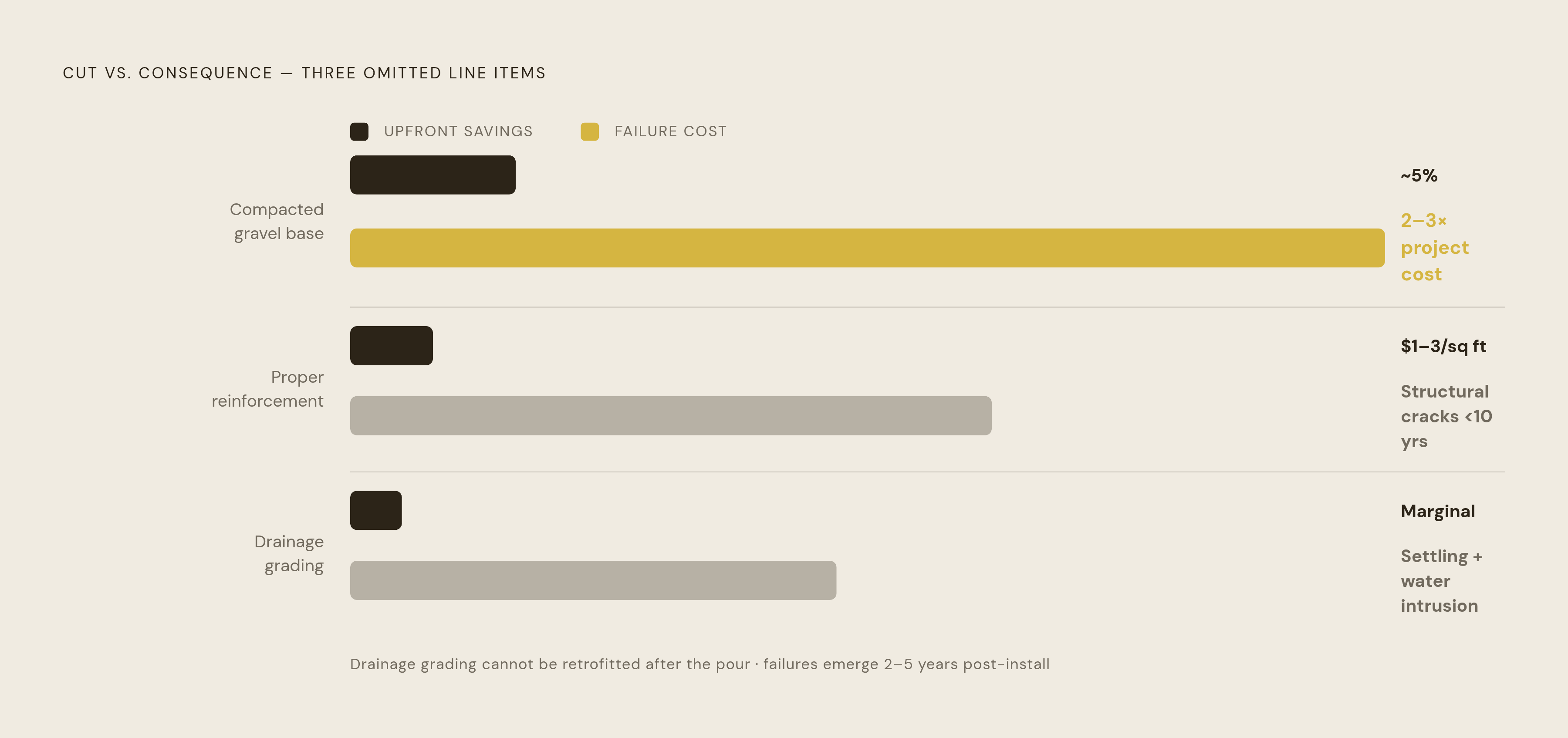
The material cost is modest, roughly $1 per square foot at the low end. And yet this is where the difference between a slab that earns its twenty-fifth birthday and one that gets jackhammered out in year six is largely determined.
Skipping the base saves a small upfront amount and creates conditions for early settlement and cracking that eventually require full slab replacement at two to three times the original project cost.
On sites with poor drainage or expansive clay soils, a geotextile fabric layer beneath the aggregate base is worth considering. It adds modest material cost and prevents fine soil particles from migrating upward into the gravel layer over time, which is one of the quieter ways a base loses its effectiveness after a few seasons of wet and dry cycling.
The gravel base is the least exciting line item in the bid. It is also among the most consequential.
Concrete Material: How Mix Design, Volume, and Delivery All Move the Number
Ready-mix concrete is priced per cubic yard delivered. The average delivered price was roughly $180 per cubic yard in 2025, with standard mixes sitting at the lower end of the range.
Mix design is the first variable worth understanding. Standard-strength concrete is the baseline for residential flatwork; it works fine for most patios in most climates. Higher-strength mixes cost more per yard and are genuinely appropriate for heavy-use applications or climates with aggressive freeze-thaw cycling. Fiber-reinforced specialty mixes run higher still. The strength upgrade is not expensive relative to the total project. It belongs in the specification conversation before the truck is ordered, not as an afterthought when someone's reading the fine print.
Slab thickness drives volume more than homeowners typically expect. A four-inch slab uses roughly 1.23 cubic yards per 100 square feet. A six-inch slab uses roughly 1.85 cubic yards for the same footprint. That is a 50 percent increase in concrete volume for an identical surface area. On a 400 square foot patio, that difference adds up to several yards and real money on the material line.
Volume estimation should always include a waste factor. Running short mid-pour is not an inconvenience; it is a structural quality problem. A cold joint between successive pours in a residential slab is a permanent weakness, full stop.
The short-load penalty catches homeowners off guard on smaller projects. Ready-mix trucks are sized for larger commercial and residential pours. When a residential patio falls below the minimum load threshold, the plant charges a per-yard surcharge that can sharply raise the effective cost of every yard delivered. A 20 by 20 patio at four inches thick requires roughly five to six cubic yards once waste is factored in. That is a small pour by the ready-mix industry's standards, and the pricing reflects it without apology.
Cement prices have been rising approximately 5 to 6 percent annually over the 2021 to 2026 period, per IBISWorld data. A quote from even twelve months prior will meaningfully understate today's material line.
Formwork and Reinforcement: The Hidden Steel and Lumber in the Bid
These are the two line items most invisible in the finished product. Which is precisely why they are the easiest to cut without the homeowner noticing until it's too late.
Formwork is the dimensional lumber framed around the pour area to contain wet concrete and establish finished edges and elevation. A rectangular patio is a straightforward forming job. Curved or irregular shapes require additional time, more material, and a crew comfortable working around complex geometry in a compressed window. A reasonable estimate of project overhead places standard forming at roughly $300 for a typical install.
Reinforcement is where the structural argument lives, and it is worth being specific about what you're getting. Wire mesh controls surface shrinkage cracking and is appropriate for standard residential slabs on stable, well-prepared subgrade. It is inexpensive per square foot. Rebar does something different: it adds tensile strength across the full slab depth and resists crack propagation under load. Rebar is appropriate for thicker slabs, high-traffic applications, and any site where subgrade stability is uncertain. The installed cost adds roughly $1 to $3 per square foot to the base, per HomeGuide's 2026 data. On a 400 square foot patio, that is $400 to $1,200 in additional cost, and it is the cost of a slab that doesn't develop structural cracks within its first decade.
Neither forming lumber nor reinforcement steel is visible once the slab cures. A contractor who specifies reinforcement type in the written scope is telling you something about how they operate. One who leaves it vague is also telling you something.
Labor: Why It Accounts for Roughly Half the Total Cost
Labor on a concrete patio is not a single task. It is a sequence: site prep crew, form-setters, pour crew, finishers, cleanup, often overlapping, sometimes the same people playing multiple roles, always time-pressured once the truck backs in. Per HomeGuide's 2026 data, labor accounts for half to more than half of total project cost. The material line is, counterintuitively, the smaller half. Most homeowners fixate on concrete price per yard as the primary cost driver. They're focusing on the wrong number.
For plain flatwork, labor runs $5 to $8 per square foot in most markets. Stamped or decorative work pushes that to $12 to $18 per square foot because of additional finishing time and the specialized tooling required to execute patterns in fresh concrete before it sets. A three-person flatwork crew typically runs six to ten hours for a standard 400 to 600 square foot residential pour, including setup, placement, finishing, and cleanup.
Concrete has a working window that most other construction materials simply don't impose. Placement and finishing must happen within a fixed period after the truck arrives. Temperature, humidity, and direct sun all compress or expand that window unpredictably. An undersized or slow crew risks finishing out of sequence, which produces surface inconsistencies and potentially compromised structure at the cold areas. There is no version of this where you pause and come back after lunch.
Site access affects the pour day in a way that often goes unpriced. If the truck can't reach the pour area, concrete moves by pump or by hand. Either method roughly doubles the labor cost for that phase and eats into the working window simultaneously.
Geographic wage variation is real and measurable. Bureau of Labor Statistics 2025 mean wages for cement masons vary significantly by metro area, and contractor billing rates layer local burden, overhead, and market conditions on top of those base wages.
Finishing Options and What Each One Actually Adds to the Cost
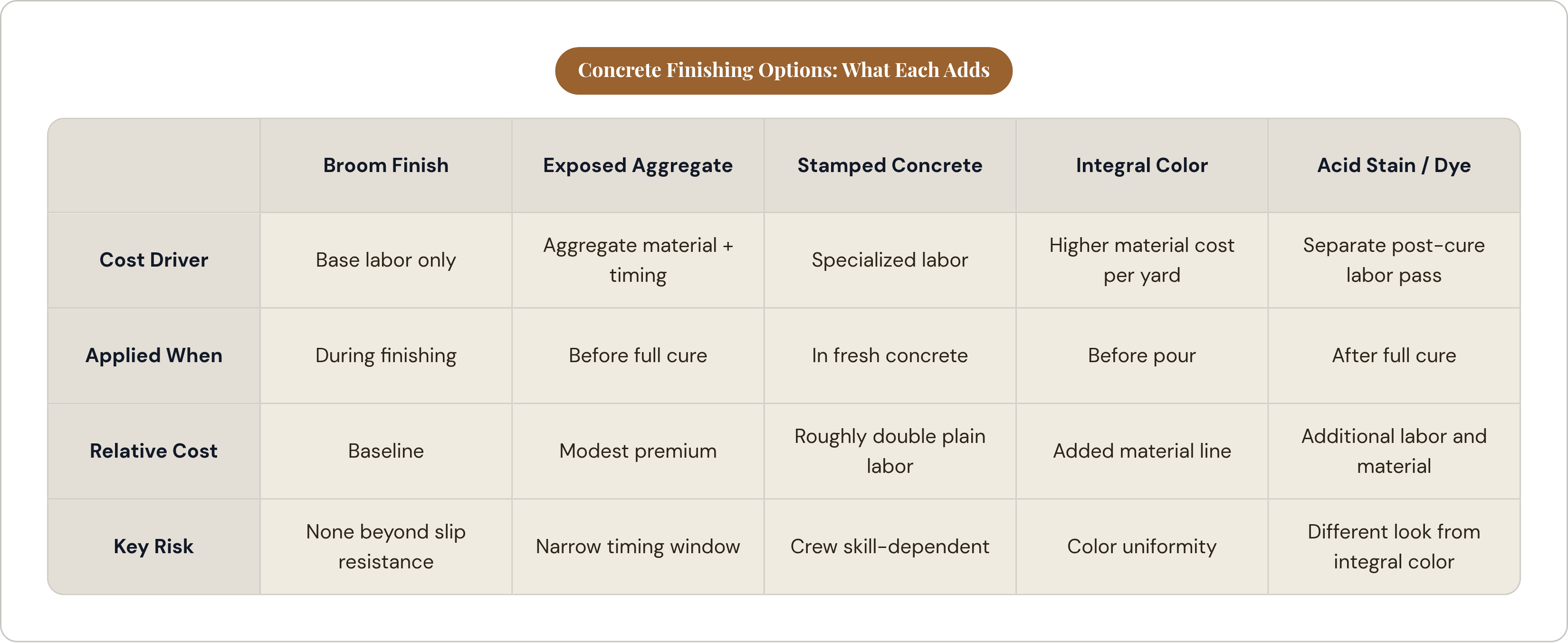
The baseline is a plain broom finish: concrete placed, screeded, floated, and broomed for slip resistance. That is included in the standard labor rate. Everything else is an additive cost in materials, labor time, or both.
Exposed aggregate involves seeding decorative stone into the surface and washing the cement paste back before full cure. The timing is less forgiving than it looks, and the material cost of the aggregate itself is a separate line item that doesn't always appear in base quotes.
Stamped concrete presses patterns into the fresh surface to simulate stone, brick, or tile. The per-square-foot labor cost roughly doubles compared to plain flatwork. The finishing sequence is more involved, the window for placing stamps is compressed, and crews who do this work well have developed specific pattern-reading instincts that take time to build. Decorative concrete reaches $30 per square foot at the high end of the market, and that number is primarily a labor story, not a material story.
Integral color is added to the mix itself, which means it costs more per yard on the material line before a single worker sets foot on the site. Acid stain or concrete dye is applied after cure, which adds a separate labor and material pass. Both approaches produce different visual results and carry different maintenance requirements; they are not interchangeable choices.
Sealing is omitted from base quotes with some regularity and regretted with similar frequency. A penetrating or film-forming sealer applied after cure protects against moisture intrusion, staining, and freeze-thaw damage. The cost is modest relative to the total project. Omitting it shortens the service life of decorative finishes specifically, sometimes by years.
A homeowner comparing a plain concrete quote to a stamped concrete quote is comparing different products. The per-square-foot gap between them lives almost entirely in labor and finishing time.
Permits, Inspections, and the Cost of Skipping Them
Most jurisdictions require a permit for permanent concrete flatwork above a minimum size threshold, typically tied to setback requirements and impervious surface limits. Permit fees are a relatively modest fixed cost in the context of the overall project, a modest sum for a standard install by one estimate.
The inspection attached to that permit is what actually matters structurally. Inspections typically verify subgrade prep and reinforcement placement before the pour happens. That means the permit process functions as an independent quality checkpoint on the two line items most likely to be cut from low bids.
The consequences of skipping permits are not hypothetical. Jurisdictions that discover unpermitted flatwork can require demolition and re-pour at full cost. Unpermitted work must be disclosed at resale and can complicate or block a transaction. Homeowner's insurance claims involving a slab can be denied if the work was completed without required permits.
For contractors, pulling permits communicates something concrete to quality-minded homeowners: the project will be built to code, documented, and inspected. That record matters in warranty conversations and in any dispute resolution that follows.
How the Line Items Add Up Across Project Scenarios
The national average sits around $3,553 to $3,722 for a mid-sized plain concrete patio, per Angi and TheFatBook's 2026 data. The realistic range for most homeowners is $1,580 to $4,465 for plain concrete on standard sites without significant decorative work, per LawnLove's 2026 data.
At the low end of the total range, $700 to $800, you are looking at a very small slab, a plain finish, a flat and accessible site, and probably some homeowner-managed labor in the mix. At the high end, $8,645 to $10,000, you have a large footprint, stamped or colored finishing, challenging site conditions, and a high-cost metropolitan market. Both numbers make sense when you trace them back through the line items.
The inputs that most reliably push a project from mid-range toward the top are stamped or decorative finishing labor, difficult site prep, and short-load penalties on small pours. Those three alone can add several thousand dollars to a project that looked average on paper.
The inputs most often cut from low bids, and most consistently responsible for callbacks and re-pours, are the gravel base, proper reinforcement, and drainage grading. Those omissions don't announce themselves at completion. They surface two to five years later as settling, cracking, and water intrusion problems that cost significantly more to correct than the original savings ever represented.
For contractors quoting competitively, the difference between a winning bid and a low bid often traces back to one of those omitted items. An itemized quote that specifies each line is simultaneously a pricing tool and a direct argument for the quality of the work. A homeowner who understands what they're looking at will see, without prompting, what's missing from the cheaper number.