Setting Project Minimums That Protect Crew Utilization
Setting minimum job prices below crew costs and overhead guarantees profit evaporates.

Utilization is the share of paid crew hours that generate billable revenue on a job site. That single number determines whether every other financial target is achievable or a fantasy. For a hardscape crew, 80 percent is the target, and it is not arbitrary. On an eight-hour day, 80 percent means roughly 6.4 hours of productive, revenue-generating site time. The rest belongs to travel, material pickup, equipment checks, and transitions between jobs. You are not going to eliminate that 20 percent. Anyone who models 90 percent utilization into their projections has never had a delivery run two hours late or lost a morning to a forecast that was wrong by exactly enough to strand a crew.
Here is where most contractors quietly go sideways: they build the schedule assuming best-case utilization, then fill gaps with small jobs when the week looks thin. That looks like resourcefulness. It is actually the mechanism that keeps a well-run business from getting ahead, and it operates below the threshold of visibility until it is well past the point of easy correction.
A two-person crew running roughly 20 field days a month has a fixed capacity. A realistic model targets something closer to 72 to 75 percent utilization, because the schedule is never perfect. The practical ceiling that actually produces 20 percent net margin, when hit consistently, sits around 80 percent. Overhead creeping toward 40 percent of revenue wipes profit even when the crew is executing cleanly and the customers are happy.
Small jobs are the primary drag on this metric, and the damage does not announce itself on any single invoice. It compounds quietly across the schedule — like a slow leak in a tire you keep meaning to fix — until the monthly numbers reveal a business that has been perpetually busy without ever catching up to itself.
How Mobilization Cost Makes Small Jobs Structurally Unprofitable
Mobilization covers everything that happens before a single paver is placed: drive time, trailer loading, site setup, teardown, return haul. These costs are fixed per job, not per hour of productive work. A one-hour install and a four-hour install carry nearly identical mobilization overhead. That is not a process problem waiting to be optimized. It is a structural feature of the trade, and hardscape mobilization is heavier than most trades precisely because of equipment weight, material staging, and site access constraints that simply cannot be compressed below a certain floor.
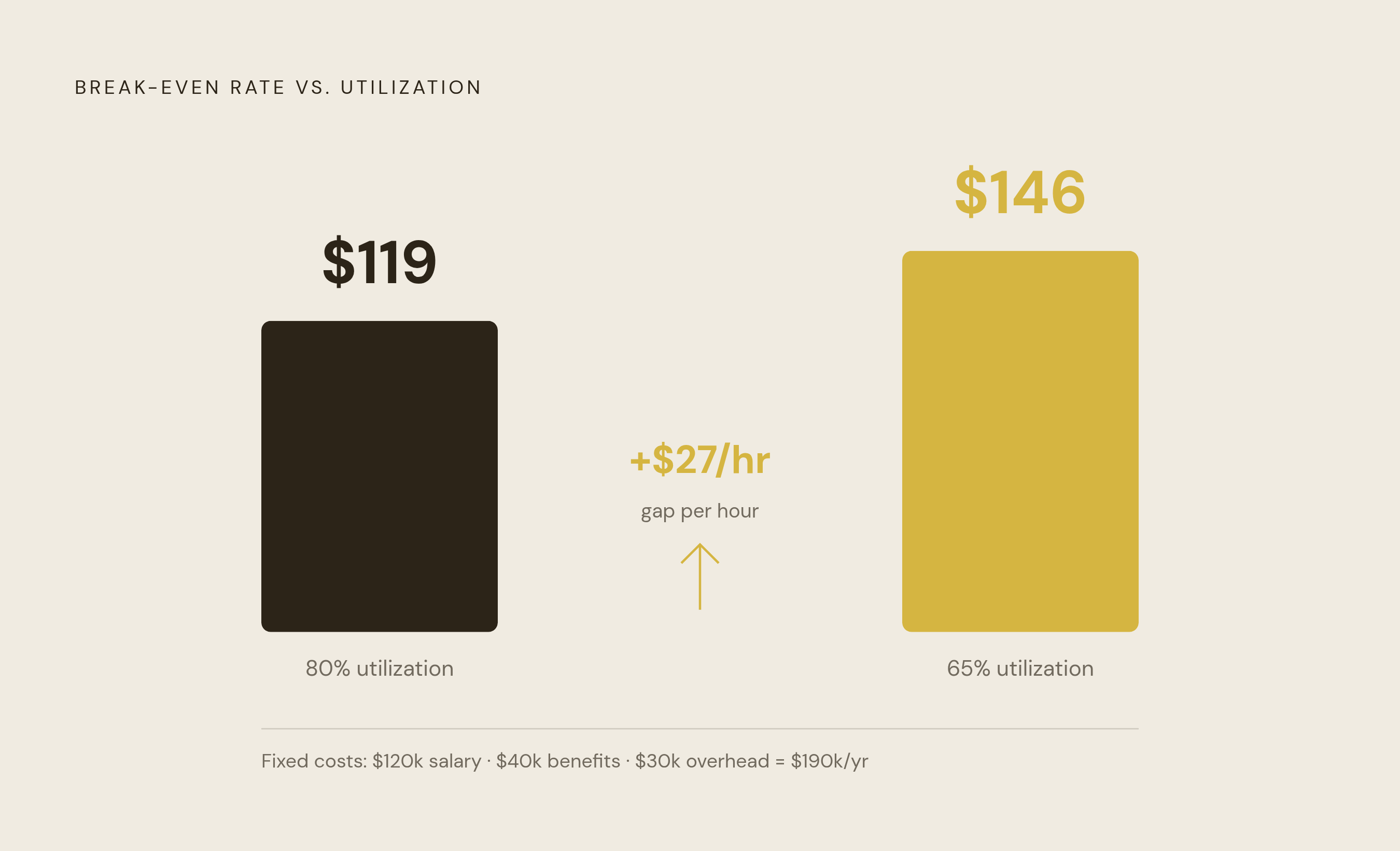
The math is unforgiving. Take a reasonable break-even calculation: total annual salary plus benefits plus overhead, divided by available hours multiplied by utilization rate. At $120,000 in salary, $40,000 in benefits, and $30,000 in overhead, a drop from 80 percent to 65 percent utilization pushes break-even from roughly $119 per hour to $146 per hour. That gap has to come from somewhere. It comes from every other job on the calendar working harder just to cover the same fixed costs that were already accounted for before the week started.
Overhead does not shrink when the job is small. It stays fixed, so small jobs carry a disproportionate share of the cost structure. That is the mathematical argument for a project minimum, and it does not require any further philosophical justification.
The Overhead Reality That a Project Minimum Has to Cover Before Profit Begins
Overhead in a hardscape business is not just fuel and hourly wages. It is insurance, equipment amortization, vehicle costs, administrative time, estimating time, and unbillable callbacks. When that aggregate reaches 40 percent of revenue, net profit evaporates even when the field work is clean. This is the margin compression that contractors typically encounter without recognizing it, because the individual line items seem defensible in isolation and the aggregate only becomes visible when the year-end numbers arrive and the math refuses to cooperate.
There is also a back-office cost that rarely gets accounted for explicitly. Manual scheduling, paper invoices, informal dispatch: each of these carries a real cost in unrealized margin and owner hours. If you are still running the operation that way, build it into your overhead burden before you calculate the minimum, because it is already in there whether you account for it or not.
A project minimum must clear the full overhead burden before it touches profit. It is not "what feels fair for the scope." It is "what covers the fixed cost structure and leaves room for margin." Anything below that number is a subsidy paid out of the owner's equity.
The second-crew dynamic makes this more acute. Adding a crew adds supervision costs, a vehicle, payroll load, and equipment before that crew reaches anything close to full utilization. Revenue rises while cash falls, and any below-minimum job accepted during that ramp period compounds the problem, because fixed costs are at their peak precisely when the new crew is least productive. Scaling to two crews without a firmly enforced minimum is not growth. It is financing growth with margin you have not yet earned.
Building the Actual Minimum: What Inputs Go Into the Number
Three inputs are non-negotiable.
First, crew cost per day: the total loaded labor figure for every crew member on the job. Wages, benefits, payroll taxes. Not the hourly rate you write on the whiteboard, which is almost always missing something.
Second, mobilization overhead: a fixed per-job charge covering travel, loading, setup, and teardown, regardless of how long the productive work actually takes. This number is constant whether the job runs two hours or eight.
Third, minimum job duration: the shortest project that lets overhead amortize across enough productive hours to leave a margin after covering the first two inputs.
Duration matters as much as ticket size, and this is where a lot of otherwise careful estimators go wrong. A fixed-price job that takes three days is structurally different from the same-price job that takes one day. The three-day version spreads mobilization cost across more productive hours and the economics look completely different even though the invoice total is identical. Ticket size alone does not tell you whether a job clears the minimum.
Geography and season move the number too. Longer drives in rural service areas inflate the mobilization component in ways that can genuinely surprise you if you have never mapped it out explicitly. A weather-compressed season reduces the denominator of available billable days, which raises what each remaining day must generate to hit the annual targets. These are not edge cases. They belong in the calculation.
Recalculate the minimum when labor rates shift materially, when you add a crew, when the service area expands, and at minimum once a year. Skilled trade wages rose more than 20 percent between early 2020 and early 2024, according to Bureau of Labor Statistics data. Any minimum built before that wage reset is operating on a cost structure that no longer exists.
What Happens to the Schedule When Minimums Are Treated as Negotiable
The most common failure mode is completely predictable: the minimum exists on paper and gets waived for slow weeks, longtime customers, or jobs that "fill a gap." Each individual waiver is defensible in the moment. Collectively, they hollow out the schedule in a way that takes months to fully register.
The slow-week justification deserves particular scrutiny because it is the most seductive one. Accepting below-minimum work to avoid a thin week locks in a bad utilization number and, critically, crowds out better work if it surfaces later in that same week. A slow week with no below-minimum jobs is a recoverable situation. A week already filled with marginal work that displaces a substantial project that called on Wednesday is an unrecoverable loss, and you will never quite know what you gave up.
The signal shows up on the calendar before it shows up in the books. A schedule packed with small, scattered jobs is not a pipeline problem. It is a symptom of a minimum that has stopped holding. Crews hopping between small jobs never build momentum on a site, and that inefficiency surfaces in output quality and, eventually, in retention. Someone quits. That cost never appears cleanly on a line item until it does, and by then it is essentially impossible to trace back to the scheduling pattern that caused it.
Contractors who hold the minimum consistently narrow their job mix toward work that funds growth. Those who negotiate it case by case stay perpetually busy without getting ahead — which is a specific kind of exhausting that is hard to explain to someone who has not lived it.
How to Hold the Minimum in the Sales Conversation Without Losing the Job
The minimum is a cost reality, not a negotiating position, and the way you communicate it in the field reflects which one you actually believe it to be. When a salesperson understands the minimum as a physical and financial constraint rather than a starting anchor, the conversation sounds different. Customers are perceptive; they can tell the difference between someone explaining a constraint and someone running a script.
Concrete language beats vague policy. Something direct: "Our minimum reflects what it actually costs to mobilize a crew, stage materials, and complete the work correctly. Below that threshold, we cannot do the job well." Most people receive that as a reasonable explanation of a trade reality, not a sales tactic, because it is.
The more productive path than outright refusal is scope expansion. If an inquiry comes in below minimum, the right question is what adjacent work would bring the project to or above the threshold. A small patio repair becomes a repair plus edge reset plus joint resanding. The scope is more defensible, the homeowner gets a more complete result, and the job now justifies the crew-day. Most homeowners considering any hardscape investment share one underlying concern: will this actually make a meaningful difference to the property? A bundled scope often answers that question more convincingly than a stripped-down job that leaves obvious adjacent problems unresolved.
Some inquiries should be referred or gracefully declined rather than converted. That is a healthy business decision. The contractor who holds the minimum consistently builds a market reputation for substantial projects, which filters the inquiry pool toward higher-value leads over time without any additional marketing expenditure.
One operational note: speed of response to inbound leads still matters regardless of minimum. The minimum does not mean slower quoting. It means faster quoting on the jobs worth quoting.
Using Scheduling and Quoting Systems to Enforce the Minimum Automatically
A minimum that lives only in the owner's head gets waived under pressure, and the pressure is highest precisely when a proposal is being built: a slow week, a returning customer, a job that almost hits the number. Relying on discipline at the moment of highest situational anxiety is a losing strategy. The discipline has to be structural, not personal.
Quoting tools that flag or block below-minimum proposals before they go out remove the decision from the sales moment entirely. The minimum should not be a conscious choice made under short-term scheduling anxiety. It should be a default that requires deliberate override, because that friction makes every waiver visible and intentional rather than reflexive. When you have to actively choose to waive the minimum, you waive it less often.
Scheduling tools that optimize for crew utilization, routing, job sequencing, and gap management make the utilization picture legible in a way that a whiteboard calendar simply cannot. When an owner or operations lead can see utilization per crew per week, below-minimum jobs show up as visible drag rather than invisible filler. Estimating tools reduce the time cost of quoting, and that matters because estimating time is overhead that only pays off on jobs won above the minimum.
Some all-in-one platforms for remodeling and hardscaping contractors are built around exactly this operational problem, with quoting, scheduling, and lead handling in a unified system, designed so that the minimum becomes a configurable standing input rather than a judgment call made fresh each time a new inquiry lands. Running separate tools for quoting, dispatch, and CRM creates the gaps where the minimum slips through undetected. When the minimum is a parameter embedded in a system that touches every job from inquiry to invoice, it stops depending on anyone remembering to enforce it.
A crew running at 80 percent utilization on jobs that all clear the minimum generates fundamentally different economics than a crew running at 90 percent on a mixed book with below-minimum filler scattered throughout. The percentage looks better in the second scenario. The bank account tells a different story.
Revisiting the Minimum as the Business Grows Past a Single Crew
The minimum that works for one crew is not the minimum that works for two. A second crew adds supervision requirements, vehicles, payroll load, and administrative complexity before it reaches anything resembling full utilization. The cost structure changes materially, and the minimum has to change with it, or the second crew operates at a loss that gets masked by the first crew's performance until the combined numbers become impossible to ignore.
Scaling revenue without scaling profit is the central trap in home service growth. A larger revenue number at a thinner margin is a worse business outcome than a smaller revenue number at a healthy one. This is straightforward in the abstract and genuinely difficult to see in real time when the calendar looks full and the trucks are moving.
Job-level profitability tracking becomes more important as the business grows, not less. At one crew, an experienced owner can often feel where the margin is, triangulating from conversations with the field and a rough read on the weekly numbers. At two or three crews running different job mixes simultaneously, that intuition breaks down. Only the data tells the truth at that scale, and owners who have not built the habit of looking at it tend to discover problems a quarter late.
The infrastructure built around the first crew's minimum creates the operational foundation that makes a second crew's ramp less cash-destructive. The systems exist, the minimum is defined, the workflow enforces it. Adding a crew into a disciplined system is a fundamentally different operation than adding a crew into a business that is still pricing reactively and hoping the schedule works out.
Treat the minimum as a living business rule, reviewed on the same cadence as insurance costs or equipment expenditures. Recalculate it when labor rates shift materially, when a crew is added, when the service area changes, or when overhead moves. Contractors who do that build a schedule that funds growth. Those who set the minimum once and let it age tend to find out why that was a mistake at the worst possible time.