Capacity Planning When You Have More Leads Than Crew Days
Rank leads by actual job value, not gut feel, to protect crew capacity.

A crew day is the atomic unit of hardscape production. One crew, one site, one day's output at full quality. Everything else in your pipeline, your scheduling, your marketing spend, your hiring decisions, flows from that unit. If you're not building around it, you're building around a number you made up.
Here's where most contractors actually go wrong: they calculate capacity by multiplying crews by working days and stop there. The real number comes after the subtractions. Weather contingency. Drive time between sites. The rework buffer for callbacks and punch-list returns. The hour and a half lost when a crew rolls up and something isn't staged correctly. I've watched contractors who could tell you their gross revenue to the dollar have no idea how many actual billable crew days they ran last month, because they'd never done that subtraction honestly.
What survives those subtractions is your real production capacity. Derive your revenue per crew day from there: average job value divided by average job duration in crew days. Once you know what a single crew day produces in dollars, every scheduling decision is a financial decision. Not a gut call. Not a favor. A financial decision.
The booking horizon is the signal contractors read too late. When a crew is consistently booked more than four days out, that's when the next hiring conversation starts. Not after the bottleneck has gotten painful. Not after you've handed three high-value leads to a competitor who had availability you didn't. Four days out, the conversation starts, because hiring in the trades is slow and skilled hardscape crew members aren't sitting around waiting.
Manual dispatch works at small scale. As crew count grows, coordinating them becomes a full-time job, and that coordination job becomes the operational ceiling before revenue ever has a chance to hit it. The constraint usually isn't demand. It's the infrastructure holding production capacity together.
How to score and sort leads before they touch the schedule
The fundamental triage question is which leads deserve a crew day, and in what order. Without a scoring system, that question gets answered by whoever calls back fastest or whichever project sounds most interesting in the moment. Neither of those is a strategy.
The variables that actually predict job value and fit: project type and scope, because a full patio and outdoor kitchen don't compete for the same crew day as a small retaining wall repair; homeowner readiness signals like a stated budget, a stated timeline, and confirmation that you're talking to the actual decision-maker; geographic fit, because proximity to current job clusters reduces mobilization cost and opens back-to-back scheduling windows; and project-to-crew match, meaning does this job's skill and equipment requirement align with what's available, or does it need a specialist crew that's already committed elsewhere.
Lead aging is the variable I see contractors underweight most consistently. A lead's probability of closing is highest in the first week. After that, it decays, and it decays faster than most people assume. Stage leads across four bands: Fresh is zero to seven days, Warm is eight to thirty, Cold is one to three months, Dormant is anything beyond that. Dormant leads leave the daily queue entirely and move to periodic reactivation. Keeping them in an active setter's daily view is a misallocation of attention that should be going toward Fresh and Warm prospects who are still inside their decision window.
What the score produces is a ranked queue. Your estimator and scheduler know which conversations to have today, which to nurture, and which to hold. The triage system doesn't eliminate leads. It sequences them so the highest-value, most-ready prospects reach the calendar first.
Protecting the estimating step when volume spikes
Estimating is where capacity pressure most visibly degrades quality. When the pipeline is full and the phone keeps ringing, site visits get rushed, quotes go generic, follow-up slips. Each of those degradations costs money in ways that don't appear immediately but compound hard over a season.
The manual quoting process has a real time cost. Each quote requiring substantial field time and back-office processing consumes estimator capacity that isn't producing revenue while it's being spent on mechanics. AI estimating tools compress that process, and contractors who've adopted them report recovering meaningful hours per month previously lost to quoting mechanics alone.
Speed to quote is a conversion variable. The contractor who responds fastest captures the appointment. But speed without accuracy is worse than slowness, and that tension is worth sitting with. The site assessment doesn't get automated away. It gets protected, because that field assessment is where the difference between a profitable job and an expensive mistake actually gets made. The goal isn't to skip the assessment. It's to spend less time on everything surrounding it so the assessment itself gets the attention it requires.
The scheduling implication is direct. Faster, more accurate quotes mean jobs enter the calendar with reliable scope and margin, which reduces the rework and scope creep that eat crew days after work begins.
When to hold a lead, defer it, or decline it, and how to do each without burning the relationship
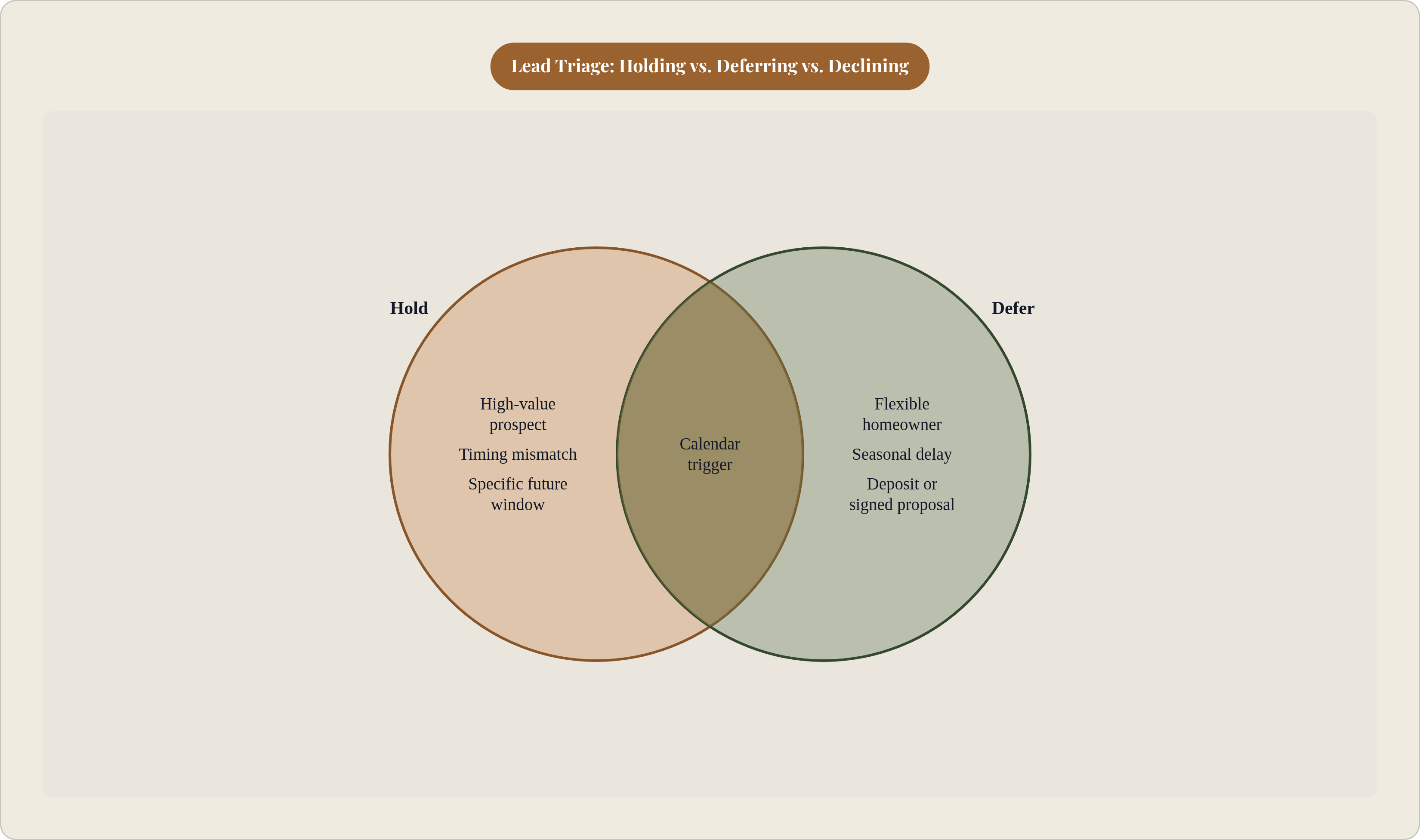
There are three legitimate outcomes for a lead that doesn't fit today's capacity: hold it, defer it, or decline it. The worst outcome, which many contractors default to, is accepting the job without the capacity to execute it well and hoping something opens up. That pattern destroys review scores and margin simultaneously, and it does so right when the season is at its most visible.
Holding works when the prospect is high-value but the timing doesn't align. The key is communicating a specific future window, not a vague "we'll be in touch." A held lead needs a calendar trigger; without one, it becomes dormant by neglect. Tell the homeowner directly: you want the project, here's the window you're targeting, here's the date you'll be back in contact. Then follow through on that date.
Deferring works when the project is legitimate but scope, season, or site conditions make a later start genuinely reasonable. Deferral is most effective with homeowners who have planned ahead, aren't in crisis mode, and have flexibility in their timeline. A deferred lead with a signed proposal or a deposit attached isn't a lead anymore. It's a scheduled crew day with a predictable revenue outcome.
Declining is the option most contractors avoid and often should use more. Low-margin job types, locations that break crew routing, scopes requiring skills or equipment the team doesn't have: these aren't leads worth holding. A clean, respectful decline preserves the relationship in a way that a botched job never does. The homeowner you turned away professionally often sends the neighbor who is a perfect fit. That referral network, the one built on honest, graceful declines rather than saying yes to everything and executing half of it poorly, is more durable than any other kind.
After-hours lead intake as a hidden capacity lever
A significant portion of homeowner decisions happen in the evening, after work and after dinner, when there's finally time to think about the project that's been on the list for months. Housecall Pro reports that 41% of jobs booked online come in after hours, a volume most contractors aren't capturing because no one is on the phone.
What happens to an after-hours lead that goes unanswered isn't ambiguous. The homeowner contacts the next contractor in their search results within minutes. By morning, they've already scheduled elsewhere, not because the first contractor lost a negotiation, but because they were simply absent.
AI-assisted intake can qualify the lead, capture project details, set an appointment, and route the job to the next morning's triage queue without a human on the other end. Every lead captured after hours and funneled into the scoring system is a potential crew day filled that would otherwise have gone to a competitor by default.
The handoff matters, though. The transition from automated capture to a human estimator should feel seamless to the homeowner. If it doesn't, the efficiency gained on intake gets lost in the first human interaction, when the homeowner senses they've been processed rather than heard. That's a recoverable problem, but it requires deliberate attention before volume scales, not after.
Matching marketing spend to actual crew availability
The mismatch that burns money is paying for leads the crew can't service within a competitive response window. A lead that waits four days for a response in a market where competitors respond in hours is effectively a lost lead, and the contractor still paid for it. Spend without the capacity to convert is waste with a marketing budget attached.
Percentage-of-revenue formulas for marketing spend are a blunt instrument when capacity is the real constraint. The right question isn't what percent of revenue to allocate to advertising. It's how many leads can actually be converted and serviced this month. Calibrate spend to crew days available, not to a revenue ratio. The math gets considerably more honest when you're working from a concrete number rather than a percentage of a projection.
Channel mix decisions matter under capacity pressure. Google Local Service Ads offer budget control and pausing capability, which is useful when the pipeline is full and the priority shifts from volume to quality. Organic channels, including Google Business Profile and SEO, continue generating leads regardless of capacity. That's an argument for maintaining them consistently, and also a reason to have the triage system operational before they produce surge volume. You cannot pause organic.
The inverse applies equally. When capacity opens up and the pipeline thins, that's the moment to increase spend, not when the crews are already booked out. Most contractors do the reverse, accelerating marketing when work slows out of anxiety rather than calibrating to the forward-looking availability curve. The anxiety is understandable. The timing is wrong.
Some AI-driven platforms charge only when revenue is actually produced, which is a structurally different fit for capacity-constrained contractors since spend scales with outcomes rather than running at a fixed rate regardless of whether the pipeline can absorb the inbound volume.
Reading the signals that the triage problem is actually a staffing problem
A triage system maximizes what current crew days produce. It cannot manufacture more of them. At some point, consistent overflow is a signal to add capacity, not just filter more carefully. Knowing the difference between those two situations is what separates contractors who grow deliberately from those who spend every season oscillating between overwhelmed and underscheduled.
The threshold signals are specific. High-scoring leads are being held or deferred routinely, not because of fit, but because there's simply no available window. The booking horizon has extended to the point where warm leads go cold before they reach the schedule. Crew utilization is consistently at or near ceiling across the full working week, with no buffer remaining for weather, callbacks, or rework. When those three signals appear together, the constraint has moved from demand management to supply expansion.
Four days of consistent booking beyond the horizon is the early trigger for starting the hiring conversation. Hiring in the trades is slow, and that isn't a solvable problem with urgency. Skilled hardscape crew members aren't available on short notice. The U.S. Bureau of Labor Statistics has documented rising wages for construction and extraction occupations, which reflects a labor market where experienced field workers are genuinely harder to find than the demand for them suggests they should be. Lead time from recruiting through onboarding to field-ready is measured in months, not weeks, and that timeline doesn't compress much regardless of how much pressure you apply to it.
AI-assisted recruiting can handle the front end of that process, posting, screening, initial communication, but it cannot shorten the production ramp of a new crew member once hired.
The business case for hiring is strongest when it's built on crew-day revenue math. If a new crew day produces a known daily revenue figure and the lead volume to fill it already exists in the pipeline, the return on the hire is concrete rather than speculative. That's a different conversation than "we've been slammed lately." It's a specific number with a specific outcome attached.
How the triage system holds together as one operational loop
The system described here is a loop. Leads enter through automated intake, including after-hours capture. They're scored and staged immediately, Fresh to Dormant, ranked by project value and fit. High-scoring leads move to fast quoting; lower-scoring leads move to nurture or reactivation sequences. Jobs that pass quoting enter the schedule with reliable scope and margin. Marketing spend is modulated against the actual number of crew days available to service new work. Booking horizon and utilization data feed the staffing signal, and when the system is consistently full, the hiring process starts before the crisis does.
What contractors report when this is working isn't fewer leads. It's fewer bad outcomes. Less chaos. Better margin per job. More consistent reviews. A crew that isn't constantly running at its edge producing the kind of work that generates callbacks instead of referrals.
A full pipeline is only an asset when there's a system determining which parts of it deserve crew days. Without that system, a full pipeline is just pressure with nowhere productive to go.