Lead Scoring Models for Hardscaping Businesses
Rank hardscaping leads by project size and buyer profile, not engagement metrics.

Lead scoring is not a marketing exercise for hardscaping businesses. It is a capacity allocation system. The businesses that score leads well deploy their estimators on work that closes at a margin worth having; the ones that score poorly fill their calendars with the wrong jobs and wonder why revenue looks healthy while profit does not. Think of it this way: a poorly scored lead pipeline is like a fishing net with holes cut in the middle — you haul in something, but you've already let the big catch slip through. The framework that makes scoring work in this trade is not generic. It is built around the specific signals that separate a $3,000 paver repair from a $30,000 outdoor living build, and those signals are not email opens.
Most hardscaping companies are small, local, and competing without the operational infrastructure that larger contractors have assembled over decades. The outdoor living market they operate in is large and still growing, but the range between a basic installation and a full design-build engagement is not merely a price gap. It represents entirely different buyer types, decision timelines, and margin profiles. A model that treats those two leads as equivalent, ranking them by surface engagement, is not just imprecise. It is actively expensive. Crews get deployed on low-margin work. Estimators spend hours on bids that were never going to close at a profitable number. High-value prospects go cold while the calendar fills up.
What follows is how to fix that, specifically for this trade.
What a High-Value Hardscaping Lead Actually Looks Like Before Anyone Picks Up the Phone
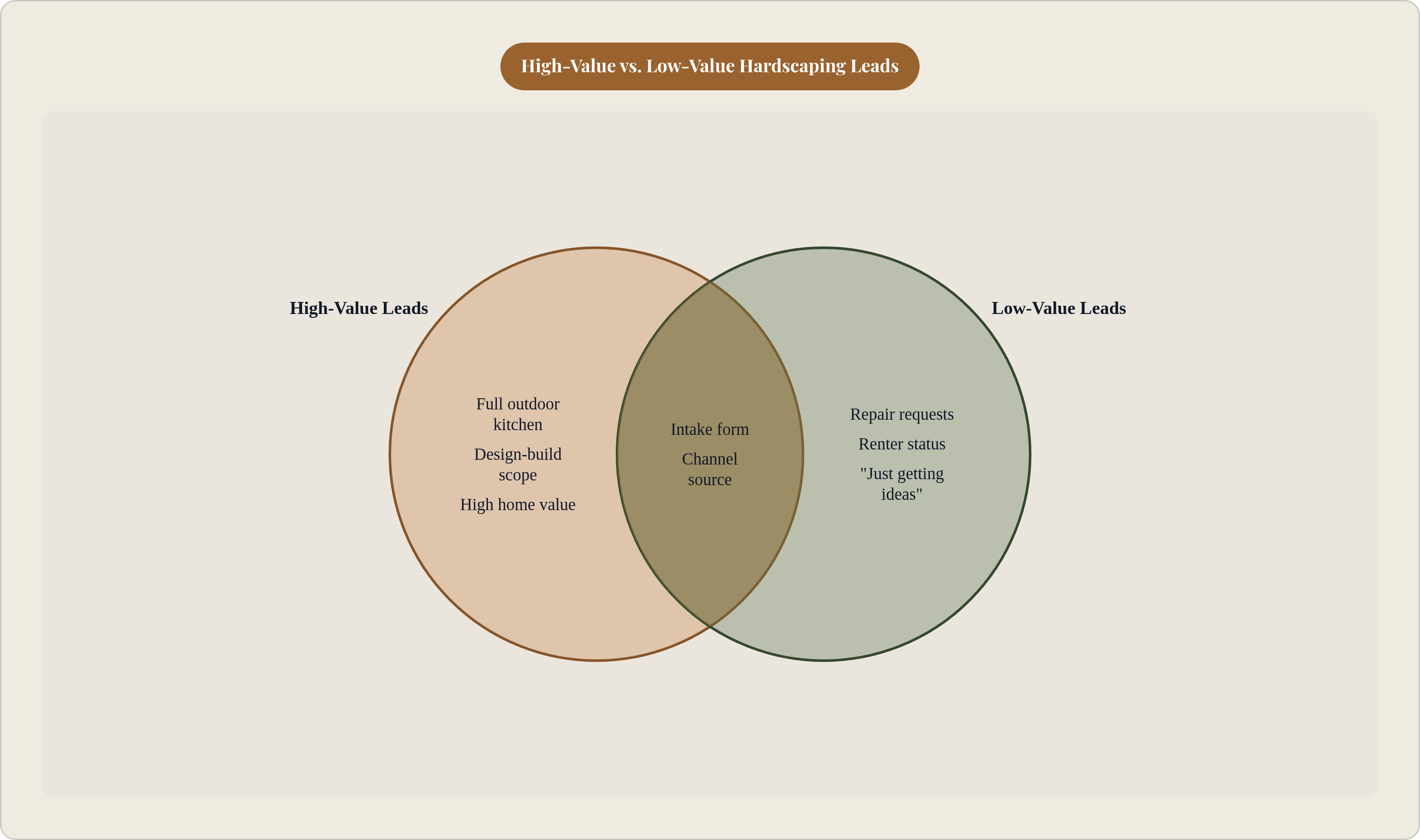
The profile of a high-value lead is observable before the first conversation. Property ownership is the baseline filter. Renters almost never commission large hardscaping work, and the occasional exception is not worth designing a system around. Homeowners with longer tenure in a property and higher home values are the natural buyers for outdoor living builds, because they have both the equity and the psychological permanence to justify the investment.
Home value functions as a proxy signal here, not as a judgment of character. A $30,000 patio on a $180,000 house is a mismatch that rarely closes; the asset simply does not support the investment, and most buyers in that situation know it even if they won't say so directly. Geographic specificity within a service area matters for exactly this reason. Some zip codes within a single market skew heavily toward design-build budgets; others skew toward repairs and small installations. Knowing which is which allows the model to weight leads differently from the first point of contact.
Project type, when declared at intake, is one of the clearest signals available. A lead who writes "I want a full outdoor kitchen with a pergola and lighting" in the first message is not the same as one who writes "I need some pavers around my mailbox." The scope signal is often sitting in plain sight in the initial form response, and most businesses aren't extracting it systematically.
Timeline language tells you where the buyer is in their decision cycle. Phrases like "we want this done before summer" indicate urgency and a buyer close to committing. "We're planning for next spring" signals a longer consideration horizon. "Just getting ideas" is a different category entirely and should route accordingly.
Prior relationship signals override nearly everything else. A past customer inquiring about a second project phase, or a referral from a recently completed high-value job, should carry an elevated baseline score before any other criterion is evaluated. These leads have already cleared the trust barrier, which is often the heaviest lift in the sales process. In other words, a referral walks in the door the way a good reputation walks into a room — it does half the work before anyone says a word.
The Five Scoring Variables That Predict Project Size in Hardscaping
Variable One: Property and Ownership Profile
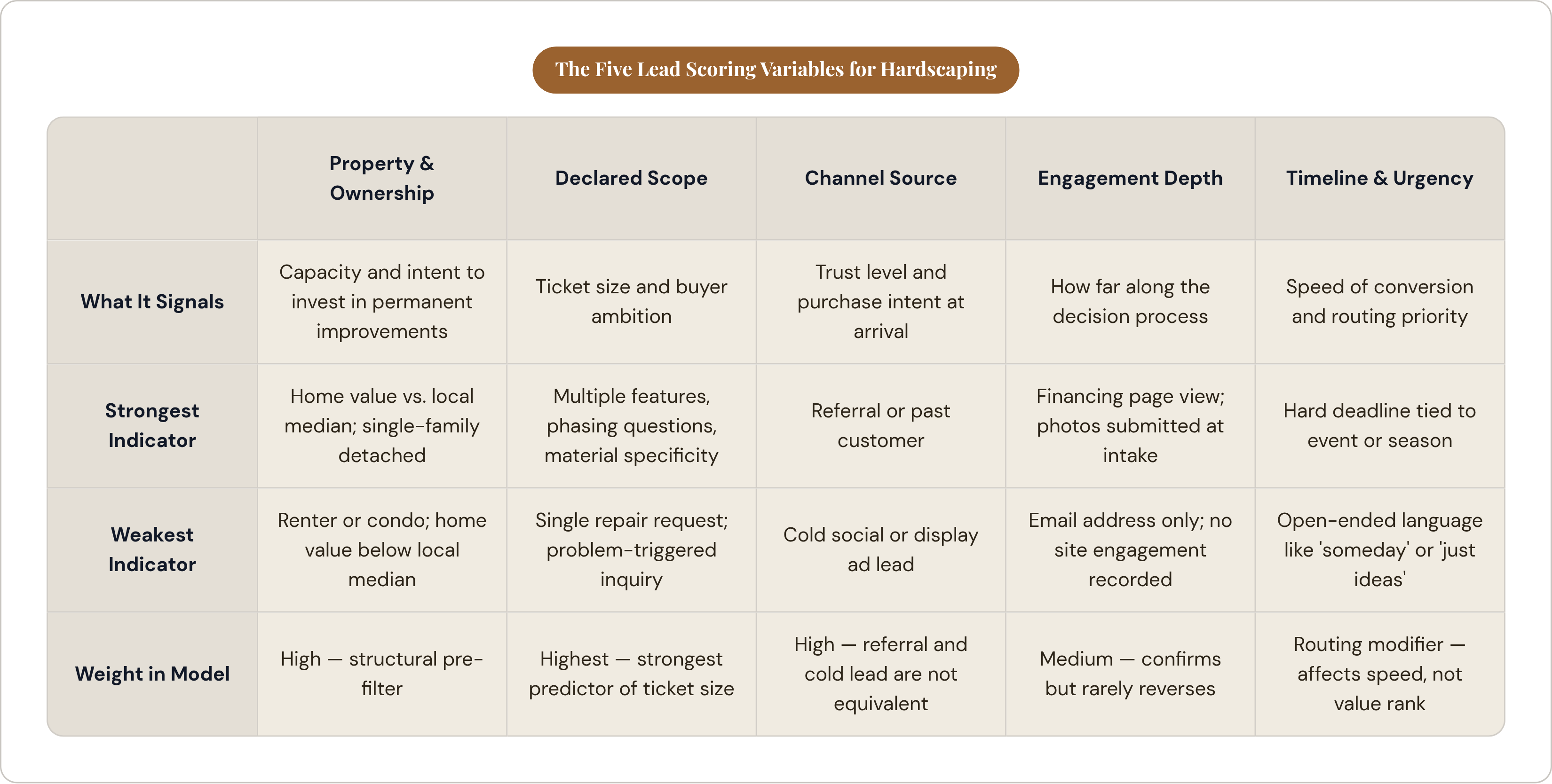
This is the structural filter before any behavioral data enters the picture. Homeowner versus renter operates as a binary; it is not a gradient. Beyond that, estimated home value relative to the local median matters, because willingness to invest in permanent outdoor improvements correlates with how much the asset is worth protecting and enhancing. Property type narrows the picture further. Outdoor living builds of any meaningful scale are almost exclusively single-family detached homes. Townhomes and condos occasionally generate legitimate inquiries, but the probability of a large design-build engagement drops substantially in those property categories.
Variable Two: Declared Project Scope
What is the lead actually asking for? Patios, retaining walls, outdoor kitchens, fire features, and full landscape integration each carry different labor and material footprints, and each signals something about the buyer's intent and budget range. Multiple feature types in a single inquiry, references to architectural drawings already in progress, questions about phasing or specific materials: these indicate a buyer who has done substantial prior research and is contemplating a larger commitment. Conversely, single-element requests, repair language like "fix the edge," or inquiries triggered by a specific problem rather than an aspirational vision, signal a smaller job. The difference between "fix my cracked paver" and "design us an outdoor living space" is the difference between a band-aid and a blueprint. The scope variable, when captured correctly at intake, does more predictive work than almost anything else in the model.
Variable Three: Channel Source
Where the lead came from tells you something important about the trust and intent they are arriving with. Referrals and past customers carry the heaviest source weight in any well-calibrated hardscaping model. They arrive pre-sold on the business's quality and are statistically most likely to close at a high ticket. Google search leads, whether from local service ads or organic results, come with high intent because the buyer initiated the search; the specific keyword matters, though, since "outdoor kitchen contractor near me" and "landscaping" are not the same buyer. Social and display ad leads typically arrive with lower intent and wider variance; they need more nurture before the score is meaningful. Direct mail, when targeted by home value and neighborhood profile, self-selects for homeowners who are already thinking about outdoor improvement, which earns it a stronger baseline score than its response rates suggest.
Variable Four: Engagement Depth Before Contact
Behavioral signals confirm and refine the picture the first three variables establish. Portfolio or project gallery visits signal visual research, which correlates with design-build intent. Financing page views are among the strongest single behavioral indicators available; a large share of outdoor living projects above a certain price point are financed, and a lead researching financing is implicitly contemplating a larger investment. A lead who submits photos, dimensions, or a site description in the intake form has made an active investment in the inquiry and is meaningfully further along than one who left only an email address. Product-level specificity, like requesting natural stone or a specific paver manufacturer, indicates prior research and higher price tolerance.
The caveat: behavioral scoring only works if the business has digital infrastructure to generate and capture that behavior. A hardscaping company with a simple brochure website and no content library won't have page-view data worth scoring. The model has to weight the signals the business actually collects.
Variable Five: Timeline and Urgency Signals
Hard deadlines, whether event-driven, move-related, or season-specific, carry the highest urgency score. These leads convert fast or they don't convert at all; they need an immediate response, and delay is typically fatal. Seasonal intent like "before summer" or "by fall" indicates a closing window exists, but allows for nurture. Open-ended language like "someday" or "just getting ideas" signals a buyer who is still in early consideration. That lead has value, but it belongs in a long-cycle nurture sequence, not on an estimator's schedule this week.
How to Weight These Variables So the Model Reflects Actual Business Priorities
A hybrid approach suits hardscaping best. Rule-based thresholds handle the disqualifiers: outside the service area, renter status, repair inquiries below the minimum job size the business profitably serves. These aren't scored; they're filtered before scoring begins. The point-based system handles everything that exists on a spectrum.
Within that point-based system, the weight hierarchy should look something like this. Declared project scope combined with property profile carries the highest weight, because together they predict ticket size more reliably than any behavioral signal. Channel source carries high weight, because a referral and a cold social media lead at the same engagement level are simply not equivalent. Engagement depth carries medium weight; it confirms and sharpens the picture, but it rarely reverses a strong or weak score that scope and property have already established. Timeline urgency functions more as a routing modifier than a value signal; it affects how fast the business responds, not whether the lead is worth pursuing.
Score thresholds need to map directly to actions, not just rankings. A high score should trigger an immediate response, priority estimator assignment, and a design consultation offer. A mid-range score should trigger an automated follow-up sequence and re-scoring based on subsequent engagement. A low score routes to a long-cycle nurture sequence, a seasonal reactivation campaign, or outright disqualification depending on what's driving the score down.
The disqualifier logic deserves equal attention. A lead that scores high on engagement but fails a geography or property filter should be removed from the active pipeline entirely, not just ranked near the bottom. Keeping low-fit leads in the system dilutes the attention given to leads that actually warrant it, and that dilution is where most of the practical value of a scoring model gets lost.
The model should also be reviewed seasonally. Spring inquiry patterns differ from fall ones, and the business's own capacity constraints change what "high value" means at different points in the year.
Score Decay and Seasonal Timing as a Hardscaping-Specific Wrinkle
Hardscaping is among the most seasonally concentrated trades in home services. Installation work compresses into a portion of the calendar year, and a lead that was genuinely warm in April is a categorically different lead in August, and different again in November. Most generic scoring models don't account for this. Hardscaping ones have to.
Score decay is the principle that a lead's score should automatically decrease as time passes without meaningful engagement. A spring inquiry that never responded to two rounds of follow-up should not still appear as a high-priority lead in September. Practically, that means specific decay rules. No response after initial outreach in the first week: reduce the score, move to nurture. No engagement after thirty days: significant score reduction, flag for seasonal reactivation. An inquiry from the prior season with no conversion: reset to a lower baseline for re-scoring, not treated as a fresh high-intent lead entering the pipeline.
Reactivation is a distinct workflow, not a continuation of original outreach. Leads that decayed over winter represent a warm audience in early spring. They already know the business. They didn't commit to a competitor, or they did and are now considering a different project. These leads should enter a re-scoring sequence with messaging that acknowledges prior contact, rather than a cold-outreach sequence that behaves as if the relationship doesn't exist.
Seasonal timing also affects how urgency scores are interpreted. A stated timeline of "before summer" carries very different weight in February than it does in May. The scoring model should account for the gap between what the lead says they want and when they said it.
Where Speed-to-Response Fits Into the Scoring System
A scoring model that correctly identifies a high-value lead and then lets that lead sit uncontacted for hours is not producing value. The score exists to trigger a response, not to organize a list. Home service buyers who reach out to multiple contractors overwhelmingly give the job to the first business that responds with something substantive, not necessarily the best bid they eventually receive. The first meaningful response sets the frame for the whole sales process.
Weekend and evening timing compounds this problem. A significant share of home service inquiries arrive outside business hours, when most hardscaping offices are unstaffed. A high-scored lead that arrives Friday afternoon and receives its first response Monday morning has been competing against every other contractor in the market for sixty-plus hours. That is not a winnable position.
Text-based initial response is the practical default for high-scored leads. Many home service buyers, particularly those doing initial research on a mobile device, prefer text over a phone call for first contact. Automated text follow-up triggered by a score threshold is a direct revenue mechanism, not an amenity.
The architecture that works: high-scored leads trigger automated immediate outreach, whether by text or a conversational response tool, while simultaneously routing to a human for same-day or next-morning follow-up. The automation holds the relationship while the human closes it. AI-assisted qualification tools can manage the initial exchange, confirm project details, and set the estimator appointment, which means the scoring model connects directly to a booked appointment without requiring manual triage at every step.
What Breaks Lead Scoring in Practice for Most Hardscaping Businesses
The model fails at the intake form more often than anywhere else. If the contact form asks only for a name, email, and a free-text "tell us about your project" field, the scoring model has almost nothing structured to work with. The intake form is the first data collection instrument the business controls, and it has to be designed with the five scoring variables in mind.
Inconsistent data entry across channels creates a similar problem. Leads arrive through website forms, phone calls, social media messages, and ad platforms, often with different fields captured each time. When intake notes are recorded differently by different people, the model can't score consistently. Standardizing intake by channel, even if it requires a brief call script or a form embedded in the CRM, is a prerequisite.
Scoring without acting destroys the practical value of the model immediately. Many businesses implement scoring, generate a ranked list, and then continue following up in the order leads were received. If the score doesn't change routing, response speed, or estimator assignment, it isn't functioning as a system. It's a decoration.
Failure to disqualify clearly is the other common failure mode. Holding low-fit leads in the active pipeline because "you never know" wastes estimator time and makes the scored list meaningless. A disqualification path with a defined re-entry condition, whether that's a minimum home value threshold or a geography expansion, is part of the system. It is not a rejection of the lead; it is an allocation of attention toward the leads most likely to produce the kind of work the business wants.
Finally, not revisiting the weights as the business changes. A model calibrated when the business was doing primarily smaller jobs needs recalibration if the business moves upmarket. The signals that separated good from great at one revenue level are the wrong criteria at the next.
Building the Scoring Model in Stages Rather Than All at Once
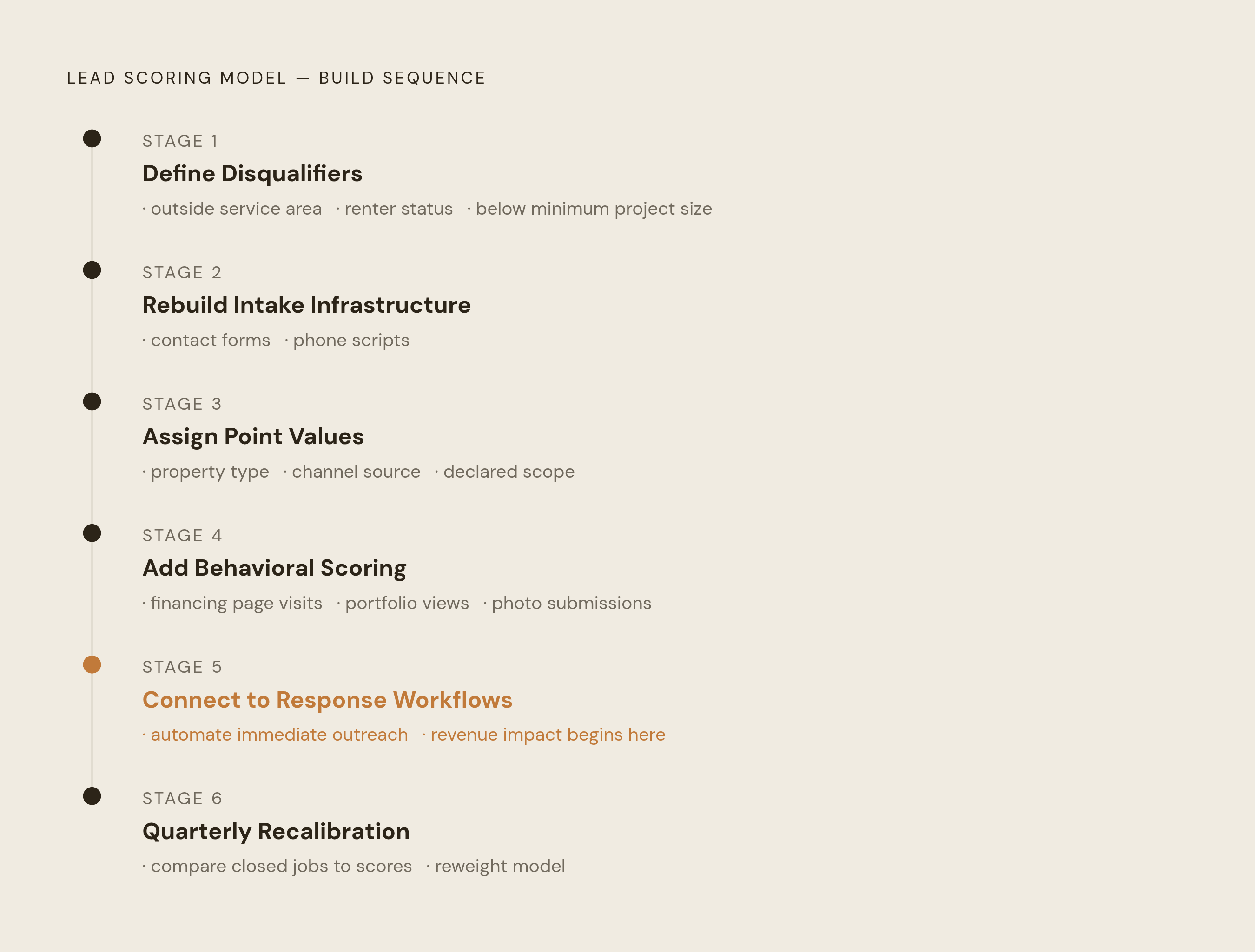
The businesses that get stuck trying to build the complete model before launching anything end up with nothing. Staged construction produces a functioning, improving system faster than comprehensive planning produces a perfect one.
Stage one is defining the disqualifiers: the binary filters that remove leads before scoring begins. Outside the service area. Renter status. Below minimum project size. Inquiry types the business doesn't serve. Get these documented first. They are the fastest wins in the whole process.
Stage two is rebuilding the intake infrastructure. Redesign contact forms and phone intake scripts to capture the five core variables. This step is a prerequisite. Scoring cannot be accurate until the model has the right inputs.
Stage three is assigning point values to the variables the business already has data on. Property type, channel source, and declared scope can typically be scored immediately. Use the existing history of closed jobs as a calibration check: did the high-scoring leads actually close at higher ticket sizes?
Stage four adds behavioral and engagement scoring as the digital footprint develops. Financing page visits, portfolio engagement, photo submissions in the intake form. These layers compound on top of the baseline model; they don't replace it.
Stage five connects scores to response workflows. Define the action triggered at each score tier. Automate the immediate-response step so high-scored leads never wait. This is where the model starts producing visible revenue impact.
Stage six is quarterly review. Compare closed jobs to their original scores. If high-scored leads are not converting at a meaningfully higher rate than mid-scored ones, the weights need adjustment. The model should get measurably better with each season of data.
The businesses that benefit most from this approach are the ones moving from informal, gut-feel qualification toward a repeatable system. The goal is not precision on day one. The goal is a framework that improves with use, allocates estimator time toward the work worth winning, and stops treating every inbound inquiry as equivalent to every other one.