Meta Ads Audience Targeting for Hardscape and Remodeling Companies
Meta plants the seed months before homeowners are ready to search for contractors.

Meta Ads work differently for hardscape and remodeling contractors than they do for most businesses running Facebook and Instagram campaigns. The whole game comes down to layering geographic, demographic, and behavioral signals so the platform surfaces homeowners who have the money and are already leaning toward a big outdoor project, before they ever type a search query into Google.
Nobody wakes up and Googles "hardscape contractor near me" with a firm budget already set. That itch builds slowly, through scrolling backyard photos at midnight, watching a neighbor's patio go in over a weekend, catching a friend's new pool deck on Instagram and feeling that little pang of envy. Google catches people after the want has already turned into a search. Meta plants the seed months before that search happens. For a project with a consideration window running anywhere from a few weeks to most of a year, that early presence matters more than most contractors give it credit for. Skip the early cultivation and half your pipeline never shows up.
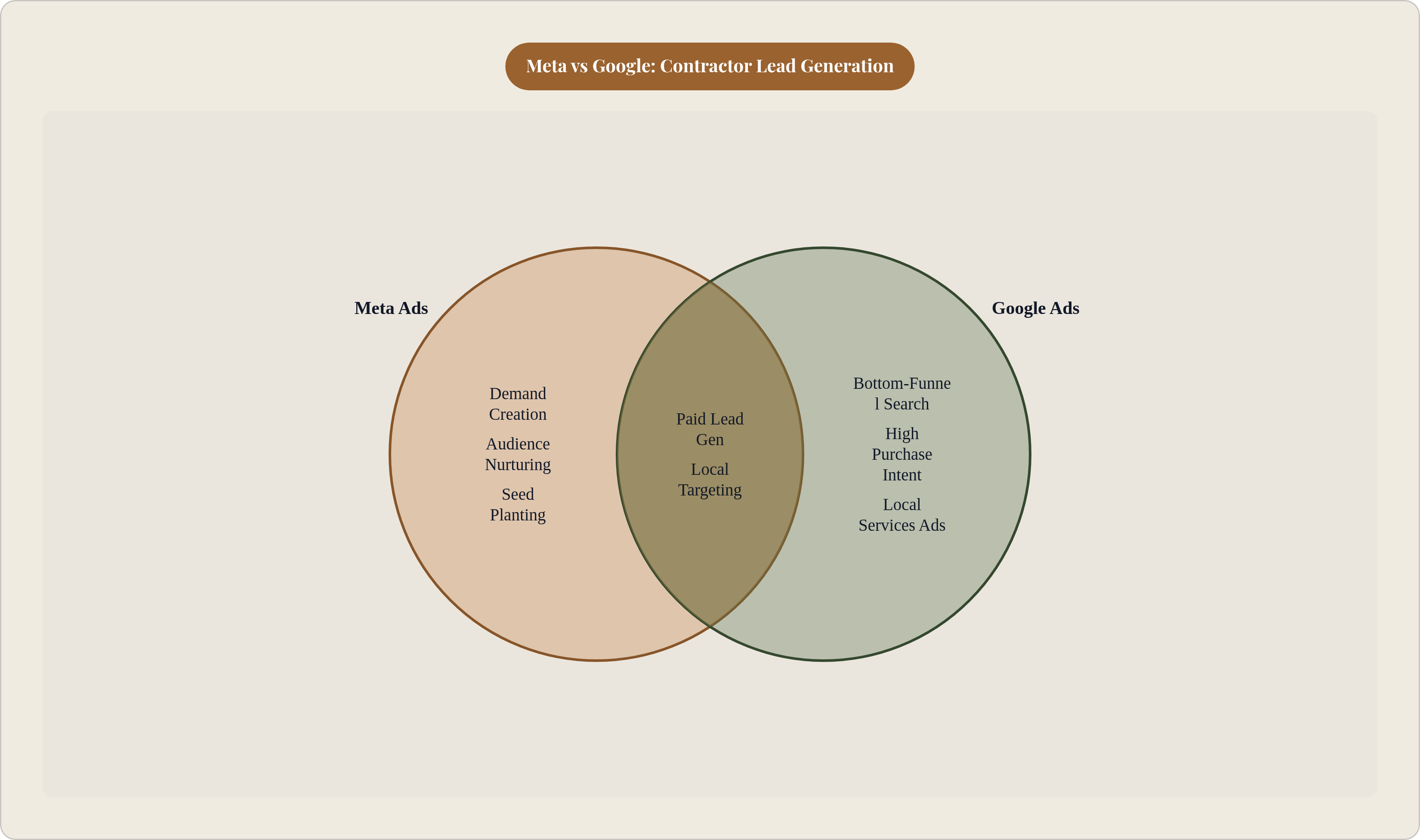
Meta builds the want, and Google catches it once it turns into action. Confuse the two jobs and you'll end up staring at a Meta cost-per-lead number that looks worse than Google's, without realizing you're comparing two totally different stages of the same buyer.
How Meta's targeting system actually works in 2025–2026
The old playbook, stacking ten interests and layering behaviors to build a "perfect audience," doesn't work the way it used to, and contractors clinging to it are burning money on autopilot. Meta treats detailed interest and behavior inputs as loose suggestions now, not hard walls. As of March 31, 2025, Meta pulled detailed-targeting exclusions from active campaigns entirely, and the option to exclude an interest or behavior is simply gone now.
Behind that shift sits Andromeda, the retrieval system Meta rolled out in late 2024. It matches ads to people in a fundamentally different way than the old system did, and the practical effect is that Meta now optimizes for who actually converts, not who checks a demographic box on paper. The contractor's job shifted from hand-building an audience to feeding the system clean signals and getting out of the way.
Advantage+ campaigns have become the default setup for most advertisers I talk to. They clear the learning phase faster, and they stabilize sooner than the old manually built campaigns did. Consolidating a handful of narrow, scattered campaigns into fewer, broader ones tends to lower cost per acquisition too. Fighting the algorithm with hand-picked, narrow targeting just doesn't pay off anymore. I still run into contractors doing it because "it worked in 2022," and I get why that instinct is hard to kill, but it doesn't hold up now.
The geographic boundary: why radius isn't just a setting
For a hardscape crew, geography is the real constraint, not a preference. Crew drive time, material delivery, equipment logistics: all of it caps how far a job can travel and still turn a profit. Geography might be the single most consequential setting in the entire campaign, more than age range, more than the interest list, more than budget.
Fifteen to twenty miles around the actual service area is the right starting point for most high-ticket home services work. Go wider than that and the algorithm fills the gap with impressions that have almost no shot at converting. You end up paying to show a great ad to people who were never going to call.
Not every zip code inside that radius carries equal weight, either. Established neighborhoods with high owner-occupancy, longer average tenure, and older housing stock concentrate the buyers most likely to commission a big project. Homes get old, systems wear out, and patios crack over time. That aging housing stock creates a natural pull toward renovation spending that a brand-new subdivision, full of renters and recent buyers still unpacking boxes, doesn't have yet.
Radius and Advantage+ audience expansion work together, so think of the geo boundary as a wall the algorithm can't cross. Everything inside that wall is where it goes looking for buyers. That's why getting the radius right matters more now than it did under the old manual system: you're picking the hunting ground, not the individual target. Contractors covering more than one city or suburb should run separate campaigns by market instead of one sprawling radius. It keeps the data readable, and it keeps the budget where it's earning its keep instead of getting averaged out across two markets that behave nothing alike.
Which homeowners are worth targeting and how to signal them to Meta's algorithm
Three types of homeowners tend to convert on big hardscape work. There's the practical backyard upgrader spending tens of thousands of dollars because the space genuinely doesn't function anymore for a family that's outgrown it. There's the homeowner heading into or already in retirement, sitting on home equity and free time, upgrading for quality of life rather than resale value. And there's the new-home or legacy-home owner personalizing a space for entertaining, the ones who want the yard to actually look like something when people come over.
An age floor of 35 to 65-plus makes sense as a targeting input. Younger homeowners buy hardscape work too, sure, but that range concentrates the financial standing and ownership tenure it actually takes to sign a contract this size.
Interest signals like "Home improvement," "Outdoor living," "Residential properties," and "Landscape design" are worth including, but treat them as hints, not filters. Behavioral signals carry more weight for this category: people who recently moved, people who've engaged with home improvement content, Meta's own inferred homeowner status.
Most home services customers, when surveyed, say they'd rather hire a local independent operator than a national chain. Meta's geographic and demographic settings can lean into that directly, but only if the messaging and imagery stay hyper-local, not generic stock-photo patio shots that could be anywhere in the country.
First-party data is the single highest-quality signal available, full stop. Upload a list of past clients, high-lifetime-value customers, or recent inquiries, and Meta gets a real conversion seed to learn from, and nothing else comes close. First-party data consistently outperforms interest stacks and manually built lookalikes when the two approaches are compared. One more move worth making: upload that past-client list as an exclusion audience too, so spend doesn't recycle back toward people who already bought from you.
In practice the setup looks like this. Set the geo boundary, set the age floor, and upload the customer list as a seed, then add a few interest hints and let the system find the converting profiles from there.
Creative does more targeting work than any audience setting
Creative carries more weight in campaign performance than any single audience setting you could tweak. In a system where the algorithm handles the audience-finding, the ad itself is what qualifies the viewer before a human ever does.
For hardscape and remodeling, the creative has one job: build desire and make the risk feel small, at the same time. A homeowner about to hand tens of thousands of dollars to someone they found scrolling Instagram needs the ad to feel aspirational and safe before they'll even tap through.
A few formats consistently earn that trust. Sharp, well-lit photos of finished projects work because the transformation has to read instantly in a feed someone's flicking through in half a second. Before-and-after sequences tend to outperform almost everything else because the value is obvious without a word of explanation. Short client testimonial videos that name a real neighborhood or project carry more weight than a generic five-star quote ever will, since that specificity is what sells it. Lifestyle imagery showing the space actually in use rounds it out: the family on the patio, the driveway leading up to a house that looks lived in, not staged.
There's a blunt test for all of this. If the first two seconds of a video or the hero image of a static ad don't stop the scroll, no amount of audience tweaking saves the campaign. Spending on stronger creative will move campaign performance more than spending on audience configuration Meta is mostly going to override anyway. Underspending on creative while overspending on audience configuration is one of the most common, and most expensive, mistakes I see on this platform.
The lead qualification gap that wastes Meta spend before it reaches the sales calendar
Run a campaign without a qualification step between the ad click and the sales call, and the pipeline fills up fast with renters, curious browsers, and homeowners whose real budget is a fraction of the project cost. Even a well-targeted campaign hitting the right neighborhoods pulls in leads who aren't close to ready. Qualification is what separates an actual prospect from someone who just liked the photo and kept scrolling.
A working qualification layer usually means an instant form on the ad itself, asking for project type, timeline, and budget range before the person even submits. Some contractors run a multi-step landing page with a short questionnaire instead. Others rely on an automated follow-up sequence that confirms project scope before anyone lands on the calendar.
Speed matters just as much as the form, maybe more. Most remodelers lose jobs because follow-up simply stops after the second attempt, no matter how strong the quote was or how good the fit looked on paper. Somebody gets busy, a call slips through, and the lead goes cold before anyone notices it happened. Automated sequences close that gap without needing a person glued to a phone all day. Wonderly's AI Agents work in exactly that space, handling inbound qualification and follow-up and booking the calendar, so the humans on the team spend their hours with people who are actually ready to sign instead of chasing maybes.
Retargeting the homeowners who looked but didn't fill out a form
A homeowner weighing a major backyard project almost never converts on the first ad they see. They click, scroll a portfolio, read a couple of reviews, close the tab, and come back days or weeks later, assuming the contractor gave them a reason to remember the name.
Meta's retargeting tools exist for exactly that gap. Website custom audiences hold visitors for up to 180 days, or up to two years when tied to a purchase event, and Page or Instagram engagement audiences hold for up to 365 days. That's a long runway to keep showing up in front of someone who's still deciding.
A layered sequence tends to work like this. First exposure is an aspirational before-and-after or finished-project photo, meant to plant the idea. Anyone who clicks but doesn't convert sees a testimonial video or project walkthrough next, adding credibility to that first spark. Anyone who's engaged more than once after that sees something hyper-local: a project from their own neighborhood, a street they'd recognize on the drive home.
That layering is the real difference between contractors who get a steady stream of inquiries and contractors who run six weeks of ads, see nothing, and quit right as the audience was entering its consideration window. Retargeting audiences run smaller, but they convert at a much higher rate, so they deserve their own line item in the budget rather than whatever's left over after prospecting spend. Worth building as standing audiences: website visitors, Instagram profile engagers, anyone who watched more than half of a project walkthrough video, and anyone who opened a lead form without submitting it.
Where Meta fits in a contractor's full marketing channel mix
No single channel carries a growing hardscape business by itself. Lean too hard on one source and the whole pipeline wobbles the moment that channel shifts, whether that's an algorithm change or a spike in cost per click nobody saw coming.
A balanced lead mix for a contractor right now looks something like this. Paid channels, Local Services Ads plus Google Ads, take the largest share, while organic search and Google Business Profile pick up a solid chunk behind that. Referrals and repeat customers fill in a meaningful piece, and social, email, and direct mail round out the rest. Meta's job in that mix is demand creation and mid-funnel nurturing. It feeds the top and middle of the pipeline while Local Services Ads and SEO pick off the bottom-of-funnel searches from people who already know exactly what they want.
Google Local Services Ads reach people already searching with strong intent, which is precisely the gap Meta is built to fill instead. Premium hardscape and remodeling leads cost more everywhere, not just on Meta. That's the right frame for judging a reasonable hardscape cost-per-lead: measured against the margin the project actually carries, not against some plumbing-industry benchmark that doesn't apply here.
Email and referral programs return more per dollar than almost anything else on this list. Both depend on an existing customer base to draw from, though, and Meta is very often what built that base in the first place. Email and Meta look like competitors for budget on paper, but in practice, one feeds the other.
None of this works if the back end can't handle what the front end generates. A contractor running Meta Ads without a system for handling volume, qualification, and fast follow-up watches cost per lead climb and close rates fall, because nobody was ready to catch what the targeting caught. Demand for home services work keeps climbing, and most contractors in the space expect real revenue growth over the next year or two. The demand is there. The real question is which contractors built the systems to actually take their share of it, and which ones let good leads go cold on a missed callback.