Why Homeowners Search "Patio Contractor Near Me" Instead of Asking for Referrals
Referrals now start the search—but homeowners verify online before they ever call.
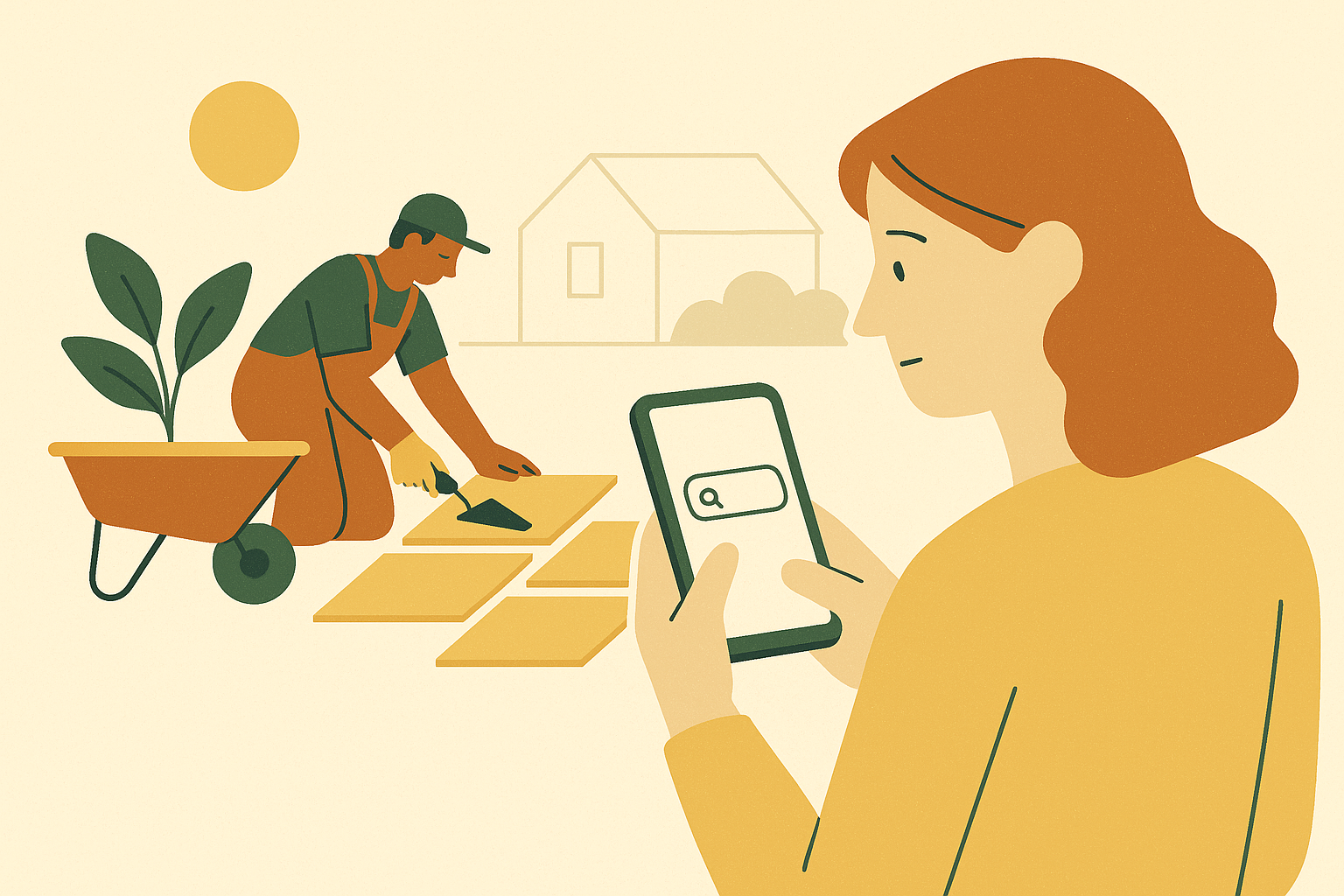
A homeowner gets a name from a neighbor, then opens their phone and searches "patio contractor near me" before they ever dial that number. Referrals don't die anymore; they just become step one of a two-step process, and step two happens entirely online, out of the referring neighbor's sight. Contractors who treat a referral like a closed deal risk losing the job anyway, because they miss what is actually happening on the other end of that phone.
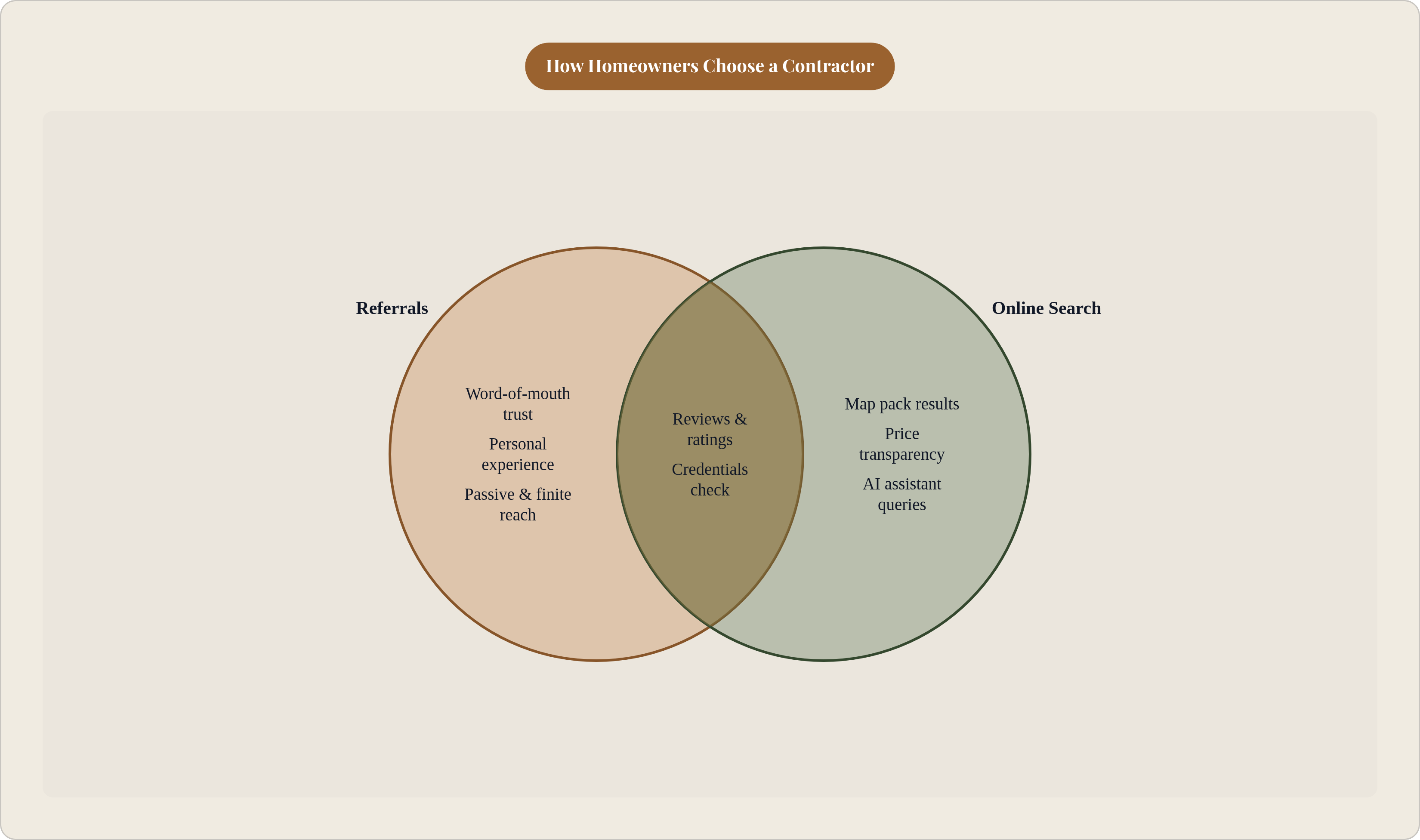
The HIRI 2024 Home Services Study found homeowners are roughly twice as likely to discover a provider through personal referral than through online search. Fine, referrals win on discovery. But Leaf Home's research found 61% of homeowners trust word-of-mouth recommendations when picking a provider, and trust isn't the same word as hire. Trust gets extended, then it gets checked, quietly, on a phone screen, while the neighbor who made the referral has no idea it's happening.
A referral used to hand off confidence from start to finish. Your neighbor used them, they were good, call them, done. Now a referral hands off permission to look further, and nothing more than that. Homeowners have verification tools that barely existed in usable form ten years ago, and they reach for them out of habit, every single time, before any call gets made. A contractor leaning on referrals alone wins the first moment and loses the second, and the second moment is where the job actually gets booked.
What homeowners do in the minutes after getting a referral
The sequence is remarkably consistent. A friend mentions a name, the homeowner opens a browser or pulls up Google Maps, types in the contractor's name or just "patio contractor near me," and starts sizing up whatever comes back.
ACHR News reports 91% of homeowners rely on online reviews before choosing a contractor. Timing is the whole story here: this checking happens before first contact, not after. The homeowner isn't reading reviews to confirm a decision they already made. They're reading reviews to decide whether the call is even worth making.
In that window, a few things get scanned fast:
- Recent reviews that match the referral's story to their own situation
- Project photos that fit the actual scope, a patio and not a deck, pavers and not stamped concrete
- Third-party signals: Google rating, review count, how the owner handles a bad review
- Basic credibility markers, licensed, insured, local, around long enough to trust
If the contractor doesn't show up cleanly here, the search doesn't stop; it keeps going, and the referral's value evaporates without anyone noticing. A competitor with stronger signals, more reviews, sharper photos, a faster reply history, can steal the call before the referred contractor ever knows there was competition. Nothing went wrong with the referral. The contractor's digital presence just failed at the one moment that counted.
Why referrals alone have a structural ceiling for patio contractors
A referral reflects one person's experience with one project. It says nothing about fit for the next homeowner's actual need, and in hardscape work, that gap matters more than most contractors want to admit.
A contractor who built a beautiful deck for someone's neighbor isn't necessarily the right fit for a patio renovation or an outdoor kitchen. Different scope, different skill set, different crew experience. The match a referral makes is made by chance, not relevance.
Referrals are passive, too. A contractor can't control when one lands, what kind of project it covers, or what price point the referring homeowner quietly implied when they said "they were great." Referral networks are also finite; they only reach the people who happen to know the people who know you. That ceiling is real and it doesn't move, no matter how good the work is.
Which is exactly why "patio contractor near me" gets typed in the first place. The homeowner wants a specialist matched to their job, not whoever a neighbor hired three years ago for something else entirely. Picture the three homeowner types hardscape contractors chase most, the backyard upgrader, the retiree improving quality of life at home, the new-homeowner finishing out the lot. Each one searches on their own timeline, with their own scope, without waiting for a name to drop at a dinner party. A referral can start that search. It can't replace the infrastructure that catches it.
What "near me" searches actually signal about homeowner intent
Google Trends shows location-modified contractor searches have grown over 600% in the past decade. That's not a niche behavior anymore. It's habitual across age groups now.
Someone typing "patio contractor near me" has already decided they want a contractor. The search isn't education, it's selection. That's a different mode entirely from scrolling Pinterest for backyard inspiration with no timeline and no budget yet. This is a buying signal.
Inside the map pack, the homeowner does three things at once: scans star ratings and review counts for the social proof a single referral can't provide, checks photos to confirm the contractor actually does the work they're picturing, and looks for responsiveness clues, recent reviews, an owner reply to a complaint, business info that reads current instead of stale.
Patio and hardscape jobs raise the stakes further because these projects represent a significant investment, and nobody calls the first name they see for a job that size. Homeowners compare two or three contractors before picking up the phone. Showing up in the search isn't enough by itself. The profile with the strongest evidence gets the click; everyone else gets skipped.
The proof points a homeowner needs to see before making contact
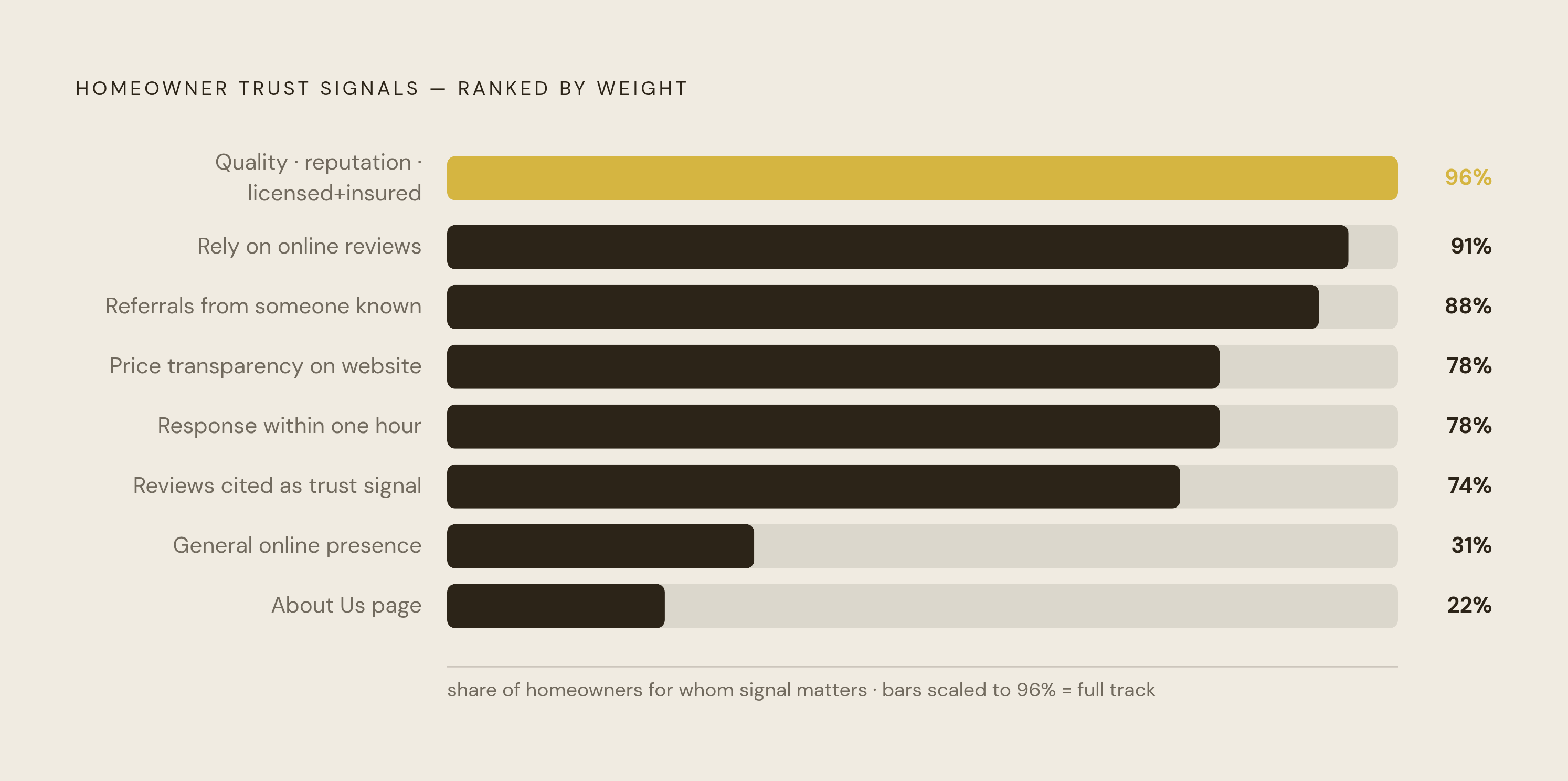
Reviews aren't optional. With 91% of homeowners relying on them before contact, both volume and recency carry weight, and both volume and recency shape how a contractor's profile reads to a homeowner scanning quickly.
The roofing industry offers a useful, transferable data point here. The My Clear Opinion / Roofing Contractor 2025 Homeowner Survey found referrals (88%) and online reviews (74%) as the two dominant trust signals, with 31% of homeowners also weighing general online presence and 22% citing an "About Us" page specifically. People want to know who they're letting into their backyard, literally.
Photos need to match the job. A homeowner planning a paver patio wants to see paver patios in the portfolio, not a generic mix of decks, driveways, and retaining walls. Mismatched photos quietly chip away at confidence even when the underlying work is excellent.
Price transparency is the most underused lever on this whole list. That same Roofing Contractor survey found 78% of homeowners are more likely to call a contractor who shows pricing on their website, yet only around a quarter of contractors post any pricing at all. That gap sits wide open for anyone willing to close it. Hardscape contractors don't need an exact quote posted. Range-based pricing by project type, "paver patios in this area typically run between X and Y," signals honesty and strips friction out of the first conversation.
Response speed matters before contact even happens. Seventy-eight percent of homeowners expect a reply within an hour, and 68% prefer text or chat over a phone call. A contractor whose reviews mention fast, easy communication has a visible edge over one whose reviews say nothing about it.
None of this outranks the fundamentals, though. HIRI's 2024 study found quality of work, reputation, and being licensed and insured rank above price for around 96% of homeowners. Lead with credentials and you're speaking the language homeowners already use to filter. Reputation pays literally, too: 72% of homeowners say they'd pay up to 10% more for a contractor with a stronger service reputation. That's not a soft marketing benefit. That's a pricing lever, plain and simple.
Where search behavior is heading and what it means for local contractors now
Gartner forecast in February 2024 that traditional search engine volume will drop 25% by 2026 as AI assistants absorb a growing share of queries. By mid-2025, AI assistants had already crossed into the billions of monthly visits worldwide. This isn't something to plan around eventually. It's already underway.
Pew Research Center found 23% of U.S. adults had used an AI assistant by early 2024, and that jumps to 43% among adults 18 to 29. The younger homeowner cohort, the backyard upgraders and new-home finishers, is already shifting how it searches, and that shift climbs into older age groups the way search behavior usually does.
Here's what changes: instead of typing "patio contractor near me" and scrolling a map pack, a homeowner asks an AI assistant something like "how much does a paver patio cost in Denver?" or "what should I check before hiring a patio contractor?" The assistant answers in plain narrative, sometimes naming a platform, sometimes naming a contractor directly, and the homeowner follows that thread without ever landing on a traditional results page. The map-pack click contractors fight over today may just not happen in that path anymore.
I'm not saying abandon Google. The map pack still runs the show right now and will for a while yet. But the proof points homeowners need in a search, reviews, photos, credentials, fast replies, are the same raw material AI systems pull from when they recommend a local contractor. A strong, review-heavy, well-documented presence isn't just a Google play anymore; it's the input feeding the next search environment too. Contractors building that now cover both channels at once. The ones skipping it risk losing the validation moment no matter which path the homeowner takes.
What contractors who win these searches do differently in their operations
Knowing this behavior exists and actually capturing it are two different things. The gap between them is operational, and it comes down to response speed, review volume, and how complete the profile looks, not some clever new marketing angle.
Take response speed. With 78% of homeowners expecting contact within an hour, contractors who automate that first touch, text, chat, an AI-handled intake, catch leads a manual end-of-day callback simply loses. It isn't close.
Review generation has to run as a system, not something you hope happens after a good job. High review counts come from asking every single time, consistently, not from the occasional exceptional job that moves someone to write something unprompted. High review counts come from a repeatable ask built into the process, usually triggered right after the job wraps.
Photo documentation deserves the same discipline. Job-site photos of finished patio and hardscape work, uploaded regularly to the Google Business Profile, build exactly the project-specific proof homeowners are scanning for in that first five minutes.
Communication itself decides jobs. Roofing Contractor's 2025 survey found around 40% of homeowners name poor communication as their biggest frustration with contractors, and about 67% say better communication is what decides which of two finalists gets the work. That's not a small factor buried at the bottom of a list. That's close to a coin flip.
Fragmented systems lose leads in the gap between inquiry and estimate, and Contractors juggling five separate tools routinely drop prospects in that gap that a single connected system would have caught. That is the core problem a connected system addresses — handling lead intake, follow-up, and quoting so the second-step validation moment converts instead of stalling out somewhere between a text message and a callback that never happens.
The referral still does its job. It gets a homeowner to open a search bar. What happens in the next five minutes is entirely up to what the contractor has built for that homeowner to find.