Trust Signals That Move Homeowners from Quote to Signed Contract
Homeowners research trust signals online before calling, and your digital presence seals the deal.

The decision is mostly made before you pick up the phone. By the time a homeowner submits a contact form or fires off a text, they've already done serious evaluation work: checked websites, read reviews, formed a preliminary ranking. The selection process is front-loaded, and it's happening entirely on the homeowner's schedule, in the homeowner's browser, without a contractor in the room.
This matters for hardscape specifically because the stakes are real. A $20,000 to $50,000 outdoor project means meaningful disruption to a home, a significant financial commitment, and no clean path to reversal if things go sideways. The confidence threshold is higher than it is for smaller service trades, so homeowners invest actual time in research before they ever reach out.
What they're doing during that research window isn't comparison shopping in the traditional sense. They're assembling a case for why it's safe to trust a contractor with their property and their money. Three fears drive the process: Will this contractor finish the job to the agreed spec? Will they disappear with a deposit or let the timeline bleed out indefinitely? Is the price I'm about to be quoted honest and reasonable? Every website visit, every review read, every Google Business Profile scan is an attempt to answer those questions before committing to a conversation.
The digital behavior that accompanies this is telling. A strong majority of homeowners prefer texting or online inquiry over phone calls during this phase. They want information on their own terms, without a sales interaction coloring their perception. And yet the moment they do reach out, patience compresses fast. A large share of homeowners expect a response within an hour of making contact. The research phase is slow and deliberate; the response expectation is immediate. Weeks of quiet consideration, then sudden urgency.
The practical implication: you cannot persuade a homeowner during the pre-contact window because there is no conversation yet. The only trust signals available to you in that phase are the ones a homeowner can find and evaluate independently. That's where the real competition begins, and most contractors aren't paying attention to it.
What a Contractor's Digital Presence Signals Before a Single Word Is Read
A hardscape contractor's website is not a brochure. Homeowners aren't reading it for information. They're scanning it for proof, and they're forming inferences faster than most contractors would believe.
A weak website signals things it never says explicitly. Stock photography, or worse, no project photography at all, implies there's no finished work worth showing. A vague headline with no service area or trade specificity makes the homeowner wonder whether you even do what they need. A quote form with no explanation of what happens afterward turns a conversion opportunity into a moment of anxiety: process opacity reads as risk.
Strong digital presence is more specific than most contractors realize. Real project photos carry considerably more weight when they reflect the actual scope the homeowner is considering. If someone is researching retaining walls, photos of paver driveways don't do the same reassurance work. Specificity matters more than volume, which is a point worth sitting with if you're tempted to upload everything you've ever built. A clear service area visible without scrolling answers the first question the homeowner is actually asking: am I even in play here? A named, simple process, something as direct as "here's what happens after you submit a request," reduces anxiety about the unknown and signals an organized operation.
Years in business and relevant trade credentials should be visible above the fold. Don't make a homeowner hunt for proof that you've been doing this a while. When credentials are buried, the inference they draw is that you're not confident in them.
Your Google Business Profile functions as a parallel first impression. Completeness matters: current hours, project photos, responses to reviews, all of it signals an active and accountable business. A profile that looks unmaintained implies a business that operates the same way. When a homeowner sees a well-reviewed contractor with 200-plus Google reviews and a clear record of years in operation, they feel safe reaching out. The credentials don't require explanation. They just need to be visible.
Reviews as the Trust Signal Homeowners Weight Most Heavily
More than nine in ten homeowners consult online reviews before choosing a contractor. Not credentials, not portfolio volume, not advertising presence. Reviews. And a comparable share trust those reviews at roughly the same level as a personal recommendation from someone they know. [These figures should be verified against a cited source, such as a BrightLocal Consumer Review Survey, before publication.] The digital word-of-mouth effect has become functionally significant, which means your review profile is operating as a constant ambient endorsement or warning, depending on its state.
What makes a review profile convincing versus suspicious has more nuance than the star average. Recency is the first filter. A stack of five-star reviews that's two years old with nothing recent implies the business has either declined or stopped caring about its reputation. Velocity matters too. Thirty reviews appearing in a single week reads as artificial to both Google's algorithm and to observant homeowners. A consistent cadence of four to eight reviews per month feels organic and signals sustained performance over time, not a single concentrated campaign.
Response behavior is something homeowners actively notice. A contractor who responds professionally to a negative review, without deflection or defensiveness, signals accountability and reachability. That's a meaningful signal in the hardscape context. A homeowner about to spend $30,000 on a project is thinking, consciously or not, about what happens if something goes wrong. A contractor who handles public criticism gracefully answers that question without being asked.
The actual language in reviews matters more than most contractors appreciate. "Done on time and exactly as quoted on our backyard patio and fire pit" is a different trust instrument than "Great company, highly recommend." The first is specific and verifiable; the second is pleasant noise. When asking satisfied customers for reviews, guiding them gently toward specificity is worth the effort.
Third-party accreditation compounds this. A BBB accreditation mark on the website adds institutional validation that review counts alone don't provide. [Claims about consumer preference for accredited contractors should be supported with a cited source before publication.] That margin, if confirmed, isn't trivial.
One more layer: the FTC's final rule banning fake reviews has made the compliance floor identical to the trust floor. Buying reviews, posting undisclosed employee reviews, suppressing negative feedback through intimidation — all of it is now illegal under that rule. The contractors who built their profiles ethically, consistently, and over time were already doing it right. Now everyone has to.
The Trust Gap That Opens Between First Contact and the Quote Meeting
The moment a homeowner submits a form or sends a text, a clock starts. Most contractors are already behind.
The average lead response time across home service companies sits near 47 minutes, and companies that respond within five minutes convert leads at roughly four times the rate of those responding after thirty minutes — figures drawn from research by the Harvard Business Review and InsideSales.com. [Confirm current applicability of these figures before publication, as the underlying studies are over a decade old.] Not a marginal difference. The same lead, the same project, a structurally different business outcome driven entirely by response timing, not price, not proposal quality, not reputation. In the race for trust, speed isn't just an advantage — it's a significant factor from the first moment.
The reason speed functions as a trust signal is not because it impresses homeowners. It's because it meets their baseline expectation. When a contractor responds quickly, the homeowner infers they run an organized operation, that the project matters to them, and that they're not so overwhelmed with work that responsiveness has deteriorated. A slow response implies the opposite of all three. You could have the most impressive portfolio in the county and a beautiful website; a slow reply undoes a meaningful portion of that goodwill before a single conversation has happened.
The content of that first response matters as much as its timing. A generic auto-reply confirming receipt and nothing else is better than silence, but it doesn't move the trust needle far. A response that uses the homeowner's name, confirms receipt, and sets a specific next step with a real time frame does considerably more work. "I'll call you Thursday between 10 and 11 to schedule a site visit" is a more reassuring statement than "someone will be in touch soon." The specificity implies process; the vagueness implies improvisation.
The interval between first contact and the quote meeting is also an underutilized trust-building window. A brief pre-meeting message, perhaps a relevant project photo, a short "here's what to expect at the site visit" overview, or a link to a review from a comparable project, extends the reassurance sequence and keeps the homeowner warm in a period when doubt can quietly compound.
What a Hardscape Quote Signals Beyond Its Line Items
Most homeowners cannot evaluate whether a hardscape quote is technically accurate. They don't have a benchmark for labor hours, material quantities, or subgrade preparation requirements. What they can evaluate, and what they absolutely do evaluate, is whether the contractor appears organized, honest, and specific about what they're committing to.
A well-structured quote signals a well-run project. Homeowners make that inference even when they can't verify the line items, and it shapes their confidence in the entire relationship.
A trust-positive hardscape quote does several specific things. It uses plain-language descriptions of scope rather than material codes or trade shorthand, so the homeowner understands what they're actually purchasing. It includes a project timeline with real start and completion milestones, which directly addresses the "will they drag this out?" fear that's been driving the homeowner's research since before they made contact. The payment schedule is tied to milestones rather than arbitrary dates. What's explicitly excluded is stated clearly, which eliminates the surprise change orders that destroy trust mid-project faster than almost any other event. The contractor's license number and insurance certificate reference are visible, not merely claimed.
A trust-negative quote, even at a competitive price, undermines confidence in predictable ways. A lump-sum number with no breakdown implies something to conceal. No timeline implies no commitment to one. A generic template with no project-specific language implies the contractor didn't actually think about this homeowner's property. Consumer resources advise homeowners to flag contractors who won't itemize costs or specify materials. Contractors who don't know that are handing a trust advantage to whoever does.
Financing as a Trust Signal Disguised as a Payment Option
Research on home improvement financing suggests that a significant portion of larger projects are financed rather than paid in full upfront. [Specific figures on financing rates and homeowner expectations should be verified against a cited source before publication.] For hardscape projects in the $20,000 to $50,000 range, a contractor who doesn't offer financing is asking homeowners to solve a significant cash-flow problem on their own.
Offering financing can increase closed deals, and not because it lowers the price. It removes the barrier of lump-sum commitment. It shifts the homeowner's mental math from "can I afford this?" to "what monthly payment works for me?" Those are very different questions, and the second is far easier to answer in the affirmative.
The trust dimension of financing is consistently overlooked. A contractor who offers structured financing signals they're an established, legitimate business. It also implies confidence in the project's quality: a contractor who expects the homeowner to regret the purchase doesn't invite a long-term payment relationship. And it communicates that the operation has real systems in place, not just a truck and a handshake.
Present financing early in the quote meeting, not as a last resort when the homeowner hesitates at the total. Offering it upfront signals it's a standard option. Offering it only after the homeowner balks signals something else entirely, and homeowners notice the difference.
What Happens to Trust Between the Quote and the Follow-Up
The post-quote window is where most hardscape contracts are lost without the contractor ever knowing why. The homeowner isn't gone. They're second-guessing, comparing, and letting doubt accumulate in the space the contractor isn't occupying.
What most contractors do in this window: send the quote, wait, and follow up once with some version of "just checking in." That phrase communicates no process and no urgency. It puts the homeowner in the position of managing the contractor's inquiry rather than receiving something of value.
Trust-building follow-up looks different. A response within 24 hours that adds something tangible, a project photo relevant to the homeowner's scope, a brief note addressing a specific question from the meeting, a link to a review from a comparable project, does more than nudge. It extends the quality of the meeting into the deliberation period and demonstrates that the contractor is still engaged, not simply waiting.
A second touchpoint at five to seven days can offer something concrete: a financing answer, a calendar window for a start date if the homeowner decides soon. Transparency about scheduling can create urgency without pressure. "We have availability starting in three weeks and we're happy to hold that while you decide" is specific and honest; it gives the homeowner a real reason to respond rather than a vague one.
AI-powered follow-up systems can automate multi-step, timed outreach via text and email, which means the sequence runs without requiring manual effort from the contractor or their staff. The technology removes the "too busy to follow up" problem, which is the actual reason most contractors let post-quote momentum die.
Tone matters as much as timing. "Did any questions come up after we met?" converts better than "Are you ready to move forward?" The first is curious and useful. The second is transactional. A homeowner who receives one thoughtful follow-up after a quote has already received more post-quote attention than most contractors provide. That alone is a differentiator, which is a fairly damning comment on industry norms.
Stacking Trust Signals Across the Full Decision Arc
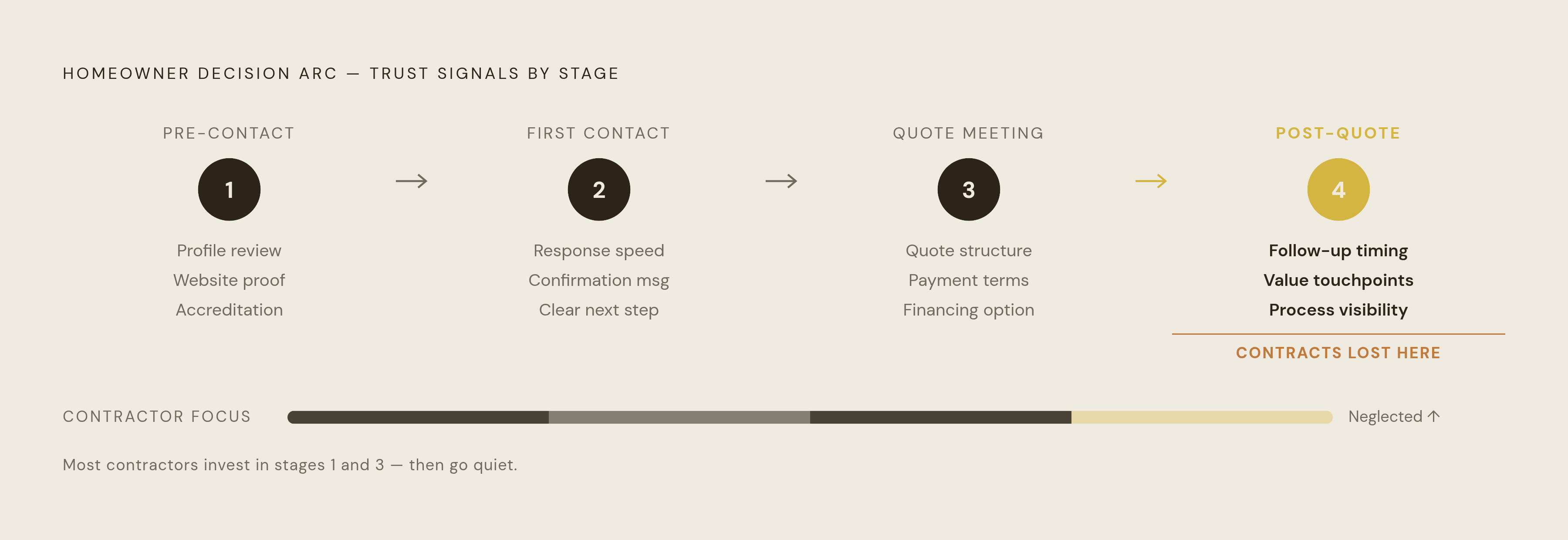
No single trust signal closes a hardscape contract. But each one reduces resistance at its specific stage, and the cumulative effect is substantial. A strong review profile makes the quote meeting warmer. A well-structured quote makes the follow-up feel like service rather than pressure. A fast first response makes the homeowner more receptive to the quote in the first place. The signals reinforce each other, and the sequence matters as much as the individual components.
The decision arc maps to its primary signals. Pre-contact: review profile, website proof, third-party accreditation. First contact: response speed, confirmation message, a specific next step. Quote meeting: quote structure, payment transparency, financing availability. Post-quote window: follow-up timing, value-added touchpoints, process visibility.
Most contractors have gaps. They invest in one or two stages, typically the first impression and the quote itself, then go quiet. The homeowner's confidence, which was building through the earlier stages, stalls or reverses in the silence. A competitor who maintains the trust sequence through the follow-up period often wins contracts they didn't earn on price or on the quality of their initial proposal. They won on consistency.
The contractors who understand this don't treat trust as a single conversation or a single document. They treat it as a sequence: each signal an installment in an ongoing argument that their company is the safe, sensible choice. When that argument runs continuously from the first Google result to the signed contract, the homeowner doesn't experience it as a decision so much as an arrival. They look up and realize they were always going to call this contractor. That's the condition worth engineering.