Hardscape vs. Landscape: What Homeowners Actually Mean When They Search
Homeowners search for landscaping but mean hardscape—and most contractors miss the sale.

Most homeowners typing "landscaping company near me" into Google have no idea they're shopping for a hardscape contractor. They want a patio, a retaining wall, an outdoor kitchen, maybe a fire pit for that slope in the backyard that's been washing out for three years. They just don't have the word for it. That gap between what they search and what they actually mean is where contractors leave real money sitting on the table, and I've watched it happen too many times to call it a coincidence anymore.
What homeowners actually want when they describe these outdoor projects
Nobody picks up the phone and says "I need a segmental retaining wall system with drainage aggregate behind it." The pattern holds consistently across sales calls. They say the slope out back keeps washing out every time it rains. Or they want somewhere to actually sit outside instead of staring at a dead patch of grass all summer.
You start hearing the same three or four callers over and over, honestly. The caller types are recognizable within the first few minutes.
There's the homeowner with a dated, underused yard, maybe just a strip of grass nobody's touched since the house was built, who wants a patio, some defined seating, a fire pit. These jobs tend to carry a meaningful price tag. The homeowner isn't thinking "install hardscape." They're thinking "make this usable," full stop.
Then there's the recently retired couple, equity built up, actual free time for the first time in decades since they're done mowing every Saturday. Permeable pavers, stone steps that don't need reseeding, anything low-maintenance, speaks directly to what they're after: enjoying the yard instead of servicing it.
And there's the new-home buyer, or the person who inherited the family place, who wants it finished. Ready for family, ready for entertaining, outdoor kitchen, pergola, some lighting so it still works after dark. This group cares less about price per square foot and more about whether it feels like it belongs there.
Underneath all three, the questions never change: can I afford this, can I trust the person doing it, will it hold up. Nobody's asking about the difference between hardscape and softscape. That's our word, not theirs.
The project types repeat too, once you've done enough of them. Outdoor kitchens extend usable living space and tend to hold their resale value. Fire pits are a cheap entry point that upsells easily into seating walls or lighting. Retaining walls get described purely as a drainage problem, never as a structural solution, and stone walkways tie the whole yard together. Drainage especially comes up in plain, frustrated language: standing water, a yard turning to mud, a hill that keeps sliding. Nobody's thinking "I need a retaining wall." They're thinking "I need this to stop."
There's also a balance people want instinctively, even without the vocabulary for it. All hardscape and no plantings reads cold, like a parking lot. All plants and no structure reads high-maintenance and half-finished. What they actually want, whether they can say it or not, is something integrated.
The market these searches are drawn from
Worth sitting with the scale for a second. IBISWorld put the U.S. landscape services industry at $188.8 billion in 2025, spread across nearly 693,000 businesses employing more than 1.4 million people. That's not a niche trade. That's a massive, scattered industry with no real center of gravity.
Residential work made up just over half of 2025 landscaping revenue, and that share has been climbing as aging-in-place trends and remote work turned backyards into something closer to essential living space than an afterthought. People are home more. They're staring at their yards more. Money follows attention, eventually.
Maintenance still wins on volume, plain mowing and trimming and seasonal cleanup, the steady stuff most landscaping businesses are built around. But design-build and hardscape are the fastest-growing slice, and the global hardscape market alone was already sitting around $35 billion in 2023.
No single company controls more than a sliver of the landscaping market, and the top players combined still only hold a fraction of it. That's about as fragmented as home services get. No dominant national brand is crowding out the local shop, which means if you're a hardscape-capable contractor surrounded by mowing crews, your ceiling isn't set by competition. It's set by how well you position yourself. That part's on you.
Why hardscape is where the real margin lives
Volume and profit don't live in the same place, and that's the whole point. Maintenance work keeps the lights on through repeat, predictable revenue, but design-build and hardscaping bring in a disproportionate share of revenue relative to maintenance work. The industry-wide profit margin hovers in the low double digits. Hardscape work is well positioned to perform at or above that level.
A contractor who intercepts a homeowner searching "landscaping" and turns them into a $25,000 patio and fire pit build just did, in one job, what a maintenance route grinds out over years of Tuesday visits. Outdoor kitchens, fire pits, pergolas, full backyard entertainment setups: these are trending hard right now, riding the same remote-work shift that pushed residential spending up in the first place.
Pairing with landscape architects to sell full turnkey design packages can capture more of a homeowner's total outdoor budget instead of one slice of it. The mismatch between what homeowners search and what they mean isn't some minor SEO quirk you clean up with better keywords. It's a margin opportunity, and most maintenance-first landscaping companies aren't staffed, or frankly interested, in going after it.
How the search-intent gap actually works in practice
Say a homeowner has water pooling near the foundation, or a slope that keeps eroding after every storm. They search "landscaping company near me" or "yard drainage fix." What comes back is a page about lawn care packages and mulch delivery. Nothing about retaining walls. Nothing about a French drain tied into an actual hardscape system.
Or take the one dreaming about an outdoor kitchen. They search "backyard renovation," land on Pinterest-style inspiration content, magazine roundups, gorgeous photos, and zero path to actually hiring anyone. They're ready to start. Nobody's shown up to say "I'll build that."
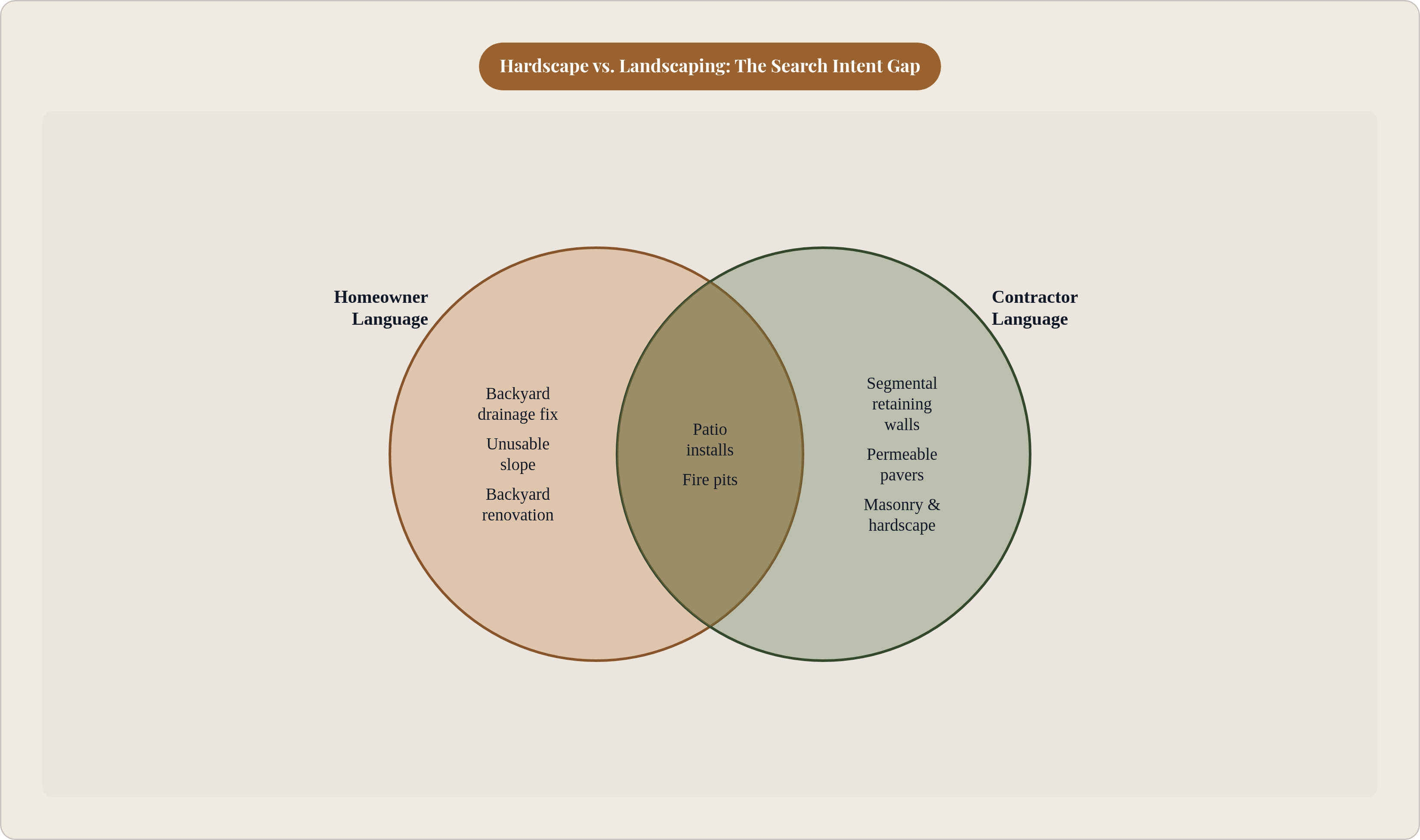
That's the gap, sitting right at the top of the funnel. Intent is hardscape. Language is landscape. Most contractor websites aren't built to connect the two, so a contractor whose site explicitly ties "landscaping" searches to patio installs and retaining walls picks up traffic that a hardscape-only site would never see.
This isn't keyword gaming. It's translation work, plain and simple: taking phrases like "backyard drainage" or "unusable slope" and connecting them to the solutions that fix them. Homeowners running these broad, early searches are usually still in discovery mode. They haven't price-shopped three contractors yet. That's exactly the moment to be standing in front of them, not the moment after.
Where contractors are invisible to homeowners who want them
Most hardscape contractor sites are written in trade language: hardscape, pavers, masonry, segmental retaining walls. Correct terms. Precise terms. And homeowners almost never type them into a search bar during early discovery, so the site might as well not exist for that person.
Position yourself purely as a hardscape specialist and you'll rank fine for something like "paver patio installer near me," a low-volume search from someone who already knows the word. But you'll miss the much bigger wave typing generic landscaping terms. Flip it the other way, and a general landscaping company with no hardscape presence just pulls in maintenance calls, never the $25,000 patio job.
Almost nobody claims the bridge outright. Something as plain as "we build the patios, walls, and outdoor kitchens that landscaping companies call out of scope" sets a contractor apart fast, because it names the gap instead of assuming the homeowner already knows it's there.
Service pages matter more than most contractors give them credit for. A page titled "Backyard Renovation," written to speak the homeowner's language while covering the actual scope of work, does the bridging on its own. Photos do a lot of that heavy lifting too. A before-and-after of an eroding slope turned into a terraced patio with plants tucked around the edges shows a homeowner exactly what they were picturing but couldn't describe.
Even the Google reviews should lean homeowner, not trade. "Fixed our drainage problem and built a beautiful patio" beats "retaining wall installation, 140 linear feet," both for search visibility and for how it reads to someone comparing contractors from their couch at 9pm.
Marketing channels that put a contractor in front of this misidentified demand
Google Local Services Ads and local SEO stay the highest-return channels in this business because they catch someone in the act of searching, not mid-scroll where nobody wants to be interrupted. Intent-based channels convert at rates interruption ads can't touch, and that gap isn't closing anytime soon.
Local SEO plays the long game. Content answering real questions, "what's the difference between landscaping and a patio install, anyway," pulls in broad traffic and slowly walks the reader toward requesting a quote. LSAs move faster: they catch the "near me" searcher at the exact moment of intent. A contractor showing up under both "landscaping" and "patio installation" queries in the same market covers both ends of the gap at once, which very few do.
Reviews close the loop. Most homeowners read reviews before hiring anyone, and the businesses sitting at 4 stars and above pull noticeably more revenue than their 3-star competitors down the street. This is the moment the intent gap either converts into a signed job or just evaporates into nothing.
Direct mail hasn't died either, especially for the retired homeowner with equity and a paid-off mortgage. Physical mail with real project photos still gets read in that demographic. Meta and other social platforms work earlier in the funnel than any of these, showing someone what their backyard could become before they've started searching at all, planting the idea before a competitor even shows up.
None of these work alone. Social builds the vision, SEO catches the search once that vision turns into intent, LSAs close the call, reviews win the side-by-side comparison. Run all four together and you've covered a homeowner from the daydream to the signature.
How fast follow-up determines whether captured intent becomes a signed job
None of the positioning work matters if the lead goes cold before anyone calls back. I'll say that flatly because it's the part contractors skip past.
A homeowner who searches "landscaping," lands on a site, and fills out a form is at peak intent right then, and they're almost certainly filling out the same form on two other contractor sites at the same moment. Speed to response is the most underinvested lever in this entire business. Response speed is one of the most consequential factors in whether a lead converts at all.
Missed-call automation recovers revenue that otherwise just vanishes. A homeowner calls after hours, the phone rings out, and that lead usually goes to whoever answers next on somebody else's list. Automated tools now catch the voicemail and start the follow-up conversation immediately, so the inquiry doesn't die just because it landed at 8pm on a Tuesday.
Here's the operational reality underneath all of it: office staff are on the phone while crews are out on job sites, quotes stack up, and there aren't enough hours to personally chase every "are you available?" text. That's the actual bottleneck, not the marketing.
AI-powered intake tools work in exactly this gap, handling inquiries so response times stay competitive without another full-time hire answering phones. It matters here specifically because everything we've walked through, the vocabulary gap, the margin sitting in hardscape, the channels built to catch it, gets wasted the second an inquiry sits unanswered for six hours. Bridge the messaging gap and then lose the lead to slow follow-up, and you haven't actually captured anything. The marketing and the operations have to move together, or the whole thing falls apart right at the moment it was supposed to pay off.