Financing Options Homeowners Use for Hardscape Projects
Most homeowners need financing, but few know which option actually fits their situation.

Hardscape jobs don't fall apart because the homeowner stopped wanting a patio. They fall apart because the number lands all at once, in one conversation, with nowhere to put it. Angi pegs a curb-appeal refresh around $3,000, a mid-range patio or wall job closer to $9,000, and a full backyard overhaul pushes past $40,000. Techo-Bloc's 2025 U.S. Contractor Survey, built from actual contractor data instead of consumer guesses, puts the typical full-scope hardscape project at roughly $55,000. A paver walkway won't hit that number, but a backyard getting rebuilt from scratch will.
Location changes the math too. Reported figures put a 400 square foot paver patio at $5,500 in Mississippi and past $11,000 in coastal California for the same square footage. "Affordable" doesn't travel well across state lines, and a contractor's read on financing has to bend with the local market instead of leaning on some national average that doesn't apply to the ZIP code they're standing in.
None of this scares homeowners off; it just pushes them toward financing. This Old House and Angi found 61% of homeowners planning 2025 renovations meant to finance the work, which tells you financing is the default plan now, not some fallback for people who can't pay cash. I've watched contractors lose jobs they should've won because they handed over a total and waited for a reaction, instead of walking through what paying for it actually looks like. So that's what this is: the walkthrough I'd give at the kitchen table, over coffee, before anyone signs anything.
How homeowners think about financing before they ever call a contractor
Most people show up with one idea already locked in, something like "I'll use my equity" or "I'll just put it on a card." Rarely do they sit down beforehand and actually weigh a HELOC against a home equity loan against contractor financing; that comparison is on the contractor to introduce, not something the homeowner walks in having already worked out.
I keep running into the same three types. There's the practical backyard upgrader, running a $20,000 to $30,000 project, sitting on some equity, defaulting to HELOC thinking unless a tight deadline pushes them toward something faster. There's the retiree improving the house they plan to stay in for good, often equity-rich but income-light, who qualifies easily for equity products but gets twitchy about a rate that moves with the Fed. And there's the newer or lower-equity owner who lands in personal loan or contractor financing territory almost by default, because the equity door just isn't open for them yet.
Here's the part nobody likes saying out loud: homeowners almost never volunteer which lane they're leaning toward, so you have to ask. I've sat through enough sales calls to know contractors who ask surface it, and contractors who don't leave money sitting on the table, every time, without knowing it.
There's a bigger current running under all this too. Redfin's 2025 data shows roughly 80% of homeowners with mortgages are locked into rates below today's market, and they're not selling. Staying put and improving what they've got is the behavior instead, and that keeps stacking equity higher in the background. More homeowners have borrowable equity sitting right now than at almost any point in recent memory, though a lot of them haven't connected that equity to the backyard they keep mentioning.
Home equity lines of credit: the most common path for homeowners with accumulated equity
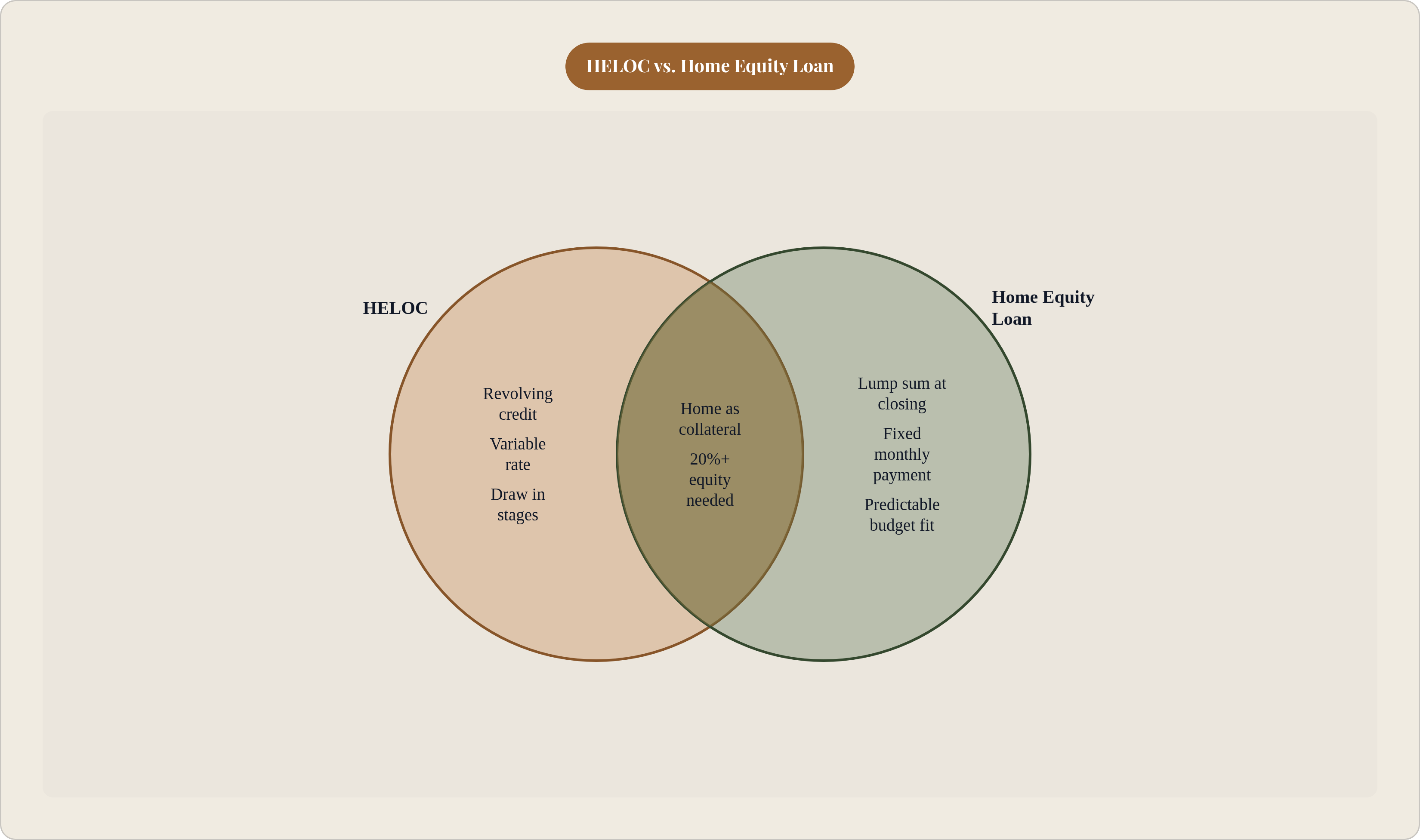
Think of a HELOC as a credit card with the house as collateral: revolving credit, drawn as needed, with a rate that moves with the market. Most lenders cap it at 85% loan-to-value, so a $400,000 home with $200,000 left on the mortgage could unlock up to $170,000 in credit.
Rates have gotten friendlier lately. Curinos had the average HELOC at 7.50% in August 2026, down from close to 9% at the start of 2025, as rate cuts worked their way through the market. LendingTree's network showed 8.00% on a $100,000 line in July 2026, versus 8.50% twelve months earlier. It's moving the right direction, which matters more than the raw number itself.
The best fit is a homeowner with real equity, some comfort with a rate that can shift, and a project that draws money in stages instead of one lump sum. Hardscape now, outdoor kitchen next spring, that kind of thing. A HELOC is still a second mortgage, though, and missing payments puts the house itself on the line. I say that plainly to every homeowner I talk to, because dodging it doesn't build trust, it erodes it, and people respect hearing the real stakes upfront.
There's a tax wrinkle worth knowing too: interest can be deductible when the money goes toward buying, building, or substantially improving the home securing the loan, per IRS rules, and a hardscape project usually clears that bar. The tradeoff is time. Approval and funding typically take several weeks, so if someone wants crews on-site next month, a HELOC is probably the wrong tool for that clock.
Home equity loans: the fixed-rate alternative for homeowners who want payment certainty
The difference from a HELOC is simple: a home equity loan pays out as a lump sum at closing, carries a fixed rate, and produces a fixed monthly payment. It's less flexible, sure, but for a lot of people, knowing the exact number never changes is worth giving up the flexibility.
Curinos had the average home equity loan rate at 7.58% in August 2026. LendingTree's partner network showed 6.62% on 15-year terms, which makes fixed-rate products look genuinely sharp against variable HELOC pricing right now, and that gap is quietly pulling demand toward fixed products. When a household budget is already stretched thin, knowing the exact bill every month beats chasing a rate that starts a touch lower and might climb later.
This fits someone with at least 20% equity who already knows what the project costs and wants zero surprises. Collateral risk is identical to a HELOC's; the home backs it either way, and there's no getting around that. But the tell is simple: a homeowner who says "I want to know exactly what I'll owe every month" is describing a home equity loan whether they realize it or not.
Why cash-out refinancing has largely exited the homeowner's toolkit right now
Cash-out refinancing swaps the whole existing mortgage for a bigger new one and hands the homeowner the difference in cash. It used to be the default way people tapped equity, until the arithmetic killed that off.
With roughly 80% of mortgage holders sitting below today's rates, refinancing into a 6% to 8% range means giving up a locked-in low rate on the entire mortgage balance, not just the chunk needed for the patio. Someone who locked in a few years back would pay meaningfully more in lifetime interest by refinancing than by leaving that mortgage alone untouched. For a hardscape project, that math almost never works.
Which is exactly why HELOCs and home equity loans have taken over as the go-to equity products. They let someone borrow against the house without touching a mortgage that's already working in their favor. So when a homeowner brings up refinancing to cover the project, that's the moment to gently surface the rate tradeoff, and it usually nudges them toward something faster and cleaner instead.
Personal loans: the fastest path without collateral, at a cost
A personal loan is fixed, unsecured, and approved purely on credit. No equity is required, there's no lien on the house, and funds can show up in days instead of weeks.
Speed and simplicity cost something, though. CBS News reported personal loan rates averaging over 12% as of February 2026, well above equity product pricing. Still, the home isn't on the line, and for plenty of homeowners that single fact settles the decision before the rate even comes up.
Speed really is the differentiator. Personal loans and contractor-arranged financing can close in one to five days; HELOCs and home equity loans typically run several weeks. That gap matters when a project has a hard start date, or when a homeowner's comparing two contractors this week and whoever can start sooner wins the job.
This fits newer homeowners without much equity built up yet. It also fits equity-rich homeowners who just don't want to pledge the house, period, no matter what the rate looks like. For smaller jobs, a fence running $1,500 to $5,000, a modest deck, total interest over a short term stays manageable even at the higher rate. That makes personal loans genuinely useful at the low end: a real first choice, not a settled-for option. And when someone has equity but is dragging their feet on committing to a second mortgage, a personal loan can close the deal today instead of waiting on them to talk themselves into, or out of, an equity product.
Contractor-arranged financing: the option that changes the sales conversation entirely
This is the one that reshapes the appointment itself. The contractor partners with a lender or financing platform, and the homeowner applies and finds out if they qualify in the same sitting where they're deciding on the project. Financing decision and project decision stop being two separate meetings held weeks apart.
A few lenders specialize here. Lyon Financial offers $50,000 to $250,000 loans, terms up to 20 years, no home equity required, built specifically around outdoor living work. Synchrony Home, the contractor-facing side of Synchrony Bank, ran 2026 merchant fees at 0% on standard 9.99% APR products, with promotional deferred-interest terms ranging 3.99% to 11.99% across 12- to 60-month windows. Some point-of-sale lenders are also designed to keep the application process light, which lowers the bar for even asking the question out loud.
Approval isn't a given, though. Underwriting tightened hard after 2024, and approval rates dropped 8 to 12 points across most contractor programs in 2024 and 2025, hitting the 660 to 700 FICO band the worst of all. A contractor leaning on one single lender in that band is quietly losing deals they don't even know they're losing. Working with a lender or platform that spreads approval across a wider network protects conversion right where it's most fragile.
Here's what actually changes the appointment: when a homeowner evaluates a project by the monthly payment instead of the total, they stop shaving scope to save upfront dollars. The patio stays full size instead of shrinking to fit a number that scared them at first glance.
The numbers back this up. A review of more than 11,000 real home improvement sales appointments found financing came up in fewer than 20% of them. When it was introduced consistently, though, close rates ran nearly five times higher, and average sale sizes were meaningfully larger, compared to appointments where financing never came up at all. The pattern holds across the industry: contractors who consistently offer financing see higher close rates and bigger average tickets. Bring financing up early and it shapes how the homeowner sees the whole project, not just how they'll eventually pay for it.
How to read a homeowner's financing fit before the proposal conversation
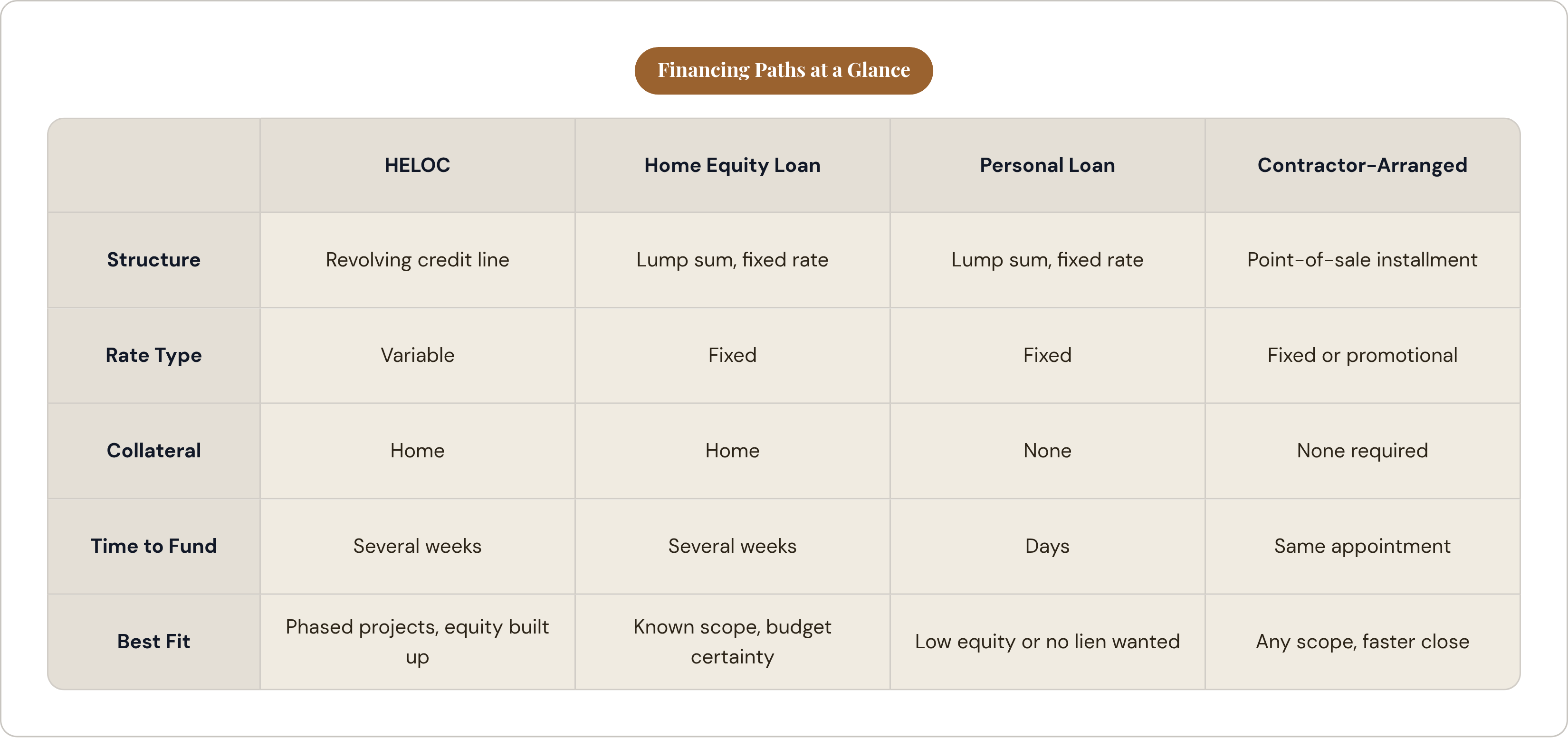
Four things tell you almost everything before the proposal's even drafted.
Equity comes first: how long have they owned the place, and has anything come up about their mortgage? Timeline comes second, since equity products take weeks to close while personal loans and point-of-sale financing take days, and that gap alone can decide which product actually fits. Risk tolerance is third; any hint of "I don't want to touch the house for this" points straight at a personal loan or contractor financing, a preference worth respecting rather than talking someone out of. Project size rounds it out. Scopes above $20,000 make fixed-term equity products or outdoor-specific lenders like Lyon Financial worth the wait, while smaller jobs make a personal loan the simpler call.
One question does most of the work: "Have you thought about how you'd like to handle payment, or would it help to walk through a few options?" It isn't pushy; it just opens a door the homeowner was already standing in front of, waiting for someone to open.
Know these five paths, HELOC, home equity loan, cash-out refi and why it's fallen off, personal loan, contractor-arranged financing, and you can match the homeowner to what actually fits instead of pushing whatever's easiest to pitch that week.
Mid-2026's rate environment rewards contractors who act on this. Equity rates have eased off their 2024-2025 highs, home equity sits at record levels, and the structural reason behind it, people locked into low mortgage rates and staying put, isn't reversing anytime soon. These financing conversations are happening with or without the contractor in the room. The choice is really just whether you're in the room for it, or finding out later that a competitor was.