What Paver Patio Installation Actually Costs in 2026
Professional paver patios run $4,000 to $16,000 depending on size and materials.
Most homeowners spend somewhere between $4,000 and $16,000 for a professionally installed paver patio, which works out to roughly $12 to $40 per square foot for materials and labor combined. That band reflects standard site conditions and conventional materials. It is not the floor, and the ceiling sits considerably higher.
Size is the first variable that organizes the numbers. A small patio around 100 square feet runs $1,200 to $4,000. A medium patio around 300 square feet lands between $3,600 and $9,000. A large patio around 500 square feet climbs to $6,000 and beyond, sometimes reaching $16,000 before a single upgrade is introduced. A 400 square foot patio built with a quality branded product, the kind of mid-tier residential job that makes up a significant share of a paving contractor's book, typically runs $12,000 to $16,000, or $30 to $40 per square foot.
The national averages cited in trade publications often land around $3,350 to $3,800 for approximately 280 square feet. That number reflects a population of simple builds that pulls the average downward, and quoting off it without context is how contractors end up either walking a project or eating margin. Mid-range residential work, jobs that involve thoughtful material choices and a professional crew, routinely exceeds it.
The per-square-foot rate also compresses as size increases. A 12-by-12 patio and a 20-by-20 patio do not scale linearly in cost because mobilization, base preparation, and crew time are not fully proportional to surface area. Larger projects spread fixed costs across more square footage — think of it as the difference between splitting a pizza two ways versus eight ways: the pizza does not get bigger, but each slice goes further. That arithmetic is worth explaining to homeowners who are on the fence about going bigger, because it is one of the few places where spending more actually improves the unit economics.
How Material Choice Sets the Floor and Ceiling on Installed Price
Material selection alone can move the installed cost from the low end of the range to more than double, before a single site condition enters the picture. That is a function of how differently materials price at the supply level and how differently they behave under a saw blade. Choosing the wrong material for a fixed budget is like buying a sports car when you budgeted for a sedan — it still gets you somewhere, just not as far as you planned.
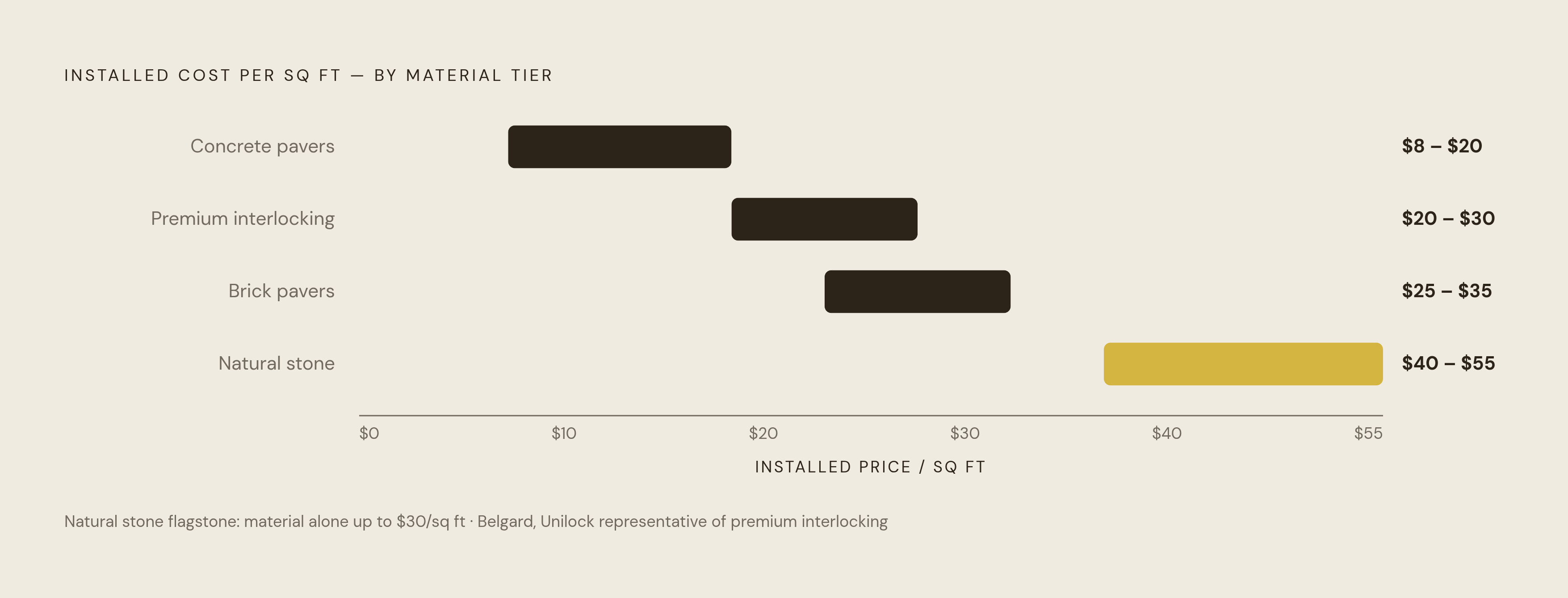
On materials alone: concrete pavers run $4 to $6 per square foot and represent the most widely used option. Brick and clay pavers sit at $4 to $8 per square foot, with a classic aesthetic and a narrower format palette. Premium interlocking pavers from manufacturers like Belgard and Unilock run $5 to $10 per square foot; their dimensional consistency reduces installation time and improves finished quality. Natural stone runs $7 to $16 per square foot for most varieties, with flagstone reaching $13 to $30 per square foot depending on source and thickness.
When you fold labor into those material costs, the installed price ladder becomes clearer. Concrete pavers anchor the low end of the installed range. Brick installs in the $25 to $35 per square foot range. Natural stone installs at $40 to $55 per square foot, sometimes more when the stone is irregular and requires hand-fitting.
A pallet of pavers covers roughly 100 to 160 square feet and costs between $335 and $1,165 depending on material type and supplier. That single data point is useful for helping a homeowner visualize what they are buying before the full quote is assembled.
What homeowners frequently miss is that the labor picture changes with the material, not just the supply cost. Irregular stone requires more cuts, more fitting, more time. A homeowner who selects natural stone at a modest square footage is not getting a less expensive job; they are getting a smaller slice of a more expensive pie. For contractors working with a homeowner on a fixed budget, material tier is the primary dial. Switching from natural stone to premium concrete pavers on a 400 square foot project can shift the total by thousands of dollars while preserving most of the visual impact.
What Labor Actually Costs and Why It Varies as Much as the Materials Do
Labor runs $50 to $80 per hour, or $4 to $11 per square foot, and accounts for 40% to 60% of total installed cost on professionally executed projects. A standard 300 square foot patio takes a professional crew roughly 35 to 40 hours to complete. Typical crew configuration is two to four workers over two to four days for a patio in the 200 to 300 square foot range, though that shifts with access and material type.
Regional variation is significant and often counterintuitive to homeowners who price-shop across markets. Southeast crews generally run $40 to $60 per hour. Northeast crews run $70 to $110 per hour per crew. That spread alone can shift the total cost of an otherwise identical project by thousands of dollars. It is geography, not negotiation leverage. Labor rates follow the same logic as real estate: location, location, location.
When a general contractor coordinates a larger outdoor renovation, their oversight adds a meaningful percentage to total cost above the base installation. That is a real line item on a real invoice, and it should appear in any quote where a GC is involved, not surface as a surprise at the end.
Labor is not a fixed percentage of project cost. It flexes with pattern complexity, site access, and regional rates. Treating it as a flat markup is how contractors erode margin on their more intricate jobs, because those jobs demand proportionally more hours per square foot installed. A crew that budgets a herringbone pattern the same way they budget a running bond will spend two unplanned days on site before they understand what happened to the profit.
The Site Conditions That Add Cost Before the First Paver Is Laid
Base preparation is not optional. Four to six inches of compacted gravel base plus one inch of leveling sand is the standard for a paver installation that holds up over time. What varies is how much base material a project actually needs, and that is determined by what is under the ground before anyone shows up with equipment.
Clayish subsoil requires more aggregate than sandy subsoil because it holds water and moves with freeze-thaw cycles. Two projects with identical footprints and identical materials can require meaningfully different base volumes based purely on soil composition. This is something a site visit reveals. A phone quote cannot.
Slope is the other pre-installation variable that adds cost in ways homeowners rarely anticipate. If a yard slopes toward the house, regrading to redirect drainage away from the foundation is not cosmetic; it is structural. Site grading can run from a few hundred dollars to several thousand depending on the scope and severity of the grade issue.
Access matters too. A backyard with a narrow gate, an elevated deck, or difficult terrain costs more to work in because material staging and equipment transport take longer. Demolition of an existing concrete patio adds $2 to $6 per square foot to the scope; a 300 square foot replacement project, including demo and new paver installation, typically runs $8,100 to $12,300. Permits, required by most municipalities above a certain patio size, run $100 to $300 in fees and add a timeline variable that belongs in every client conversation from the start.
These are the line items homeowners are least aware of and most surprised by. A contractor who surfaces them early does not risk losing the project; they build the credibility that wins it.
How Design Complexity Multiplies Labor Costs on Otherwise Similar Projects
A simple rectangular layout with a running bond pattern is, from a labor standpoint, as efficient as paver installation gets. Cuts are minimal, lines are predictable, and a skilled crew moves quickly. That is where the low end of the labor range lives for any given material tier.
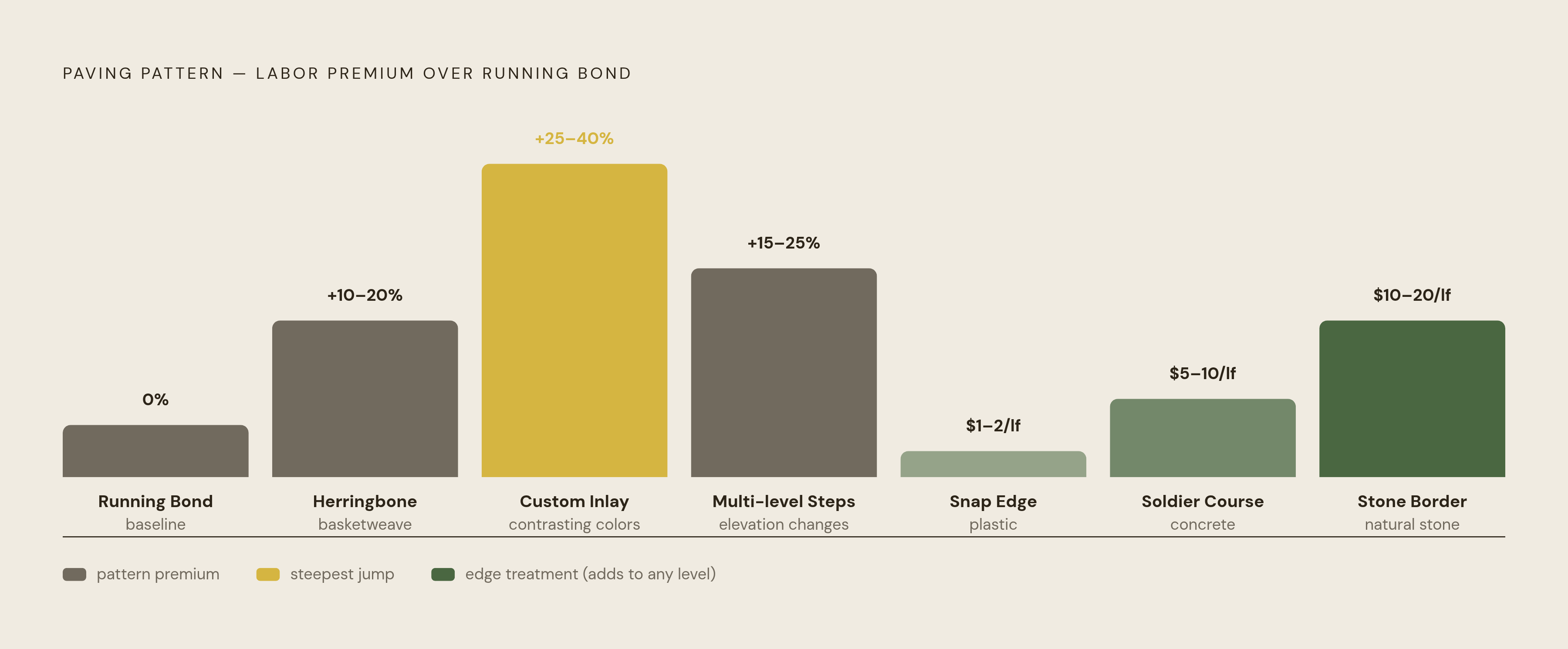
Complexity adds cost in measurable increments. Herringbone, basketweave, and circular patterns require more cuts and more time, adding roughly 10% to 20% to labor costs. Custom patterns with contrasting colors or inlaid designs can add 25% to 40% to labor, and they generate more material waste, which affects the supply order. Multiple levels or steps, common on sloped sites where grade change is both a site challenge and a design opportunity, add 15% to 25% to the final price.
Edge treatment is its own cost variable and compounds whatever pattern premium is already in play. Plastic snap-edge restraints run $1 to $2 per linear foot. A concrete soldier course border runs $5 to $10 per linear foot. A natural stone border can reach $10 to $20 per linear foot. On a large or irregularly shaped patio, the perimeter is long enough that edge treatment becomes a meaningful budget line, not a footnote.
Design complexity is also a value conversation, and contractors who treat it that way close more of these jobs. Intricate patterns represent visible craftsmanship, the tangible difference between a professional installation and something a motivated homeowner can approximate over a long weekend. Pricing that premium transparently, and explaining what produces it, is what keeps a complex job from feeling expensive and starts making it feel worth it.
What Outdoor Living Add-Ons Do to a Project's Total and Its Value Proposition
A paver patio is a surface. The add-ons are what make it a place people actually want to be, and they are also what convert a mid-range project into a higher-scope engagement. If a bare patio is the opening line, the add-ons are the punchline that makes the whole joke land.
The reference points are concrete. A paver seating wall runs $50 to $100 per linear foot. A built-in gas or wood fire pit runs $1,500 to $5,000; a freestanding unit runs $300 to $800. An outdoor kitchen rough-in starts around $5,000; a full outdoor kitchen runs $6,000 to $22,000. A professionally installed pergola lands between $2,100 and $6,000. Landscape lighting runs $80 to $300 per fixture. A covered patio or roof structure ranges from $3,000 to $20,000 depending on materials and whether it is new construction or a retrofit.
A paver patio with a fire pit is the configuration most homeowners end up describing when they explain what they actually want. That combination runs $6,000 to $22,000 for most residential builds, with simpler iterations at the lower end and custom multi-feature builds with gas lines and integrated seating walls reaching $15,000 to $25,000 and beyond.
This is where the high-end tier of the original range, $15,000 to $35,000 or more for a 400 to 800 square foot outdoor living space with natural stone and integrated features, stops looking like an outlier. The homeowner who asks for a patio quote is, in many cases, the homeowner who will spend well into the five figures or more once the full scope is on the table. What they want to do in the space determines where the project actually lands. The initial number just opens the conversation.
How Contractors Use This Cost Structure to Quote Accurately and Sell Confidently
The wide cost range exists because each variable, material tier, site conditions, design complexity, add-ons, layers onto the base in a predictable sequence. A contractor who can walk a homeowner through that sequence is doing two things at once: building an accurate quote and building the homeowner's confidence that the number reflects reality, not improvisation.
Start with size and material to anchor a realistic range. Use the site visit to surface the base-prep, access, and demo variables that published averages ignore entirely. Use the design consultation to identify pattern and complexity premiums before they become change orders. Use the add-on conversation to expand scope based on what the homeowner actually wants to do in the space, not just what they initially asked for.
The homeowners most likely to invest in high-value paver work, those upgrading a dated outdoor space, retirees investing in livability, new owners finishing a property, are also the most responsive to a contractor who explains what they are buying and why it costs what it does. They are not hunting for the lowest number. They are looking for a number they can trust, from someone they believe arrived at it honestly.
Speed matters here too. The interval between site visit and delivered proposal is one of the clearest signals of professionalism a homeowner observes before a single paver is moved. Contractors using purpose-built estimating tools can move from site assessment to a detailed, multi-option proposal faster without sacrificing the accuracy that makes those proposals defensible.
The contractors who win high-margin outdoor living projects are not the ones with the lowest bids. They are the ones whose pricing made sense to the homeowner. The cost structure described here is already present in every job. Knowing how to walk someone through it is the skill that closes it.