Change Order Pricing as a Margin Recovery Tool
Most contractors underprice change orders and never collect payment for half the work.

Change order pricing is the fastest way to recover lost margin, and almost nobody prices it right. The gap between what a change order should cost and what actually lands on the invoice is where profit disappears, quietly, on jobs that look totally fine on paper until the very end.
The home services market keeps growing, sure, but a lot of contractors net way less than their estimate promised. That gap doesn't come from bad bids; it builds up during execution, one under-priced scope change at a time. I've spent fifteen years staring at job cost reports, and change orders are the biggest leak I've ever found, bigger than material waste, bigger than callback labor, bigger than almost anything else on the report.
Here's the pattern I keep running into: a project closes with five change orders, every single one shows a profit line, and the job still finishes in the red. Costs tied to those changes scatter across a dozen cost codes, and nobody ever circles back to add them up and pin them on the change that caused them. So the change orders look great on the summary page, and the base contract quietly eats a loss that nobody in the room can point to or explain.
Material costs have outrun change order pricing for years now. Roofing materials, steel, aluminum, it's all moved fast, and every unrepriced scope addition on an active job takes a bite out of margin whether anyone notices or not. I've heard PMs say "change orders are where we make our money" more times than I can count, and almost none of them have the job costing to back that up. They're guessing, and usually they're wrong.
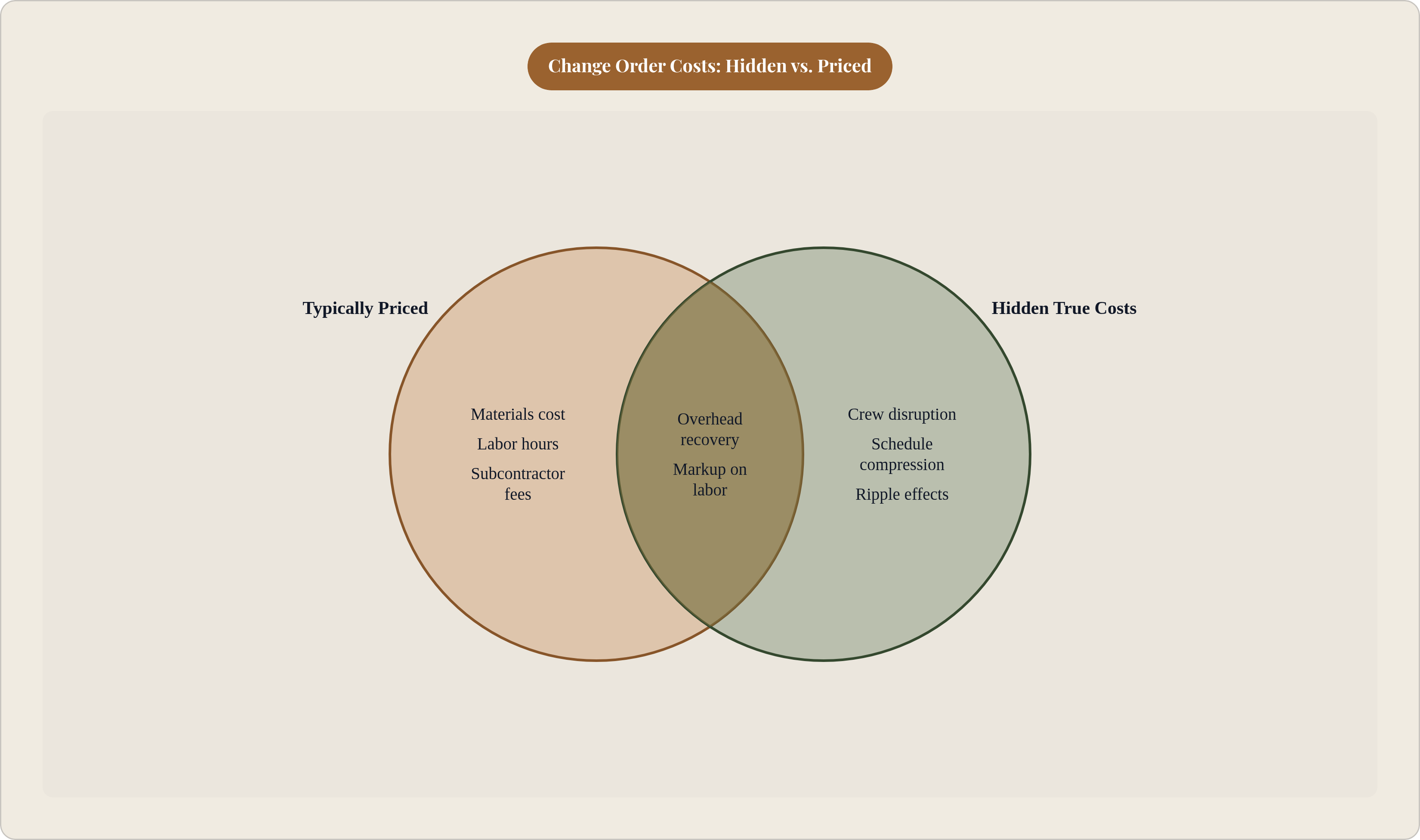
What change orders actually cost versus what contractors typically price into them
Ask a PM what a change order costs and you'll get materials plus labor hours. That covers only a fraction of the real cost.
Here's what gets left out, every time:
- Crew disruption. Stopping a productive flow, walking the new scope, re-sequencing the day; that's real time, and almost nobody logs it anywhere.
- Coordination overhead. Phone calls, revised drawings, re-briefing a sub who already had a plan for the day and now has to throw it out.
- Schedule compression. A change pushes the downstream trades, and now you're compressing a timeline that was already tight, which raises the odds of rework later.
- Ripple effects. A change in one part of the project often kills productivity in the scope right next to it, even though nobody touched that scope at all.
The NRCA has documented that unmanaged scope growth pushes total project costs well past the original contract value, sometimes by a wide margin. The compounding effect of a dozen small changes drives that number, none of which looked dangerous by itself.
Then there's the "while you're at it" trap. A homeowner asks for one more outlet, one more paver course, one more little thing while the crew's already standing there. Feels trivial in the moment, but over the life of a project, those small verbal asks stack into a real block of labor that never gets invoiced. On a moderately complex remodel, I've seen undocumented changes eat up close to a tenth of the original contract value: work that got done and never got paid for, sitting there, gone.
The core problem is invisibility. None of these hidden costs land in a cost code labeled "change order impact," so the PM reports the change order as profitable and the owner believes him. Meanwhile the base contract absorbs a loss that shows up in the final numbers with no clear cause attached to it, and everyone shrugs and blames the weather.
The markup logic that actually recovers true incremental cost
Most contracts cap change order markup at a combined overhead-and-profit rate somewhere in the low to mid teens. That number was built to cover direct cost plus a thin margin on clean, sequential, planned scope, which is exactly the opposite of what a change order is.
Contractors who've actually tracked change order profitability against true cost end up needing markup well above that boilerplate rate just to break even on the disruption, let alone make money on it.
Here's a floor-up way to price one correctly. Start with your overhead recovery rate: take annual overhead and divide it by realistic billable hours, not total hours in the year, and that number usually lands higher than what most owners think their overhead costs per hour. Add direct labor at fully burdened cost, meaning wages plus taxes, insurance, and benefits, not just the wage rate sitting on the paycheck. Price materials at current replacement cost, not the number frozen in the original bid; if lumber or aluminum moved since you signed the contract, your change order price has to move with it. Add subcontractor costs with your standard markup on top, then layer in a disruption allowance, either a flat fee or a set number of crew hours, on every change order regardless of size.
Last step, and this is the one people skip: apply overhead and profit markup to the full subtotal, not just the materials line. A lot of contractors mark up materials and shrug at labor, which is backwards, because labor disruption is almost always the bigger cost.
The disruption fee deserves its own line item or its own markup tier. Skip it, and every change order you write quietly subsidizes the overhead it creates. If your contract language caps change order markup below what true cost recovery requires, that clause carries real financial risk. Renegotiate it at the next renewal, and fix it in every contract you sign after that.
Treating change order approval as a system, not a negotiation
The most common failure isn't underpricing a change order. It's never getting the thing signed at all.
Verbal approvals aren't approvals. The homeowner remembers a friendly conversation on the driveway; the contractor remembers a commitment. At invoice time, neither one matches, and the contractor's the one holding unpaid work. Most contracts also set a deadline for submitting change order pricing after the directed work gets identified, often just a few weeks. Miss that window and you can lose the legal right to collect, even with the work finished and sitting right there in plain sight.
A repeatable system fixes this, and it runs in the same order every time. Identify the scope change the moment it's requested, not at the end of the week when someone's reconstructing it from memory. Document the site conditions that triggered the change while they're still fresh and visible. Price it from a standardized template, not gut feel or a number pulled off the top of somebody's head. Present the written documentation before any work on the changed scope starts. Collect written approval, a signature, an email, a digital acceptance, before the crew proceeds. Bill it separately from the base contract and track it through to closure.
How you frame the policy matters almost as much as the policy itself. "This is how we protect your project from cost surprises" turns the whole process into a client benefit, and clients respond to that framing well because, honestly, it's true.
No exceptions, ever. "Just this once" is the exact phrase that breaks the system. One undocumented change normalizes the next one, and a few jobs later the system's gone, replaced by whatever people remember from the driveway.
The metric that tells you whether this is working is your change order recovery rate: the share of scope changes that get documented, approved, and invoiced. The gap between changes that happened and changes that got paid is donated margin, and it's a number you can actually pull if you're tracking it properly.
How to present a change order so the client approves it rather than disputes it
A change order the client doesn't understand is a change order they're going to fight. Presentation functions as a closing tool here, full stop.
The clearest presentations show three things in plain language: what changed, why it changed, and what it costs. Use the original scope as the reference point. "Here's what was in the original contract, here's what's different now, here's the cost impact." That structure makes the delta legible, and it makes the number defensible instead of arbitrary.
Name the disruption fee out loud. Don't bury it inside a lump markup and hope nobody asks about it. A client who sees "disruption and re-sequencing fee: $340" with one line explaining it pushes back far less than a client staring at an unexplained 22% markup sitting on a materials line with no context.
The homeowners in this world, people investing in outdoor living space, retirees upgrading a property, new owners personalizing a place they just bought, are making real financial decisions with real money. They respond well to feeling informed, and they respond badly to feeling ambushed. Contractors who meet price pushback with a specific value justification, explaining exactly what the cost covers and why it's fair, close a much bigger share of change orders than the ones who default to discounting the number or just quietly eating it.
Speed matters more than most PMs think it does. A change order presented the same day the change gets identified reads as good project management. The identical change order presented two weeks later reads as an ambush, even though the price hasn't moved an inch.
Digital tools close some of this gap. A clean PDF, a client portal, a digital signature workflow; these make the whole interaction feel more professional and cut down the friction of getting the signature before work starts, instead of chasing it after.
Job costing discipline that makes change order margin visible after the fact
None of this matters if you can't see it once the job closes. A contractor who doesn't track change orders separately from the base contract can't tell a profitable project from a break-even one. The numbers blend together, and the problem stays invisible for years, sometimes for the life of the company.
Change orders need their own cost and revenue line: separate code, separate margin calculation, separate review at close-out. Every completed project should be able to answer a short list of questions. How many change orders happened, and how many got documented and approved? What's the total value of approved changes against the total value of every change that actually occurred, approved or not? Did each one recover its real cost, disruption included, and did the base contract perform to estimate, or did change order chaos drag it under?
When gross margin comes in below estimate quarter after quarter, the diagnostic almost always points to one of three places: scope creep that never got invoiced, change orders approved verbally but never enforced on paper, or job costing that didn't allocate overhead honestly. Change orders touch all three at once, which is exactly why they're worth fixing first, before you go chasing anything else.
A quarterly review of material costs, overhead rates, and markup assumptions catches drift before it compounds into something bigger. It's an hour of work that saves a full quarter of squeezed margin, and most owners skip it anyway because it feels administrative instead of urgent, right up until the numbers come in ugly.
The contractors who fix this fastest run change order creation, client approval, and job cost tracking through one connected workflow instead of a spreadsheet, a text thread, and a filing cabinet full of unsigned paper. I've seen that shift alone turn a guessed-at recovery rate into a number an owner can pull up on a Tuesday morning and actually manage, the same way he'd manage labor cost or material waste, and the change order line stops being a mystery and becomes something he can act on.