Material Cost Volatility and Hardscape Bid Protection
Escalation clauses let contractors protect margins when material prices spike between bid and build.

Material prices moved faster than bid prices through 2025 and into 2026, and hardscape contractors ate the difference. This piece is the playbook for protecting against that again: contract language, quoting habits, and supplier moves that keep a price swing from turning your job into charity work.
What an unprotected bid actually costs when prices move
There's a specialty steel contractor case I keep coming back to. The bid was submitted with no escalation clause, and an owner-caused delay pushed mobilization out four months. Procurement landed right in the middle of a price spike. The material cost increase on that fixed-price bid was big enough, in percentage terms, to flip a planned profit into a net loss bigger than the original margin would have been. That's a whole job going upside down.
And here's the part that stings: the delay came from the owner's side, not from any planning mistake on the contractor's part. The contractor had no lever to pull, no clause to point to, no way to say "the price changed, so the number changes too." He just absorbed it.
Scale that down to a backyard job. A patio, retaining wall, or outdoor kitchen quoted in early spring might mobilize in late summer. That's a normal timeline, not an aggressive one, and it's also months of exposure to steel, concrete, and lumber prices you don't control. Regional contractor groups have already reported jobs getting rebid or cut down in scope after material quotes came back way over what was budgeted, because time passed and prices moved, not because anyone miscalculated. The 2025 ASG National Workforce Survey found a real share of respondents had projects canceled, postponed, or scaled back over rising costs, and tariffs came up specifically as a driver for a chunk of them.
Smaller shops feel this harder. You don't have the inventory buffer a national firm has, and you don't have a long-term supply deal locking your steel price for the year. You're buying at spot price, mostly, which means you're the one absorbing the swing.
So let's be clear about what's actually happening when you hand a homeowner a fixed number with no protection built in: you're giving them a price guarantee, and you're the one financing it if the market moves against you.
How escalation clauses work and what to put in one
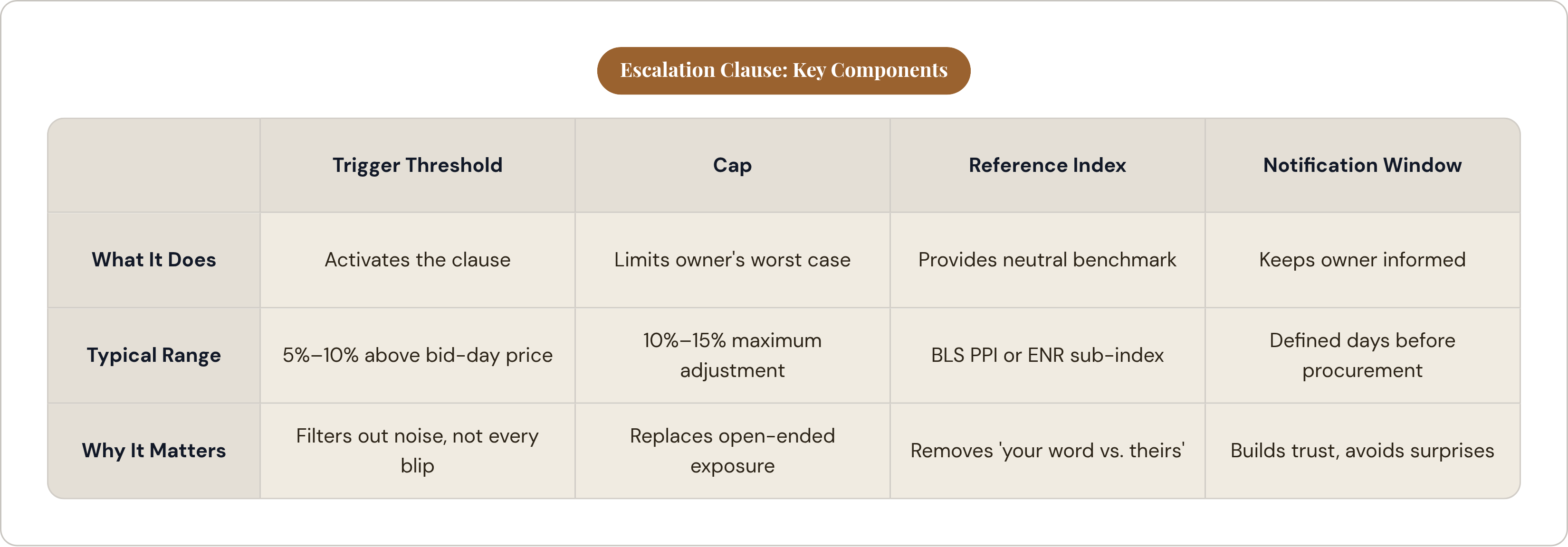
An escalation clause lets your contract price move if material costs move past a certain point between the day you sign and the day you actually buy the materials. The details are where it gets useful.
There are two ways to build one. A cost-based clause compares what you actually paid at procurement to what you estimated on bid day, which is simple, but it means you need to keep your invoices straight and be ready to show them. An index-based clause ties the adjustment to a published number, like the BLS Producer Price Index or an ENR construction cost index. It's harder for a homeowner to argue with a government number than with your invoice, so I lean index-based whenever I can.
Every clause needs a few working parts:
- Trigger threshold, the percentage jump that turns the clause on. Most contractors land somewhere between 5% and 10% above the bid-day price.
- Cap, the ceiling on how far the adjustment can go, usually 10% to 15%. This matters because it gives the homeowner a known worst case instead of an open-ended number.
- Reference index, named specifically, such as BLS PPI "Inputs to Nonresidential Construction," or the steel or concrete sub-index under it.
- Documentation, meaning supplier invoices plus index readings pulled on bid day and again at procurement.
- Notification window, spelling out how fast you tell the homeowner once a trigger looks close.
Build it so it works both directions. If prices rise, the price goes up, and if prices fall before you procure, the price comes down. This is a fairness measure and a framing tool: 34 state DOTs now allow material price adjustments on highway contracts, many using this exact hybrid structure with a cap. That's mainstream enough to mention to a skeptical homeowner without sounding like you're inventing a loophole.
Go back to that steel contractor. Run his numbers with a properly written clause in place, cap included, and the loss turns into a profit. The clause wouldn't recover every dollar, but it would recover the majority of it, which is the difference between a bad year and a project that sinks the company.
One more thing: skip the soft language, because "significant increase" and "market conditions" mean nothing in a dispute. Name the index, and name the number. Courts want that, and so does the homeowner once they actually read the page.
How to bring an escalation clause into a residential conversation without losing the job
Here's the part most contractors get backwards. They think adding an escalation clause makes the bid look riskier, so they either skip it or they inflate the base number to cover themselves just in case. Both moves cost you the job or cost you margin.
Flip it. Without a clause, you're pricing for the worst case that might happen, which means your baseline number is padded and less competitive. With a clause, you price to today's actual cost and let the clause absorb the tail risk. That's a lower number on the page, which is exactly what wins bids against a competitor who's padding blind.
Homeowners fall into a few buckets, whether it's the couple upgrading the backyard on a budget, the retiree improving quality of life at home, or the family renovating a legacy property. All of them worry about the same thing: getting surprised by a number after they've already committed. The clause answers that worry as long as you explain it as a ceiling instead of a blank check.
So walk them through it in order. Start with what's locked: labor, design, layout, scope. Then explain what moves and why, in plain terms: "Steel and concrete prices are being set right now by tariff policy in Washington and global supply chains, not by me and not by you." Then name the cap out loud: "The most this number can move is 12%, and only if the government's own price index moves that much before I place the order." Then give them the upside: "If prices drop before I buy, your price drops too."
Break out steel, concrete, and lumber as separate line items in the written quote. When a homeowner can see exactly which materials carry the risk, the clause stops looking arbitrary and starts looking like basic bookkeeping. Vague percentage ranges with no cap, or a clause buried on page four of the contract where nobody reads it, are what kill trust. That's how you turn a fair protection into a fight.
Quote-validity windows and why shortening them protects margin
Suppliers have already adjusted to this environment. A lot of material suppliers now reprice monthly, some biweekly, and in a genuinely volatile stretch, a supplier quote might only hold for two weeks. Meanwhile most contractor proposals still say 30 or 60 days, a number that made sense five years ago and doesn't match anything happening on the supply side today.
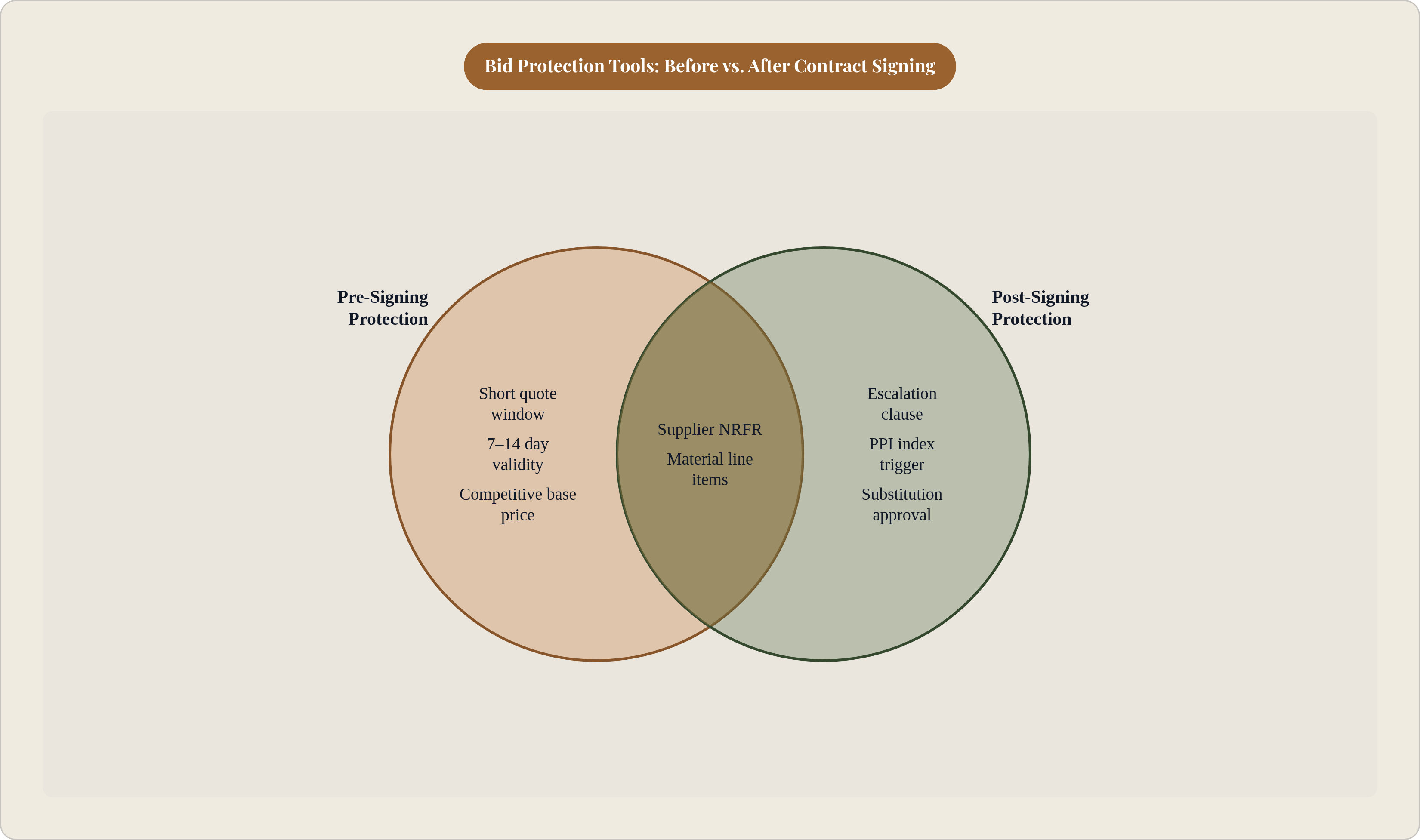
Match your window to the market. In a high-volatility stretch, keep proposals with steel, concrete, or lumber good for 7 to 14 days, no more. In calmer periods, 21 to 30 days is fine, but only if you've also got the escalation clause doing the work after signing. Think of it as two layers: the short window protects you before the contract's signed, and the clause protects you after.
Frame the short window as market fact, not personal urgency. Something like: "My supplier holds this price for two weeks, so that's how long I can hold mine." That's true, it's specific, and it takes the pressure off you personally.
Put the validity window in a named field at the top of every proposal template, not buried in the fine print, and make it something you point to out loud in the closing conversation. Done right, it creates a real reason for someone to decide soon, without you having to manufacture urgency you don't actually feel.
Procurement timing as a margin tool: when to buy ahead and how to do it
If you can see prices rising, locking in your material cost ahead of mobilization turns a risk into a margin buffer. A mid-size GC in the research locked in a large steel order in late 2025, right before prices jumped hard in early 2026. Storage cost him a little, but the price protection saved him a lot.
The tool for this is called NRFR: Not Ready for Release. You lock the price with the supplier now, then schedule delivery for whenever the job actually mobilizes. It takes a real supplier relationship and usually a credit line, since you're committing to a purchase before you need the material in hand. It works best on steel, concrete block, and pavers, the items with longer lead times and the most price swing.
This isn't for every job. It works when you already have a signed contract, because buying ahead speculatively before a job is even awarded is its own gamble. You need somewhere to store the material, or a supplier willing to hold it on your account. And cash flow is a real limit for smaller shops, so if you can't do this today, treat it as something to build toward as your supplier relationship gets stronger, not a tool you need on day one.
Right now, the materials worth locking in early are steel edging and structural components, concrete pavers if your local lead times run long, and specialty masonry pieces that only a couple of regional suppliers carry.
Build a fallback into the contract too. Get written approval upfront, before you break ground, for swapping a specified material to an approved equivalent if procurement pricing spikes unexpectedly. Negotiate that flexibility at signing. Trying to get it approved mid-project, under pressure, with a homeowner already anxious about cost, is a much harder conversation.
Using PPI data and regional cost indexes to build defensible bids
The BLS Producer Price Index is free, it updates every month, and it breaks down specifically enough to be useful for hardscape work. Look at "Inputs to Nonresidential Construction," and the sub-indexes for steel mill products, concrete and cement, and lumber and wood products. Using the PPI as your reference index in an escalation clause means nobody can argue with the number, since it's a federal publication, not your opinion.
For regional detail, ENR's construction cost indexes fill the gap the PPI leaves. National averages hide a lot. Southern and Midwestern markets have seen smaller increases in steel and cement than coastal metros in recent stretches, and freight and diesel costs widen that gap further. If you're bidding in a lower-cost region and benchmarking against a national number, you're either scaring homeowners with a price that's too high or leaving contingency on the table you didn't need to leave.
The workflow here takes five minutes: pull the relevant PPI reading the day you submit the bid, save it in the job file, and use that number as your baseline for any escalation math down the road. It's a small habit that leaves a clean paper trail.
When you're the one explaining a price adjustment to a homeowner, naming a government index instead of your own judgment removes the "is he just padding this" question before it gets asked. The trigger is external, and you didn't set it. You're just tracking it.
One limit worth knowing: the PPI tracks categories, not your specific supplier's specific product. Use it as the trigger, not as your only proof of actual cost change. Pair it with your supplier invoices and you've got a record that holds up either way.
Supplier relationships and the structural advantages of being a reliable buyer
National firms get inventory buffers, long-term supply contracts, and preferred pricing tiers that an independent hardscape contractor isn't going to match at the same scale. That gap is real. But it's narrower than most small contractors assume, and it closes based on behavior, not size.
What suppliers actually want from you: consistent order volume, payment they don't have to chase, and advance notice of what's coming. Being predictable matters more here than being big.
Share your project pipeline with your main supplier, even loosely, 60 to 90 days out. That gives them room to flag a good pricing window before it closes. Ask them directly for a heads-up before price sheets change; a lot of suppliers know a shift is coming before it shows up on paper. Push for an NRFR arrangement as a standing option you can use whenever you need it, not something you have to negotiate fresh every time. And put your volume with fewer suppliers instead of shopping every single order around. Even modest, consistent volume sends a signal that gets you better treatment.
Don't go all-in with one supplier though, since sole-source dependency is a risk of its own in a market this volatile. Keep a second, qualified supplier lined up for the materials that matter most, concrete pavers and steel edging especially, so you've got somewhere to turn if your primary's price spikes or their lead time stretches out.
This compounds. The contractor who moves fast, pays on time, and keeps suppliers in the loop on upcoming work is the one who gets protected when allocation gets tight and everyone's calling for the same truckload of rebar. That relationship doesn't show up on a normal day. It shows up on the worst day of the year, which is exactly when you need it to.
Pulling the playbook together into a quoting and contracting workflow
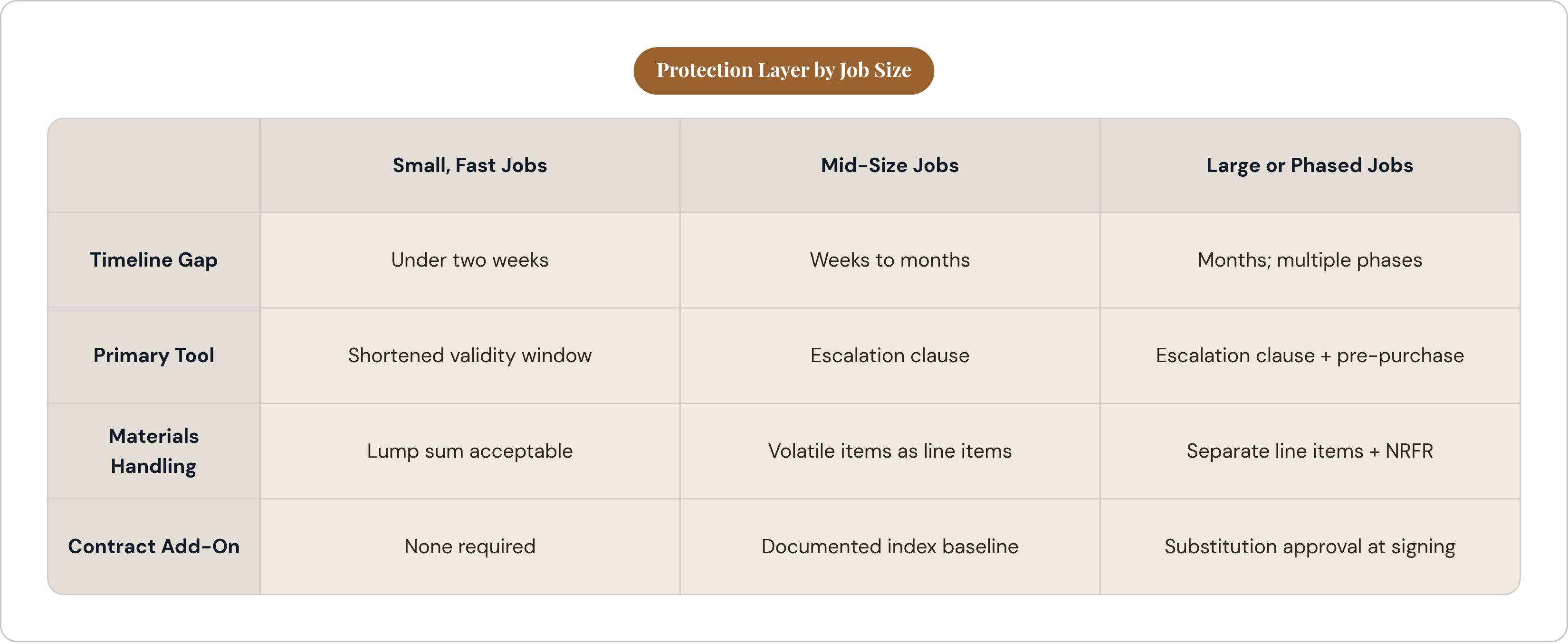
None of this needs to run on every job. Match the level of protection to the level of exposure, and you'll save yourself a lot of paperwork on the jobs that don't need it.
Small jobs moving fast, under two weeks from quote to mobilization, a shortened validity window alone is probably enough. Mid-size jobs with a real gap between signing and starting need the escalation clause, a documented index baseline, and volatile materials called out as their own line items. Large or phased jobs deserve the whole kit: escalation clause, pre-purchasing on the materials you can lock in, an NRFR arrangement with your supplier, and substitution approval written into the contract before anyone breaks ground.
At the proposal stage, the sequence is simple. Pull current PPI readings for the categories you're using and drop them in the job file. Flag which line items carry the most exposure and list them separately instead of burying them in one lump sum. Set the validity window explicitly, right in the proposal header, where it can't be missed or argued about later.
That's the whole system: know your exposure, name your numbers, and never hand out a fixed price you can't actually stand behind for the length of time it takes to build the job.