A Paver Base Calculator Operators Can Actually Trust for Bids
Correct base sizing prevents costly callbacks and underbids on paver jobs.

The base layer does three things: distributes load across the soil below so point pressure doesn't cause settling, moves water away from the surface to prevent pooling underneath the pavers, and resists frost heave through freeze-thaw cycles. Every one of those functions depends on the base being sized correctly. Undersizing doesn't produce an immediate failure. It produces a slow drift, a surface that settles unevenly, pools water in the wrong places, shifts pavers out of alignment two winters from now. By then you're back on-site for a remediation job that eats the original margin and then some. I've seen it happen on jobs where everything looked fine at punch-list.
Most generic calculators treat the base as a single layer. It isn't. There are two distinct components: the compacted crushed stone base, which handles structural support and drainage, and the bedding sand layer above it, which creates a smooth, level surface for setting each paver. Conflating these two into one depth figure is not a simplification; it is a structural misunderstanding baked into the tool from the start.
Material selection is another variable most calculators ignore. Angular, fractured crushed stone, called Crusher Run, DGA, or ABC gravel depending on your region, interlocks under compaction in a way that rounded river rock or pea gravel simply cannot replicate. The interlocking is the point. A tool that accepts any material input without flagging this distinction leaves a critical decision to chance, which is fine for a weekend project and genuinely problematic for a commercial bid.
The base must also extend beyond the finished paver field on all sides. Skip this and you get what some call the teeter-totter effect: edge units with no support beneath them pivot on the restraint below, and the edge of your installation starts lifting within a season. This means the area you calculate for material should reflect the actual dug footprint, not the finished surface dimension the homeowner measured off their deck. The base also needs to pitch away from adjacent structures at a consistent grade, which affects excavation depth planning. That variable is absent from nearly every tool designed for homeowners.
How Application Type Sets Base Depth, and Why a Single Default Ruins Driveway Bids
Base depth is not a judgment call made on-site. It follows the load the surface will carry, and those loads are not remotely equivalent across application types. A patio sees foot traffic. A residential driveway carries passenger vehicles. A heavy-load application handles RVs or commercial equipment. The ICPI established minimum depth recommendations for each category for a reason, and the numbers differ meaningfully between them.
A calculator that applies a single default depth will price a patio accurately and systematically underprice every driveway and commercial bid it touches. That's not a random error; it's a directional one that consistently hits the higher-value jobs hardest. A driveway bid built on patio depth assumptions is underordering material on exactly the work where getting the base right matters most, both structurally and financially.
What a contractor-grade tool should provide is a project-type selector that loads the appropriate depth standard automatically, not a blank field that asks the user to recall the correct number under the time pressure of assembling a bid. That's the wrong moment to be consulting a reference chart. I've watched experienced guys second-guess themselves on depth specs mid-estimate and just go with what felt right. Sometimes they were correct. Sometimes they weren't, and they didn't find out until the order was already in.
One thing no calculator can fully resolve: soil conditions. Expansive clay, poor drainage, and heavy frost exposure can push depth requirements beyond standard minimums. A tool built for field professionals should, at minimum, prompt the user to consider whether site conditions warrant an independent assessment. That prompt alone distinguishes it from a tool that treats every job like a level, well-drained suburban backyard.
The Compaction Factor: The Single Most Common Reason Material Orders Come Up Short
Loose crushed stone compacts significantly under a plate tamper. A contractor who orders the volume needed for the finished compacted depth will always come up short. Always. It is the default outcome when the compaction factor is omitted, and it happens on job sites constantly, not just among beginners.
A reasonable allowance is roughly a fifth more than the compacted depth implies, though the precise factor varies by material gradation. On a mid-size patio, this difference translates to a real gap in cubic yards. On a large driveway, it can exceed a full cubic yard; at bulk landscape supply pricing, that represents genuine dollar cost and, more critically, a schedule risk if a second delivery becomes necessary. A crew standing around waiting for a stone delivery is not an abstraction. It's a real afternoon, and you're paying for it.
DIY calculators typically output the finished-depth volume and stop there. The assumption is that the user knows to add more. Most homeowners don't know this, which is forgivable. Contractors who rely on the same tool and miss the omission are building a structural shortfall into their bids and calling it an estimate.
A contractor-grade calculator applies the compaction factor automatically and outputs the adjusted order quantity: the number that goes on the purchase order, not the theoretical finished-installation volume. There is also a separate conversion requirement for bedding sand. Bulk deliveries are often subject to local axle-weight limits, and sand is commonly ordered by weight rather than volume. Converting cubic yards to tons is a practical field necessity, not a secondary interface feature.
Pattern-Based Waste Factors: Where the Paver Count and the Base Calculation Both Go Wrong Together
Cut patterns generate waste. The type of pattern determines how much, and field experience confirms the logic pretty reliably.
A simple stack bond produces minimal waste, with cuts running along a single axis. Running bond adds a modest waste allowance and is the baseline for most residential patio work. Basket weave and standard herringbone patterns introduce moderate waste as cuts become more varied. Diagonal herringbone and other angled layouts carry the highest standard waste factors, because every edge of the field involves a cut at an angle that produces a remnant. Curved or irregular layouts sit outside any general assumption; they require a careful field measure and a conservative estimate made by someone who has actually stood at that site.
The compounding error works like this: a paver count built on a waste-free area estimate comes up short mid-job. The contractor faces a second delivery fee and the real risk of a color-lot mismatch. Color variation between production batches is visible, especially in natural-toned or variegated products. It is the kind of thing a homeowner notices immediately and mentions every time someone asks for a referral. A single purchase order that includes the full waste allowance eliminates this risk. Splitting the order to reduce the initial estimate is false economy, every time.
Base area calculations are affected too. The dug footprint extends beyond the finished paver field, and pattern-driven oversize cuts mean the working area often exceeds the nominal square footage entered into a basic calculator. A tool that accepts pattern type as an input and applies a corresponding waste factor is doing real estimating work. A tool that applies a flat waste percentage regardless of pattern is approximating, and approximations accumulate across a season into margin loss that doesn't announce itself on any single bid.
How to Read a Worked Base Calculation as a Bid Cross-Check
A mid-size residential patio of roughly 200 square feet, built in running bond with standard concrete pavers, is a useful reference case because every variable is visible at a scale that's easy to follow.
The calculation runs in a specific order. Start with the dug area, not the finished paver area; extend all sides to account for edge restraint and the perimeter zone that prevents edge-unit tipping. Convert gravel depth from inches to feet, multiply by the dug area in square feet, divide by 27 to reach cubic yards, then apply the compaction factor to arrive at the loose-material order quantity. Calculate bedding sand separately: it is a thinner, distinct layer with its own density and a rule-of-thumb volume per square foot that differs from the gravel base. Calculate paver count from the finished surface area, apply the waste factor appropriate to running bond, and round up to a full pallet or bundle. Partial orders are logistically inconvenient and often more expensive per unit.
The cross-check habit worth building: run the calculator before the bid, then run it again before calling in the material order. The second pass reconciles the estimate against any field-measure revisions made during the sales process, and dimensions change more often than anyone wants to admit. A homeowner walks the space with you and decides the patio should extend to the edge of the second tree rather than the first. Small on the ground, meaningful on the material order.
For jobs above a few cubic yards, bulk delivery from a landscape supply yard is substantially more economical than bagged product. A contractor-grade calculator should output quantities in both cubic yards for bulk ordering and tons for weight-limited deliveries. The bag-count output is a DIY feature. The cubic yard and tonnage output is what the purchase order actually needs.
What Separates Contractor-Grade Calculator Tools from DIY-Oriented Ones in Practice
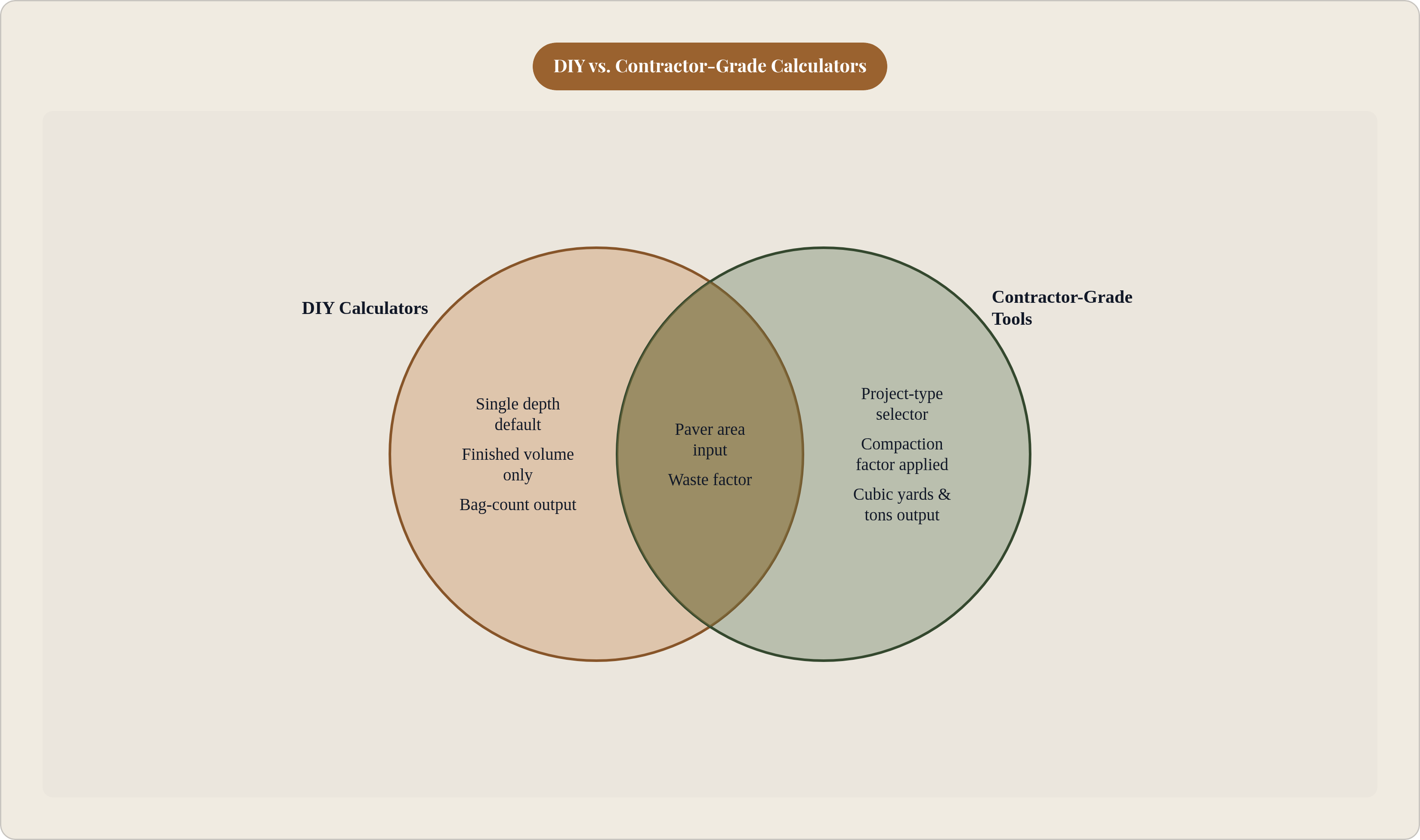
The minimum feature set for a contractor-grade tool is not a long list, but every item on it matters: a project-type selector that loads appropriate depth standards for the application; automatic compaction factor applied to gravel volume, outputting the order quantity rather than the compacted-depth volume; separate layer calculations for gravel base and bedding sand; a pattern-type selector with corresponding waste factors; output in both cubic yards and tons; an area input that reflects the dug footprint with a clear prompt about extending beyond the finished surface. These are not enhancements. They are the baseline for a tool that is actually usable on a real job.
Unilock's Speed-Calc is a manufacturer-integrated example built for contractors and dealers rather than homeowners. It calculates required bundles and layers from area and measurements, incorporates a wall calculator for combined-scope projects, and runs on mobile, which matters when you're quoting in someone's backyard and don't want to carry a laptop.
BuildVision AI positions its calculator for bid-time use. It converts square footage to paver count with pattern-appropriate waste factors and outputs a full material section covering compacted aggregate base, bedding sand, and polymeric joint sand. The stated intent is that contractors use it at bid time to lock quantities and again before ordering to reconcile against the final field measure, which mirrors the two-pass habit that protects margin.
Some platforms built for hardscape and home service contractors connect material quantities to quoting, lead follow-up, and job operations so that the output of a base calculation feeds directly into a deliverable bid rather than sitting in a spreadsheet waiting to be manually transcribed somewhere else.
The practical test for any tool: run it on a job you have already completed and compare its output to what you actually ordered. If the compaction factor and pattern waste are not reflected in the numbers, the tool is systematically underquoting your real material costs. That test takes ten minutes.
Turning Accurate Base Calculations into Bids That Protect Margin
A consistent shortfall in base material calculation is not a one-job problem. It is a systematic margin drain across every bid that uses the same flawed inputs. The individual dollar amounts per job are not alarming on their own. Across a full season, they are, and the drain is largely invisible because no single bid fails dramatically enough to force a reckoning.
The specific points where miscalculation costs real money: a mid-job material reorder with a second delivery cost and a crew standing around waiting; a color-lot mismatch on that reorder that becomes a visible quality problem the homeowner mentions to everyone; underpriced driveway and commercial bids where the depth difference between application types represents substantially more material than a patio default implies; and labor estimates that don't account for the additional compaction passes a correct base depth actually requires.
Accurate calculation also changes how you talk to clients, and this part matters more than it gets credit for. A contractor who can explain why the base depth for a driveway was sized differently than a patio, and what that means for longevity a decade out, sounds like someone who has seen installations fail and knows exactly why. Homeowners making a meaningful investment in their property respond to that specificity. It justifies pricing above the lowest competing bid without you having to say a word about price. The knowledge does the work.
Run the contractor-grade calculator at bid time, run it again before placing the material order, and send a single purchase order that includes the full waste allowance for pavers. Do that on every job, without exception.