Which Hardscape Jobs to Decline and How to Say No
Flat bids on hardscape jobs hide the real costs that kill your margins.

Hardscape gross margins typically run between 35 and 50 percent, which sounds comfortable until you've watched a single bad job erase three good ones. Materials exposure is real and project-specific. Hardscape labor is specialized. And project duration means one miscalculation compounds across days or weeks, not hours.
The flat bid is where most of it goes wrong. You price a fixed number, then the crew pulls back sod and finds a buried irrigation line nobody mentioned, or the grading doesn't match what you walked during the estimate, or drainage reveals itself as a genuine structural problem and not a minor consideration. You absorb the difference. Every time. Time-and-materials with a consistent markup protects against this; a flat number does not. A fixed price has no mechanism to recover costs from conditions that were invisible at the estimate stage.
Permit fees are a quieter version of the same problem. Many municipalities require permits for hardscaping, retaining walls, and grading, and those fees are real costs. When they're left out of scope, they compress margin without ever showing up on any line item you can point to later.
Subcontractor costs work the same way. On hardscape jobs, sub costs are directly attributable to individual projects. When a sub gets called in mid-job to resolve something unanticipated, the impact is immediate. A job that looked fine on paper can finish the week at breakeven, or below, because an unexpected scope condition required outside help you hadn't budgeted for.
The $15,000 patio job can still hurt you badly. If the crew spends two days on callbacks fixing drainage that was never properly scoped, the gross margin number in the accounting software is irrelevant. Margin doesn't disappear at invoicing. It disappears during scoping, when risk isn't priced or isn't acknowledged at all.
Client Signals That Predict a Bad Job More Reliably Than the Scope Does
A homeowner who opens the conversation by referencing a competing bid that's 30 percent below yours is not presenting a negotiation opportunity. They're telling you what they value. The shortcuts that make a competitor's bid 30 percent cheaper, thinner pavers, lower-grade base gravel, drainage infrastructure skipped entirely, don't disappear when you match the price. They become your callbacks, your crew's second visit, and your reputation problem on that street.
Vague scope requests that escalate are worth taking seriously. "Can we make this a bit better?" without specifics is not an organic creative conversation. It's an early indicator of a client who will grow the job verbally, mid-project, without acknowledging that growth has a cost. Scope creep doesn't announce itself as a problem; it announces itself as enthusiasm. By the time it's clearly costing you, the calendar is full, the crew is stretched, and the margin has already gone.
Clients generally don't resent fee adjustments for scope changes. What they resent is surprises. A client who bristles at a change-order conversation before work even starts is showing you exactly how they'll respond when you bring one to them in week two. That's not speculation. That's the job telling you what it is.
Generic material specifications are a subtler signal, but a consistent one. When a client can't articulate grade, thickness, or material preference during the proposal phase, they're almost always shopping on price. They'll resist upgrades later not because the upgrade isn't warranted, but because they came in with a number and the number was always the point.
The question worth asking before every proposal: is this client buying a result, or buying a price? Those are different engagements entirely. Conflating them is where the trouble starts, and it starts earlier than most contractors want to admit.
The Four Job Types Hardscape Contractors Should Decline by Default
Jobs Priced Below Your Breakeven Rate
Every job priced below your cost floor loses money. Taking more of them doesn't fix the problem; it accelerates it. The breakeven rate isn't a rough sense of what feels fair. It's a calculated number, and contractors who operate on intuition here systematically underprice because intuition discounts overhead, quietly absorbs callbacks, and forgets about the jobs that didn't go cleanly.
When the gap between your number and a client's reference point is material, whether from a competing bid or a neighbor's patio from three years ago, that gap rarely closes through negotiation without sacrificing scope. If the scope gets sacrificed, the quality follows. And then you own the result regardless of whose expectations were unrealistic.
Flat-Bid Projects With Unresolved Site Unknowns
Difficult grading, unlocated utilities, drainage that hasn't been properly assessed: each of these is a potential margin wipeout on a fixed price. The correct response to a site with genuine unknowns is to price the uncertainty explicitly into the bid if you can actually quantify it, switch to time-and-materials, or decline. There's no other option that works, and the contractors who keep searching for one find the answer in their year-end numbers.
Scope-Undefined Projects From Clients Who Resist Written Specifications
A client who won't commit to a written scope in the proposal phase is telling you the scope will expand verbally once work begins. Hardscape jobs, even at the modest end of the range, carry enough materials and labor exposure that running them on a handshake is a structural error, not just a communication preference. Risk doesn't disappear because it isn't written down. It just transfers to you.
Work Outside Your Crew's Demonstrated Capability
A retaining wall engineered to hold back a significant slope and a decorative courtyard patio are technically distinct projects. The crew and equipment that performs at a high level on one is genuinely wrong for the other. Taking a project that requires subcontractors you don't have established relationships with, or skills your crew is developing during the job itself, transfers the learning cost directly to your margin and to the client's outcome.
Specialization is the structural alternative to this problem. Contractors who narrow to drainage solutions, outdoor living structures, or specific material systems become the obvious choice for those jobs and an equally obvious pass for work outside that range. The client gets referred somewhere better suited to their project. That's not a loss for anyone.
Using Capacity Honestly as a Reason to Decline
Declining because you're genuinely booked is straightforward. Declining because you're nearly booked and the job doesn't merit the slot requires more honesty with yourself, and that's where real discipline lives.
A crew booked more than four days out is already signaling a hiring trigger. Taking marginal jobs in that window delays the hiring decision while quietly degrading the quality of everything else in the queue. I've seen contractors accept a mediocre job on a slow Thursday and spend the next three weeks wishing they hadn't, because a better one came in Friday morning and there was nowhere to put it.
Capacity-based declines are not losses. They're forcing functions. They surface whether the pipeline has enough quality work to justify selectivity, or whether marketing and lead generation need attention. Contractors who use capacity as cover for avoiding the harder question, whether this job is actually worth taking at all, miss the chance to tighten their job mix as the business matures.
The revenue-per-employee gap between maintenance-heavy operators and hardscape-focused contractors reflects not just regional market conditions but the compounded effect of job selection discipline over time. That gap is built at the proposal stage, one decision at a time, repeated across years.
How to Say No: The Language and Timing That Preserve the Relationship
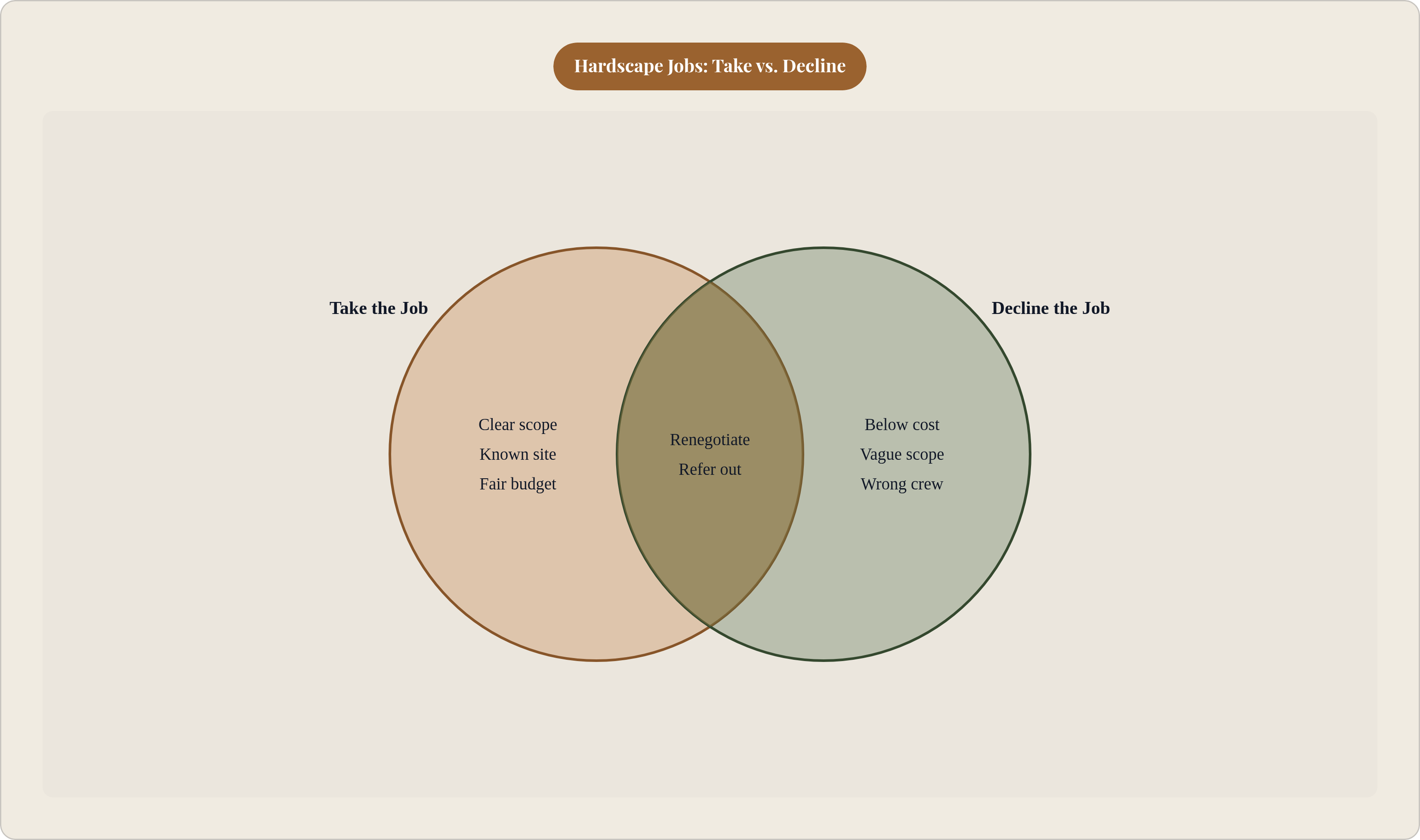
Before you say anything, decide what you're actually communicating: is this a no, or a not-under-these-terms?
A not-under-these-terms decline keeps the door open. The timing doesn't work. The rate is below what the project requires to be done properly. The scope needs to be defined before you can commit. These are honest positions that give the client something to act on rather than a rejection to absorb and resent.
A clean no, when the client fit is wrong or the project type is outside your scope, should be direct. Ambiguity doesn't protect the relationship. It delays the client's ability to find the right contractor, which is actually the one useful thing you can do for them at that point.
For a budget issue, name it plainly: "This project as scoped would require a budget closer to X to be done properly. If that's workable, I'd like to talk further." That sentence gives the client real information and treats them like an adult capable of making decisions with accurate data.
For a fit issue, "not the right match for our work" is clear and complete. It avoids the social evasion of "we're very busy right now," which invites a callback in three weeks and creates a follow-up loop that wastes everyone's time, including yours.
Return the call even when the answer is no. The contractor who calls back promptly and declines professionally is remembered. The one who goes silent is not. In a referral-driven business, the homeowner who received a clear, respectful no is more likely to send a referral than one who spent two weeks waiting on a response that never materialized.
One more thing worth saying: avoid the price-yourself-out approach as a primary filter. Quoting high to discourage an undesirable client occasionally backfires. Some clients accept the inflated number, and now you own a job you didn't want at a rate that still doesn't justify the crew time, the scheduling burden, or the reputational exposure. A direct decline is cleaner than a price signal that misfires.
Timing matters more than most contractors acknowledge. A decline at the inquiry stage costs essentially nothing. A decline after a site visit is a mild inconvenience. Backing out after a proposal has been submitted damages the relationship and your standing in the local market. The earlier the no comes, the lower the cost to everyone involved.
How a Tighter Job Filter Connects to the Leads and Pipeline You Build Upstream
Selectivity is only sustainable when lead flow is consistent enough that declining one job doesn't trigger a cash-flow concern. Contractors who struggle to say no usually have a pipeline problem, not a willpower problem. The discipline to decline follows from having enough good work coming in that you can afford to let the bad work go.
The upstream fix is attracting the right clients before the phone rings. The homeowner investing in a backyard for the next twenty years, the client who came in asking about craftsmanship rather than comparing quotes: these are the profiles where hardscape value is clearest and price resistance is lowest. Marketing that speaks to transformation and longevity filters inbound leads before the first conversation happens.
Speed-to-lead is the operational variable most small hardscape operations get wrong. Businesses that respond to inbound leads quickly convert a substantially higher percentage of them into appointments. The lead arrives while the crew is in the field, nobody answers, and a competitor does. Automated text follow-up and after-hours intake can capture inquiries that would otherwise go to voicemail, ensuring every qualified lead is captured before a competitor gets there first.
A tighter job filter raises average project value. Higher average project value funds better marketing. Better marketing generates better leads. Better leads make the filter easier to apply. The whole system rewards selectivity, but only once the pipeline is healthy enough to support it. Building that pipeline is the prerequisite. Protecting it with a principled filter is the practice that compounds.