Change Order Pricing and Documentation on Hardscaping Jobs
Subsurface surprises and owner additions demand distinct pricing strategies and documentation.

General construction has its standard triggers: design inconsistencies, late-stage scope clarifications, owner-requested additions, material substitutions, regulatory requirements discovered after signing. All of those apply here. But hardscaping work has its own category of changes that deserve explicit attention, because they are both common and genuinely difficult to anticipate at bid time.
Subsurface surprises are the most disruptive. Rock that wasn't on the geotechnical report, unsuitable soils that require removal and replacement, buried utilities not shown on any plan: all of these halt work, require immediate decisions, and cost meaningfully more than the equivalent work originally scoped. Grade conditions that differ materially from what the bid documents represented are a close second. When the actual topography of a site diverges from the survey or the design drawings, every calculation from excavation to drainage to wall height is affected simultaneously.
Irrigation lines and drainage conflicts uncovered during excavation are routine on established residential properties. The original installer rarely documented runs with any precision, and no amount of pre-bid due diligence fully eliminates the risk. Then there are owner additions mid-project: the patio gets extended by a few hundred square feet, a retaining wall section gets added, the material specification gets upgraded after the homeowner sees a sample in person. These are not failures of planning. They are the natural behavior of clients who are making real decisions about their property for the first time, often under the influence of seeing things take shape in front of them.
Here is the thing, though: these are predictable categories even when the specific instance is not. You will hit rock on some percentage of jobs. You will find irrigation conflicts on some percentage of jobs. Owners will ask for additions on some percentage of jobs. I have never run a full season without at least a handful of each. Treating scope change as the exception rather than the norm is the first and most damaging mental error a hardscaping contractor can make. It leads to underpriced contingencies, inadequate contract language, and a posture of genuine surprise when a change materializes, which is the worst possible headspace for a conversation about additional money.
One more thing worth stating plainly: changes always cost more than equivalent work priced in the original bid. They disrupt the planned flow of the job. They require remobilization. They pull crews off their rhythm and create scheduling ripple effects on other active projects. The extra cost is not padding. It is the real cost of work that was never planned, and it deserves to be priced accordingly.
How to Price a Change Order: Choosing Between Lump Sum, Unit Price, and Time and Materials
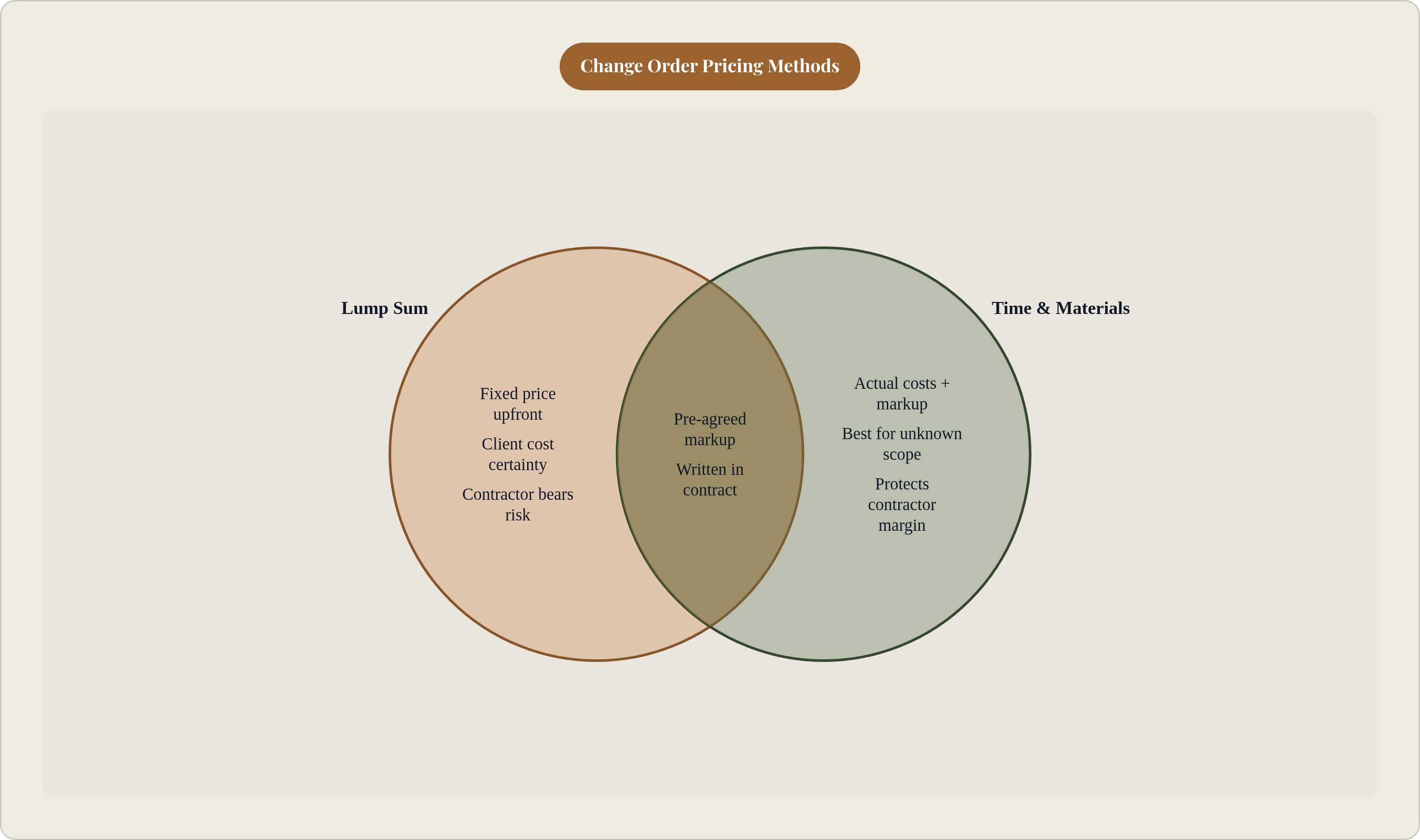
The pricing method for a change order should follow the clarity of scope at the moment of negotiation. Not habit, not client preference, not whatever method the original contract used by default. The method that matches the conditions of the specific change is the right method.
Lump sum is a fixed price negotiated before work begins. It works when the changed scope is fully defined and measurable before anyone picks up a shovel. It gives the client cost certainty, which they generally prefer, and it gives the contractor a clean margin target if the estimate is accurate. The risk is that any miscalculation in the estimate falls entirely on you. Use it when you can measure and price the change with genuine confidence, not just approximate confidence.
Unit pricing is a fixed cost per measurable unit: per square foot, per linear foot, per ton of material hauled. It works when the type of work is clear but the quantity will not be known until the work progresses. Retaining wall extensions, paver additions, grading adjustments where the final footprint shifts as the site reveals itself: these are natural unit price situations. The client knows what they will pay per unit, the contractor knows the margin on each one, and quantity risk is shared rather than absorbed entirely by one party.
Time and materials is actual labor and material costs plus a consistent, pre-agreed markup. It is the right choice when scope is genuinely uncertain at the time of agreement. In hardscaping work where subsurface conditions, difficult grading, or irrigation conflicts reveal themselves incrementally, T&M keeps the risk of the unknown off the contractor's margin. Giving a flat bid on work with real uncertainty means you absorb every cost overrun. That is not a risk worth accepting when T&M is a legitimate and widely understood pricing structure, and most experienced clients recognize it as such.
Whichever method is chosen, it must be written into the change order document explicitly. Ambiguity about pricing structure is its own source of disputes, and it is entirely avoidable.
The Markup Trap That Quietly Erodes Profit on Change Order Work
Margin and markup are not the same number. Confusing them is one of the most consistent causes of underpricing on change orders, and it compounds quietly over an entire season of jobs.
Markup is a percentage added to total cost to arrive at the selling price. Margin is the percentage of the selling price that remains after all costs are accounted for. The margin is always a smaller percentage than the markup used to produce it. A contractor who targets a specific gross margin must apply a meaningfully higher markup to their costs to actually achieve it. These two figures are not interchangeable, and treating them as if they are means consistently leaving money on the table, sometimes by a lot.
The stakes are higher in hardscaping than in some adjacent service categories. Installation and design-build work typically carries higher materials exposure and longer job durations than maintenance work, which means the margin on each project must absorb more potential variance. Getting this calculation right is more consequential here, not less.
Many construction contracts contain markup caps, often expressed as a combined overhead and profit limit. Those caps, as written, frequently do not cover true costs when overhead allocation, mobilization, and disruption are factored in. For work performed by subcontractors and supervised by a general contractor, additional markup on the sub's pricing is often restricted further. The discipline required is knowing your actual costs, including the ones that are easy to overlook in the moment, before agreeing to any cap. Hardscaping and design-build work commands higher gross margins than commodity landscaping precisely because of the specialized skill and materials involved. Change order pricing should reflect that positioning without apology.
What a Fully Defensible Change Order Document Must Contain
A change order document that cannot survive a dispute is not a change order. It is a memo. The distinction matters when payment is withheld.
The signed form itself must contain authorized signatures from all parties: contractor and owner at minimum, and any additional parties required by the contract. It must contain an explicit description of the scope change, what is being added, removed, or modified, written with enough specificity that a third party reading it for the first time would understand exactly what work is in scope. It must state the agreed price and the pricing method used. It must note any adjustment to the project timeline.
Behind the form, the itemized cost breakdown should list labor, materials, equipment, subcontractor costs, overhead, and profit as separate line items. Supporting documentation from suppliers or subcontractors should be attached wherever applicable. A form with a total price is easy to challenge; a form backed by supplier quotes and subcontractor invoices is substantially harder to dispute. I have seen more than one change order argument end the moment a stack of dated supplier quotes hit the table.
Drawings or sketches of the change, signed alongside the written document, close the most common gap in hardscaping change order disputes. A sketch that corresponds precisely to the scope description leaves very little room for a client to later claim the work performed was different from what was agreed. It sounds like extra effort. It is less effort than a mediation.
The contemporaneous paper trail is the final layer: written records of all related communications, daily logs recording labor, materials, and equipment used on the changed work, and site photographs taken before, during, and after. Written notifications issued to the owner before the formal change order was signed document that the contractor flagged the issue in writing even if the paperwork followed shortly after.
The change order document should be as detailed about the change as the original contract was about the original scope. Not a summary. A record.
Notice Timing and the Contract Clauses That Can Void an Otherwise Valid Claim
Most construction contracts contain notice provisions. The contractor must notify the owner within a defined window after discovering a condition that gives rise to a change. Missing that window can extinguish the right to compensation entirely, even when the underlying scope change is real and the costs are legitimate. The work was done, the cost was real, and the claim is gone because the paperwork was late. It happens.
Typical notice windows in standard contract language fall in the range of one to two weeks from discovery. The exact deadline lives in the specific contract, not in industry convention. That means the first thing to do with any new contract is locate the notice provision and know the deadline before a single crew member sets foot on site. Read the clause. Write the date on the inside cover of the job folder if you have to.
The practical discipline: when a site condition or owner request signals a potential change, issue written notice immediately. Before the scope is fully priced. Before the change order form is drafted. The notice clock starts at discovery, not at agreement on price. Notification and documentation are two separate acts, and treating them as one is where contractors miss deadlines without realizing it.
For hardscaping contractors managing multiple active jobs simultaneously, a simple internal trigger is the most reliable protection: any field condition that differs from what the bid documents represented generates a written notice that day. Do it immediately. Do it before the paperwork catches up. That day.
How Original Bid Structure Affects the Leverage You Have on Change Orders Later
The structure of the original bid determines how much resistance a contractor will face on change order pricing. This is underappreciated, and it is consequential.
The less granular the unit pricing in the original bid, the less ammunition the owner has to challenge individual line items on a change order. Conversely, an overly detailed bid with many unit prices can invite scope shopping. Owners and their representatives can accept certain line items and reject others, or use a detailed breakdown to solicit competing prices on individual components of the project. A comprehensive unit price schedule functions as a price guide for the client, and that is rarely in the contractor's interest.
A cleaner bid structure for most hardscaping work is a single project price, or prices broken by phase such as hardscape, irrigation, grading, and planting, rather than an itemized unit schedule. This preserves the integrity of the overall pricing and reduces the surface area for line-item challenges.
What should be included at bid time to support change order pricing later is different from unit pricing. Explicit change order thresholds, such as the number of design revision rounds included before additional fees apply, specific site conditions excluded from base scope, and the pricing method that will govern future changes, should all be stated in the original contract. Establishing T&M, unit pricing, or lump sum as the change order method in the original contract means the conversation never has to be relitigated under the pressure of mid-job negotiation.
And this one is non-negotiable: never reduce the original bid with the expectation of recovering margin through change orders. Owners and their representatives are skeptical of change orders by default. There is no guarantee any change order will be approved at the price the contractor needs. Margin recovery through change orders is a strategy that fails often enough that it should not be a strategy at all.
How to Present a Change Order to a Client So It Gets Approved Rather Than Disputed
The conditions for a change order approval are largely set before the change order is ever written. Clients who understand at contract signing that scope changes generate formal paperwork, that this is normal in construction, and that it does not indicate poor planning or opportunistic pricing, are far less likely to push back when one arrives.
Establish the process at contract signing. Explain what a change order is, when one will be issued, what the client needs to do to approve it, and what happens to the project timeline if approval is delayed. The first change order should not be the first conversation about the change order process. That conversation, held under the pressure of a pending cost increase, almost always goes worse than it needs to.
When presenting a price adjustment, frame it around client benefit rather than contractor cost recovery. "This modification improves long-term drainage and prevents erosion against the wall foundation" lands differently than "we hit unexpected conditions and it costs more." Both statements are true. Only one of them gives the client a reason to see the change as worthwhile rather than as a problem being handed to them.
Proactive communication during the job reduces the surprise factor when a change order arrives. Regular updates on what has been discovered, what is pending, and what approvals will be needed convert the change order from a confrontation into a confirmation. By the time the client signs, they should already understand what is changing and why. The document confirms an agreement that has been developing through conversation, rather than announcing a development the client is encountering cold.
Building a Repeatable Change Order System Rather Than Handling Each One Ad Hoc
Ad hoc change order handling is where the process breaks down. Different forms on different jobs. Inconsistent documentation. Markup calculations done from memory rather than from a checklist. Notice windows missed because no one tracked the discovery date. Every one of those failures has a dollar figure attached to it.
A repeatable system has a small number of defined components. A standard change order form used on every job, every time, not drafted fresh per incident. An internal trigger: any field condition or owner request that deviates from contracted scope generates a written notice the same day. A pricing checklist that runs through labor, materials, equipment, overhead allocation, and profit markup, reviewed against actual costs rather than against a markup habit. A documentation protocol that attaches photographs, daily logs, and supplier quotes before the form goes to the client. A signature-before-work-begins rule with no exceptions, including for the clients you trust most.
The system also lives in the original contract. Pricing method for changes, notice requirements, revision round limits: these are set once, documented clearly, and applied consistently rather than negotiated under the pressure of mid-project conflict.
For hardscaping companies managing multiple crews and concurrent projects, the system is what makes consistent execution possible without the owner reviewing every change personally. The contractors who protect margin at scale are not the ones with the sharpest instincts in the moment. They are the ones who built a process their whole team can execute without improvisation, because when the process is that clean, nobody skips it and nobody has to be reminded.