Gross Margin Benchmarks for Common Hardscape Projects
Know which hardscape projects actually make money and which ones just keep you busy.

Gross margin in hardscape contracting is not uniform across project types, and treating it as though it were is one of the most expensive assumptions a growing contractor can make. Some categories routinely yield margins in the high thirties to mid-forties; others, despite commanding large invoices, compress to the low twenties by the time labor and materials shake out. Knowing where each project type realistically lands lets you price with conviction, pursue the right work, and build a business that actually scales.
Why Gross Margin Is the Number That Actually Matters
Revenue is flattering. Gross margin is honest.
Gross margin, defined simply as revenue minus direct costs (materials, labor, subcontractors, equipment) divided by revenue, tells you what percentage of every dollar stays in the business before overhead takes its share. A contractor doing two million in revenue at a 22% gross margin is in a materially weaker position than one doing one million at 40%. The absolute dollar amounts are closer than the topline suggests, and the smaller operation has far more breathing room to reinvest, absorb mistakes, or weather a slow season without panic.
Hardscape is particularly susceptible to margin confusion because invoices are large and material costs are visible, but labor variability gets underestimated constantly. A patio that runs three days longer than projected does not just cost you wages. It delays the next job, strains your crew, and poisons the relationship you needed to convert into a referral. The job looked fine on paper and quietly bled out in the field.
Concrete and Asphalt Flatwork: The Baseline
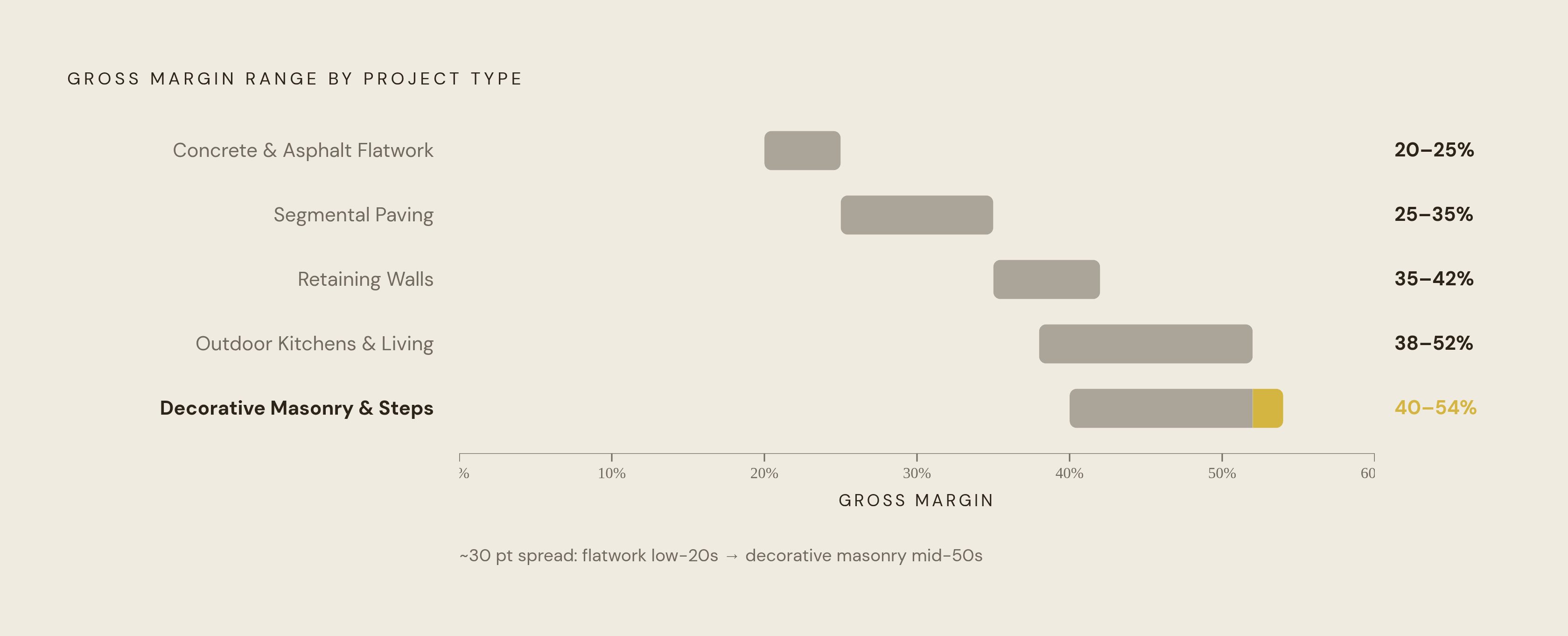
Poured concrete walkways, aprons, and basic pads represent some of the most commoditized work in the exterior trades. Margins here land in the low to mid-twenties, and in competitive markets, even that can feel generous. [Note: These margin figures reflect commonly reported industry ranges; contractors should verify against their own job costing data and consult industry sources such as the Interlocking Concrete Pavement Institute (ICPI) or similar trade organizations for benchmarks.]
The compression is structural. Concrete pricing is largely transparent; customers call three contractors, compare line items, and use the gap to negotiate. Material costs are substantial and non-negotiable. Labor, while not extraordinarily skilled, is time-intensive and deeply sensitive to weather delays and cure schedules. Equipment costs accumulate faster than they appear on a quick estimate, especially when you start factoring in fuel, wear, and the cost of a machine sitting idle while you wait for concrete to set.
This is not a category to avoid entirely. Volume operators can build genuine efficiency systems around flatwork. But for a contractor trying to grow margin dollars rather than just revenue, concrete flatwork is rarely the engine of the business. It is more often the filler between higher-value projects.
Asphalt driveways follow a similar pattern, sometimes landing even lower because material price volatility tied to petroleum markets makes consistent pricing genuinely difficult. Contractors who do significant asphalt volume learn quickly to build escalation clauses into contracts or shorten the window between estimate and execution. The ones who do not learn that lesson usually learn it expensively.
Segmental Paving: Where Margin Starts to Improve
Brick pavers, concrete pavers, and natural stone patios and driveways occupy a more favorable margin band, generally ranging from the mid-twenties to the mid-thirties for operators who have the relevant experience and skills.
Several things drive this improvement. The product itself carries perceived premium value; customers who want pavers are self-selecting into a category where price is not the primary decision driver. The skill premium is real and defensible. Proper base preparation, pattern layout, edge restraint installation, and joint sand compaction require genuine expertise, and most customers who understand what they are buying accept that framing without much resistance. Material variety also creates upsell opportunity. A customer who came in for standard concrete pavers can, with the right conversation, move toward tumbled travertine or large-format porcelain, each of which carries a significantly higher material markup and a higher labor rate.
The margin risk in segmental paving is almost always in the base. Underestimating excavation depth, encountering unexpected drainage issues, or skimping on compacted aggregate to hit a price point creates callbacks that are expensive to resolve and quietly corrosive to reputation. The customer does not see what is underneath. But they see everything that fails when what is underneath was wrong.
Retaining Walls: High Complexity, Rewarding Margins
Retaining walls, particularly engineered walls or walls exceeding the height threshold that requires geogrid reinforcement, yield gross margins in the mid-thirties to low forties for contractors who understand what they are actually selling. [Note: Height thresholds requiring engineering review vary by jurisdiction; contractors should confirm local building code requirements.]
Retaining walls are deceptive in their complexity. The visible finished product, stacked block or natural stone, dramatically understates the engineering, excavation, drainage, compaction, and batter calculation that make the wall functional over a decade-plus horizon. Contractors who price walls based on face square footage without fully accounting for the below-grade work routinely undersell themselves, often without realizing it until they are halfway through an excavation that bore no resemblance to what they budgeted.
The margin opportunity exists because retaining wall projects are rarely shopped on price alone. A customer with a failing slope or a drainage problem that is actively damaging their property is motivated by fear and function, not by finding the lowest bid. That dynamic, paired with demonstrable expertise and a clearly communicated scope, supports strong pricing without significant pushback.
Wall systems using manufactured block products allow for relatively predictable material costs, which makes margin modeling more reliable than in some other categories. Natural stone walls tend to carry higher margins, but they require more experienced crews and tighter project management to prevent labor overruns from consuming the upside.
Outdoor Kitchens and Living Structures: A High-Margin Category in the Trade
Outdoor kitchens, fire features, pergolas with structural masonry components, and integrated outdoor living spaces can represent strong gross margin opportunities in hardscape, often landing between the high thirties and low fifties for builders who control their subcontractor relationships and their material sourcing.
These projects are inherently custom. No two outdoor kitchens are identical in layout, appliance selection, countertop material, or finish detail. Custom work resists commoditization, and projects that resist commoditization support premium pricing. The customer profile also skews toward buyers who have made a deliberate lifestyle investment; they are not looking for the cheapest option. They are looking for the most capable and trustworthy contractor. That distinction matters enormously when it comes time to hold your price.
Material markups in this category are substantially higher than in flatwork or even segmental paving. Appliances, countertops, cabinetry, lighting, and fire components all carry meaningful markup opportunity. A contractor who sources and supplies these components captures margin at every layer of the project. The contractor who lets the customer purchase their own appliances and then wonders why the job felt thin captures none of it.
Labor complexity is also higher, often involving masonry, carpentry, electrical, gas, and plumbing subcontractors. This is where margin discipline matters most. Subcontractor management, scope clarity, and change order protocols either protect the margin you sold or let it drain away one unanticipated revision at a time. Jobs that projected strong margins can finish significantly lower when the back half of the project is not actively managed.
Steps, Columns, and Decorative Masonry: Underpriced and Undervalued
Freestanding columns, entry pillars, decorative steps, and custom masonry features are among the most underpriced line items in the industry relative to the skill and time they require.
These are highly visible, highly skilled elements that customers remember long after the patio beneath them fades into the background. Yet many contractors price them as though they were simple stacked block. They are not. Accurate layout, level and plumb execution across multiple courses, proper cap integration, and mortar discipline all require a level of craft that justifies a meaningfully higher labor rate than basic paving work.
Contractors who break these elements out as distinct line items, rather than bundling them into a general patio scope, frequently find that customers accept the pricing without pushback. The work is visible. The value is intuitive. People understand that a tapered column with a bluestone cap is not the same thing as a four-inch concrete walkway, even if they could not tell you exactly why.
Margins on decorative masonry, when priced as a skilled trade rather than a commodity service, can rival or exceed outdoor kitchen margins on a per-unit basis. The problem is not the market. It is the habit of underselling.
How Project Mix Shapes Your Business's Overall Health
The practical implication of understanding margin by category is this: the projects you pursue most aggressively should reflect the margins they generate, not just the revenue they represent.
A contractor whose pipeline is dominated by flatwork and basic paving will need significantly higher volume to generate the same gross profit as a contractor who has repositioned toward retaining walls, outdoor living, and decorative masonry. Higher volume means more crews, more trucks, more scheduling complexity, more callbacks, and more administrative burden. The operational cost of that scale frequently consumes the additional revenue before it ever reaches the owner. Contractors with higher revenue do not always achieve proportionally higher net income than smaller, more selective competitors.
The most profitable hardscape businesses are not necessarily the largest ones. They are the ones that have deliberately curated their project mix toward categories with durable margin, built the portfolio and reputation to command those projects consistently, and priced with enough precision to protect the margin through execution rather than selling it well and then giving it back in the field.
Pricing With Confidence Requires Actual Data
Margin benchmarks give you a target. They do not give you a guarantee. The gap between a target margin and your actual margin at project completion is almost always a function of estimating accuracy: how precisely you predicted labor hours, how closely you tracked material waste, and how effectively you managed scope changes before they quietly became your problem.
Contractors who track job costing at a granular level, actual hours versus estimated hours, actual material quantities versus projected, gross margin at completion versus gross margin at sale, build an institutional knowledge base that makes every subsequent estimate more defensible. Those who rely on intuition and memory alone repeat the same underestimates because the feedback loop is never formalized. The experience accumulates, but the lesson does not.
Closing the loop between what you projected and what you actually made is not administrative overhead. It is the mechanism by which lived experience converts into reliable margin. Know your numbers by category. Price accordingly. Build a portfolio of work that reflects where the real margin lives in this trade.