AI Agents for Hardscaping Sales Follow-Up
Automated follow-up systems capture sales that vanish between estimate and decision.

The deal almost never dies at the estimate. It dies in the silence after. That's the uncomfortable truth most hardscaping owners don't see, because the revenue that disappears in that silence never shows up in any report. There's no line item for "leads we had and lost to inaction." The jobs just don't happen, and the owner assumes the price was wrong or the pitch was weak. Usually, it was neither. The prospect went quiet, no one followed up with any urgency or consistency, and three weeks later someone else is pouring their patio. This is a systems problem. And it has a systems solution.
Why Speed to First Response Determines Whether a Lead Converts at All
Most hardscaping inquiries don't arrive when anyone is sitting at a desk. They come in through web forms submitted after dinner, through texts sent while an owner is standing on a job site calling out dimensions, through calls placed during peak install hours when every available person is in the ground. The leads aren't being ignored out of laziness. The business just has no mechanism for catching them in real time.
That gap is expensive. Research across the home services industry is consistent on this point: the conversion advantage of responding within minutes versus hours is not marginal. It collapses sharply the longer a lead waits. A meaningful share of callers who reach voicemail won't call back at all. A significant portion of online inquiries arrive after business hours, when no one is available to respond. And a homeowner who fills out a form Sunday evening researching patios or retaining walls is not going to wait until Tuesday morning for someone to get back to them.
The competitive dimension makes this more acute. If three hardscapers receive the same referral, the one who responds in minutes gets the appointment. The others get silence. Hardscaping's specific sales dynamic compounds this further: these are high-ticket, low-frequency projects with longer decision windows. Homeowners shop multiple bids. Seasonal demand creates bursts of estimates that overwhelm any manual follow-up system. Whoever follows up best, not just whoever bids lowest, often wins.
The industry average response time sits at many hours, not minutes. That gap is precisely where AI closes the deal before the conversation even begins.
What AI Agents Actually Do in a Hardscaping Sales Workflow
An AI Agent is software that acts autonomously on a defined task. It doesn't wait to be prompted by a human. It responds, follows up, books, and logs on its own, according to rules the owner sets once and doesn't have to manage continuously. That distinction matters, because most people who haven't used one picture a chatbot. Chatbots answer questions. Agents take action.
In a hardscaping sales context, the core actions look like this. The moment a web form is submitted, a text comes in, or a call goes unanswered, the agent responds within seconds, any time of day or night. It collects qualifying information before a human ever joins the conversation: project type, lot details, rough timeline, budget range. It books the on-site estimate directly into the owner's or salesperson's calendar, sends a confirmation, and sets reminders for both sides. Every interaction is logged into the CRM automatically, with no manual data entry required.
Then comes the function that pays for everything else: the estimate-chaser. After a quote goes out, the agent monitors which estimates haven't been accepted after a defined window. It automatically sends a follow-up sequence across email, text, or both, on a cadence the owner configures. These messages can reference the specific project discussed. Not "just checking in," but something that signals the business actually remembers who this person is and what they asked about. If the prospect wants to revisit or ask questions, a booking link surfaces automatically.
What the agent is not doing is replacing the site visit, the relationship, or the close. It is eliminating the dead air between human touchpoints, the silence where deals go to die.
The Multi-Channel Follow-Up Stack Hardscapers Aren't Using
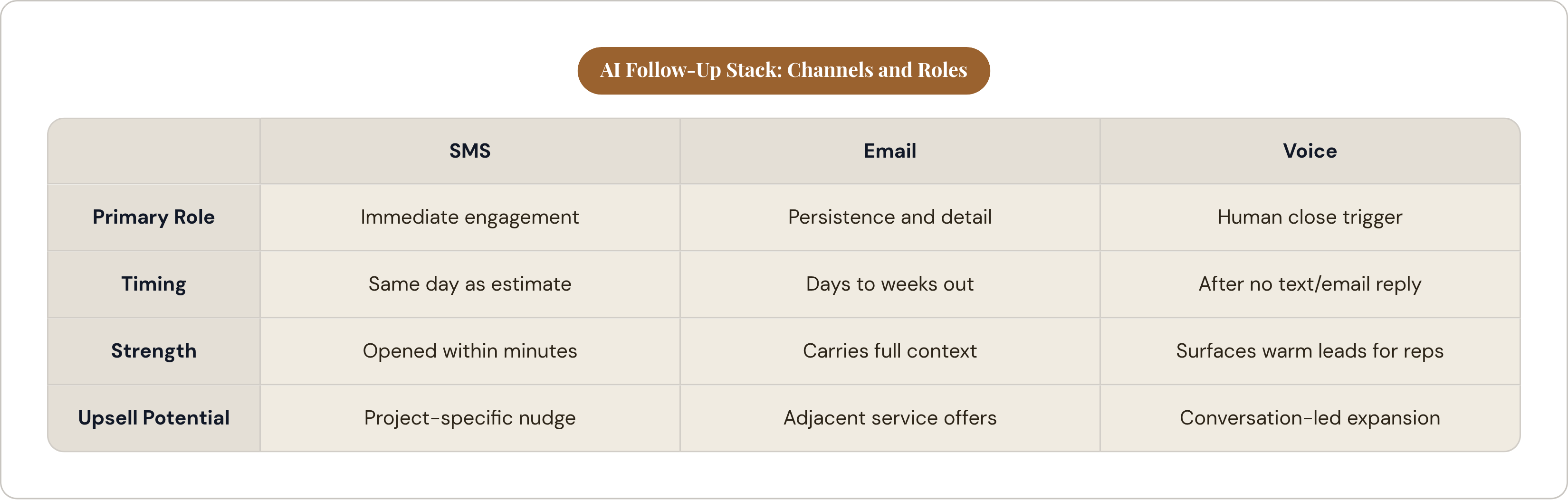
Most hardscaping businesses follow up in one channel, once. Usually it's a single email, sometimes a phone call that goes to voicemail. That's the entire system.
SMS is the highest-engagement layer available, and it's almost entirely unused in this industry. Text messages are opened at dramatically higher rates than email and within minutes of receipt. For a prospect who has already met with you, walked their yard with you, and received your estimate, a brief and personalized text doesn't feel intrusive. It signals that you're organized and attentive. An AI agent can send that text the moment an estimate is delivered, referencing the project by name, before the prospect has even had time to compare bids.
Email functions as the persistence layer. It carries more detail: estimate summaries, material explanations, answers to common objections, financing options if applicable. AI-driven email sequences space messages intelligently, not three in one day, but a cadence over days and weeks that keeps the business present without overwhelming the prospect. The compounding effect is real. A prospect who receives a text the day after the estimate, an email two days later, and another text a week out is substantially more likely to respond than one who received a single message that went unanswered.
Voice follow-up completes the stack. AI can flag which prospects haven't responded to text or email and surface them for a human call at the right moment, with context on where the conversation stands.
There's also an upsell dimension that most operators leave entirely untouched. Follow-up sequences can introduce adjacent services, outdoor lighting, seasonal maintenance, irrigation, based on what the prospect originally inquired about. A single project conversation, handled with a well-designed AI sequence, can open the door to a longer customer relationship before the first invoice is even paid.
The Visual Objection That Kills Hardscaping Deals Before Follow-Up Even Begins
Hardscaping carries a sales challenge that most home services don't face at the same scale. The product doesn't exist yet. The homeowner is being asked to commit a significant sum of money to something they can only imagine, based on a PDF estimate and whatever mental picture they can construct from a few reference photos.
The single most common objection in hardscaping sales isn't price. It's "I can't really picture how it'll look." And critically, that objection usually doesn't get voiced. It just becomes silence after the estimate. The prospect isn't saying no; they're saying they're not convinced enough to say yes. That distinction matters because silence feels like a lost deal when it's actually a recoverable one.
AI visualization tools address this directly. They generate photorealistic before-and-after renderings of the homeowner's actual property: their yard, their house, their dimensions. The prospect can see paver colors, retaining wall materials, patio layouts, and outdoor kitchen placements before any work begins. These visuals can be delivered as part of the estimate itself, or sent via AI follow-up as a reason to re-engage a prospect who went quiet.
That's the key connection. When a follow-up message includes a rendering of the finished project on the prospect's actual property, it gives them something new to respond to. It's not another "did you make a decision?" It's new information that moves them forward. Most competitors are sending a PDF quote and a generic email. A hardscaper who sends a photorealistic visualization alongside a personalized follow-up text is operating in an entirely different category of professionalism.
AI Sales Coaching as a Backstop for the Deals Agents Can't Close Alone
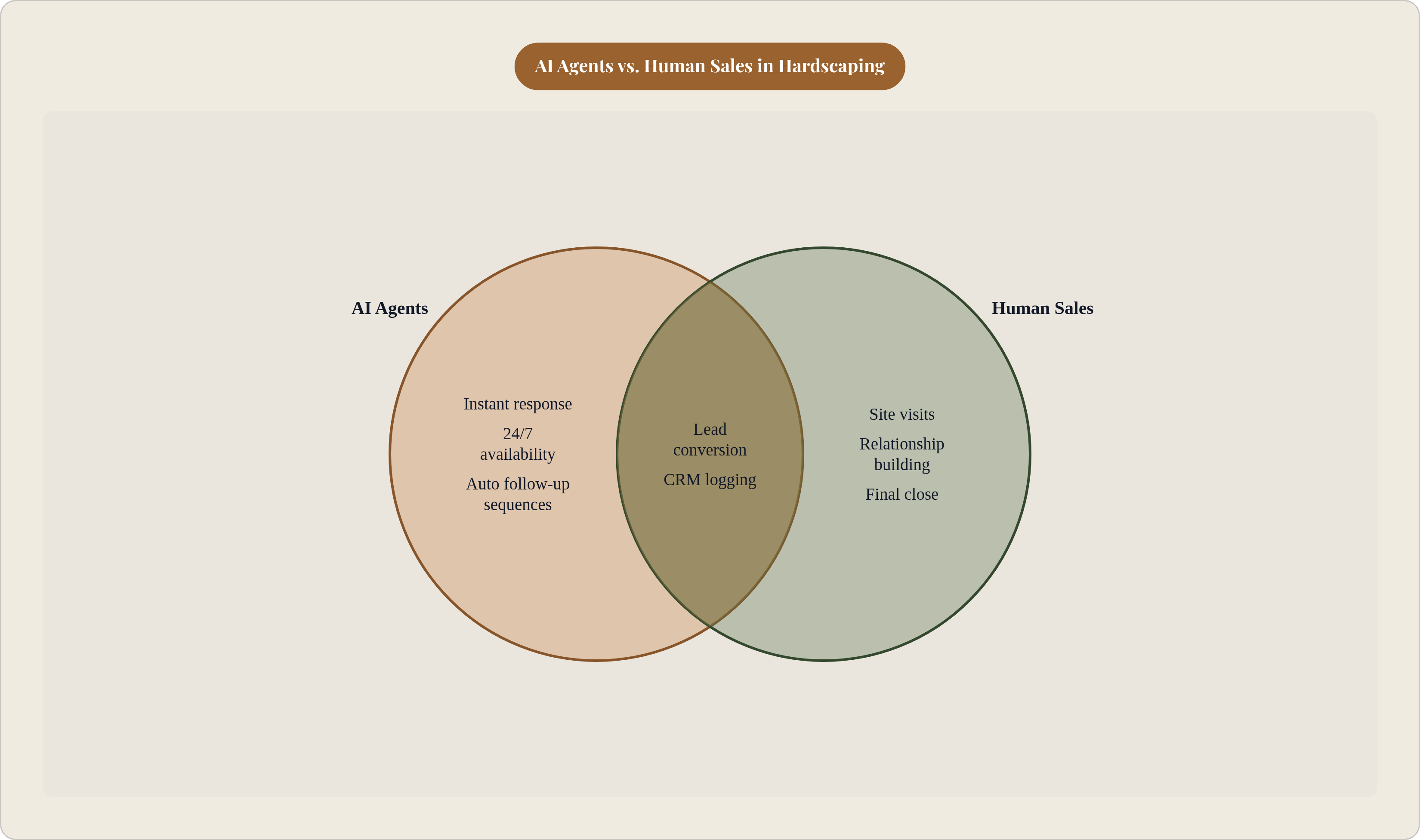
At some point in a large hardscaping project, a prospect wants to talk to a person. AI handles the outreach and keeps the lead warm, but the human close still matters, and in most small hardscaping operations, that close is inconsistent in ways the owner has no visibility into.
The coaching gap is straightforward. Owners don't have time to listen to call recordings. New hires or owner-operators handling sales have no structured feedback loop. They learn slowly, through lost deals, with no clear picture of what went wrong or why.
AI sales coaching tools change that. They record and analyze sales conversations automatically, scoring each call against defined criteria: Did the rep uncover the prospect's timeline? Did they address the visualization objection? Did they quote with confidence or introduce doubt? The system flags calls where a bookable lead was misclassified as "not interested," which surfaces real conversion losses the owner didn't know existed.
The ramp-time payoff is significant for any business trying to scale past the owner doing all the selling. New reps who receive daily, specific feedback reach full effectiveness in weeks rather than months. Generic coaching tells someone to be more confident. AI coaching tells them exactly which moment in a specific call they lost the thread, and what to do differently next time.
The system view is this: AI Agents bring leads in and keep them warm. AI coaching ensures the human close is as strong as the automated outreach. Both ends of the sale get sharper simultaneously.
Why Most Hardscaping Owners Haven't Done This Yet, and What That Window Means
Across the landscaping and hardscaping industry, the vast majority of operators have not adopted AI tools in any meaningful way. Those who have uniformly report positive results. The barriers keeping most owners out are real, but they are not technical.
The most common assumption is that setup is slow, expensive, or requires expertise the owner doesn't have. Closely related is the fatigue that comes from years of fragmented software stacks, a CRM that doesn't talk to the scheduling app, which doesn't connect to the email tool. Many owners have been burned by software that promised integration and delivered manual workarounds. That skepticism is rational, but it's being applied to a different generation of tooling.
The broader small business adoption curve is moving fast. AI adoption among small and mid-sized businesses has accelerated sharply in recent years. Hardscaping is notably behind that curve. Which means the first-mover advantage is still available, and it is consequential.
When most competitors are still following up manually, or not at all, a business with an AI-driven follow-up system wins on responsiveness alone. The homeowner who submits a form and gets a thoughtful, project-specific response within two minutes is not conducting a neutral comparison with the business that responds two days later. The comparison is already over.
The window is finite. As these tools become cheaper and more accessible, the advantage compresses. Early adopters build the customer base and the reputation before the market catches up. Hardscaping's seasonal demand pattern makes this especially relevant: spring and early summer concentrate a disproportionate share of decision-making into short windows, which makes speed and responsiveness during those peak periods worth more than at almost any other time of year.
What a Functioning AI Follow-Up System Looks Like End to End
Trace the full journey once. A prospect submits a web form on Sunday evening. An AI agent responds within minutes, asks qualifying questions about the project, and books a Monday morning callback or site visit. The appointment confirmation lands in both calendars automatically.
The site visit happens. The estimate is delivered. That same day, the agent sends a text referencing the specific project, attaches a visualization of the finished space if one is available. Two days pass with no response. An email goes out with more detail on materials, process, and timeline. Another few days pass. The lead is surfaced for a human call, flagged as high-priority in the CRM, with a full record of every prior interaction visible to whoever picks up the phone.
The job books. The work gets done. Then the agent schedules a post-project follow-up to request a review and introduce seasonal maintenance services, turning a single transaction into the beginning of an ongoing relationship.
What the owner experiences on their end: fewer leads disappearing without explanation, a visible pipeline in one place, and more time spent doing site work rather than chasing quotes that should have converted on their own.
This only works cleanly when the AI agent, CRM, calendar, quoting, and communication tools share data. Fragmented stacks break the sequence at every handoff. The unified system is not a luxury feature; it's the structural requirement that makes everything else function.
The revenue implication is worth stating plainly. The deals being recovered here are not the result of new marketing spend. They are revenue already earned through lead generation, jobs that were paid for at the top of the funnel and then abandoned in silence. Recovering them costs nothing additional. It just requires eliminating the silence.
The estimate was never the problem. The silence after it was. And silence, at this point, is a choice.