AI for Construction and Hardscaping Business Management
Competitors are already using AI to capture leads while you're on job sites.

The dominant mental model among independent contractors is that AI is for bigger companies, later stages, more stable operations. Something to revisit once there's margin for experimentation. That framing is self-reinforcing: if you haven't seen it produce revenue inside your own business, it registers as theoretical. And because most owners in this industry are heads-down on job sites from first light until late afternoon, there hasn't been a natural moment to sit down and actually test it.
Here's what makes that delay costly. Adoption is already accelerating among the businesses you compete with directly. Housecall Pro's 2024 survey found that a meaningful share of small home service businesses had already adopted AI tools, and among those who did, most reported direct revenue impact they could actually point to. Thryv's 2025 data shows adoption among small businesses jumped sharply in a single year. The window where early adoption gives you disproportionate advantage doesn't stay open forever, and it's not going to announce itself when it closes.
There's a second layer of competitive pressure most owners haven't registered yet. Homeowners are increasingly using AI tools to research and shortlist contractors before making a single phone call. If your business isn't surfacing in those queries, and isn't fast when a lead does arrive, you're eliminated before competition even begins.
Think about what that means practically. An owner who answers calls manually and delivers quotes two days after first contact is competing, on every lead, against a business that responds in under two minutes and sends a quote the same hour. Not occasionally. Every lead, every day, weekends included. Waiting on AI adoption is like showing up to a footrace after the starting gun — you're not late to the idea, you're late to the finish line.
What AI-powered lead response actually looks like in a hardscaping business
Most inbound calls to trade businesses go unanswered during working hours. This isn't a discipline problem; it's structural. The owner is on a job site. The crew is working. Nobody is near a phone. I've watched owners come in at the end of a day, pull up their missed calls, and do the rough math on what just walked away. It's a real number, and it happens every productive workday.
AI receptionist tools address this directly. They answer inbound calls and texts immediately, qualify the lead by asking about project type, location, timeline, and rough budget, and either book an estimate on the spot or route a full summary to the owner for follow-up. The homeowner gets a responsive conversation within seconds. The owner gets a qualified lead summary instead of a voicemail they won't check until 6 p.m.
The first-respondent dynamic is well-documented in home services research. A lead that waits even a few hours is more likely to have already scheduled with a competitor. Hardscaping projects are high-ticket, comparison-shopped, and often financed. Homeowners in that mindset are making multiple inquiries simultaneously, and they generally go with whoever engages them first in a substantive way. Speed of response is a close-rate variable, not a courtesy metric.
A significant share of jobs booked through online platforms originate outside business hours, per Housecall Pro's data. Without AI, those inquiries sit until morning, at which point the homeowner has frequently moved on. AI captures them in real time, without a receptionist, without an answering service, and without the owner leaving a job site to pick up a phone. Every unanswered after-hours lead is a patio that someone else is going to pour.
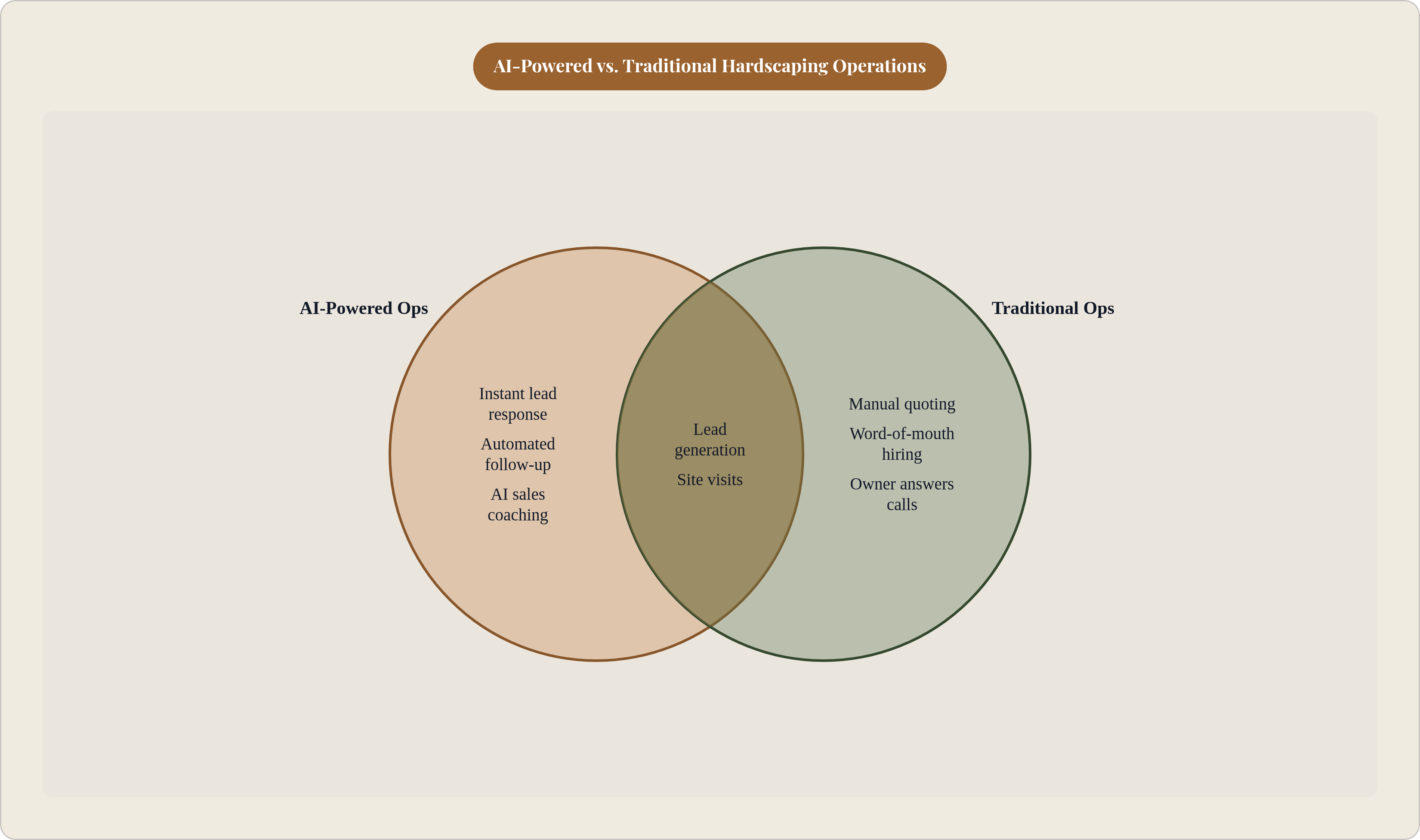
AI-generated quotes and estimates: where speed becomes a close-rate advantage
Traditional quoting in hardscaping follows a predictable, slow sequence: site visit, manual measurement, material calculation, markup application, proposal formatting, delivery. Start to finish, that often takes days from first contact. For a homeowner actively comparing three contractors, days is too long. You already know this. You've lost jobs to it.
The margin risk compounds the time problem. A small percentage miscalculation on a large hardscaping project is a real dollar swing. Quoting from memory or gut feel after a long day on-site produces inconsistency, and inconsistency erodes either the margin or the close rate, sometimes both on the same job.
AI-assisted quoting compresses this considerably. Satellite and 3D measurement tools, now available across roofing, grading, paving, and landscape layout, feed dimensions directly into material calculators and proposal templates. The output is a professional, itemized quote delivered in minutes while the homeowner is still actively comparing options, not after they've already signed with someone else.
Contractors who deliver quotes quickly after initial inquiry close at higher rates than those who take a day or more to respond. That's not surprising. What's worth noting is how consistently that variable shows up in close-rate analysis across fragmented markets where no single operator dominates on brand recognition alone.
AI quoting also standardizes pricing across the entire business. Every job runs through the same logic, the same markup structure, the same material assumptions. That consistency protects margin and eliminates the variation that creeps in when human judgment is applied under fatigue at the end of a long site day. One of the quietest ways small contractors give away margin is right there, and most of them never isolate it as a problem because they're too busy to look back at the numbers.
Combined with AI lead capture, the effect is a more automated top-of-funnel: lead arrives, AI qualifies it, quote is generated and delivered, follow-up is triggered. The owner touches none of it until a high-probability conversation is warranted.
How AI handles the follow-up and nurture work that most hardscaping businesses simply don't do
The typical pattern after a quote goes out: the homeowner doesn't respond immediately, the owner moves on to the next job, the lead quietly dies. This is not negligence. It's capacity. There is nobody assigned to follow up, no system built to do it, and no room in the owner's day to manage a nurture sequence manually. I've yet to meet a small hardscaping operator with a systematic follow-up process. What that means is a real volume of qualified, quoted leads simply never gets pursued to a decision.
AI-enhanced CRM tools automate the follow-up sequence entirely. A text goes out the day after the quote. An email follows two days later. At day five, if the lead still hasn't responded, the owner gets a call prompt tied to the specific project details. All of it is triggered automatically, all of it is personalized to the job, and none of it requires anyone to execute or remember.
The post-job automation layer adds further compounding value. Review requests fire automatically within a day of project completion. Two-week check-ins go out. Seasonal upgrade or maintenance reminders follow in the appropriate cycle. This is the kind of ongoing customer relationship that generates repeat business and referrals, built without hiring, without a marketing department, and without the owner managing each touchpoint manually.
A business running AI follow-up is working a larger share of the leads it generates. A business without it is working only the ones that happened to close fast on their own. Everything else was paid for in marketing spend and then abandoned — like planting seeds and walking away before the rain.
AI sales coaching: how in-the-field feedback is closing the gap between quoting and winning
Fast lead response and automated follow-up address the top of the funnel. They don't address what happens when the owner or a salesperson is standing in a homeowner's backyard, walking through a project. That conversation determines whether a quoted job actually converts, and for most small contractors, there is no systematic mechanism to improve it over time.
Traditional sales coaching for small contractors is occasional, informal, and unscalable. You debrief a job that went sideways, you share a tip over lunch, and nothing compounds because nothing is systematic. The feedback loop is too slow and too vague to change behavior.
AI coaching platforms, including Rilla, Siro, and SalesAsk, record in-home and phone sales conversations and deliver specific, actionable feedback within minutes of the call ending. Granular feedback. Not "be more confident" but "you moved to price before establishing the value of the warranty; here is the sequence that performs better." That is a materially different quality of instruction than what most small contractors have had access to historically, regardless of how long they've been in the business.
Some platforms deliver prompts in real time, while the technician is still in the appointment, surfacing objection-handling guidance at the moment it's needed. For a hardscaping business with one or two people handling sales conversations, this provides access to systematic conversation review that was previously only available to operators with dedicated sales management. It's not perfect. Most coaching platforms surface useful insights but don't yet natively connect a specific coaching improvement to a booked job and a dollar amount in the CRM. That attribution loop is still largely a manual step.
AI in scheduling, dispatch, and the daily operational workflow a crew actually runs on
Scheduling and dispatch are where margin lives in hardscaping, and where daily improvisation quietly bleeds it out. A crew sent to the wrong address, a job that runs long and blows out the afternoon slot, a supplier delivery that arrives two hours late and idles three people: each of these is a margin event, not a logistical inconvenience. Multiply them across a busy season and the number is significant.
AI scheduling tools analyze job duration history, crew skill sets, geographic clustering of job sites, and weather data to build routes and timetables that reduce drive time and idle time. The day requires less improvisation because the system has already accounted for the variables that typically generate chaos by mid-morning.
Trade business owners consistently identify workflow optimization, specifically reducing technician downtime and improving routing, as AI's highest-impact operational application, per Simpro's 2025 Trades Outlook. For hardscaping specifically, the variables compound: job sites are geographically dispersed, projects span multiple days, and material delivery timing directly affects crew productivity. AI that accounts for all three reduces the number of real-time decisions the owner has to make while also doing physical work on-site.
Automated dispatch notifications keep customers informed without requiring the owner or an office to field status calls. That reduces inbound "where is my crew?" volume and improves customer satisfaction without adding a staff role to manage it. Post-job, AI triggers invoicing automatically at project completion, which reduces the gap between work done and cash received. Most trade business owners know exactly what that gap costs them across a busy season.
AI for recruiting and screening in a market where qualified labor is the real growth constraint
The ceiling most hardscaping owners hit first is not leads. It is not close rate. It is crew capacity. They cannot take more jobs because they cannot find or keep qualified people, and every other growth initiative is constrained by that bottleneck.
The qualified labor shortage across construction and trades is severe. A large majority of construction firms report difficulty finding qualified workers, and wages have risen substantially since 2022, according to Associated Builders and Contractors data. The informal recruiting model many small operators rely on, a Craigslist post, word of mouth, whoever shows up and seems capable, produces a thin and unreliable pipeline with no systematic screening and high turnover.
AI recruiting tools apply the same speed-to-response logic to candidate pipelines that AI lead response applies to customer inquiries. When a candidate submits interest, the AI texts them immediately, runs a qualification conversation covering experience, availability, certifications, and geographic range, and schedules an interview automatically. Candidates who don't hear back within hours frequently accept elsewhere. The same dynamic plays out with customer leads; it just feels less urgent because nobody calculates the cost of an unfilled position the same way they calculate a lost job. A slow hiring process is just a leaky bucket with a hard hat on.
AI screening also enables a tiered hiring approach that most small contractors have never had the administrative capacity to operate. Entry-level candidates who have mechanical aptitude but lack certifications can be identified and routed into a training pathway rather than simply rejected. That builds a longer-term talent pipeline rather than a purely transactional one. In a labor market that shows no near-term indication of self-correcting, businesses that build systematic recruiting infrastructure accumulate an advantage that becomes harder to close over time.
Where hardscaping businesses are in the AI adoption curve, and what the competitive gap looks like now
Only a modest share of residential contractors had meaningfully integrated AI into their workflows by early 2026, per ServiceTitan's 2026 Residential State of the Trades report. Among those who did, the majority report measurable business impact, and that figure roughly doubled in a single year. The gap between early movers and late adopters is already widening, even if it isn't fully visible from inside either business yet.
The competitive dynamic isn't complicated. A business running AI lead response, AI quoting, and AI follow-up is working a larger share of every lead it generates, including the significant portion that arrives after hours, on weekends, and during active job site hours. A competitor without those tools is working only the leads it happens to catch manually. That gap widens each month, quietly and continuously.
At the marketing layer, the pressure is already structural. Homeowners using AI tools to research and shortlist contractors are filtering on responsiveness and credibility signals before they ever pick up the phone. Businesses that are slow to respond or difficult to surface through those queries are at a disadvantage before direct competition begins.
The average trade business still manages a fragmented stack of multiple software systems with no integration strategy, per Simpro's 2025 Trades Outlook. Most of the data those systems generate is never actually used to improve decisions. Better lead conversion, faster quoting, and systematic follow-up accumulate in one direction month over month. Businesses running unified, AI-integrated systems are pulling away from those running disconnected tools, and the distance compounds.
The practical starting point: which AI applications to run first and what each one actually requires
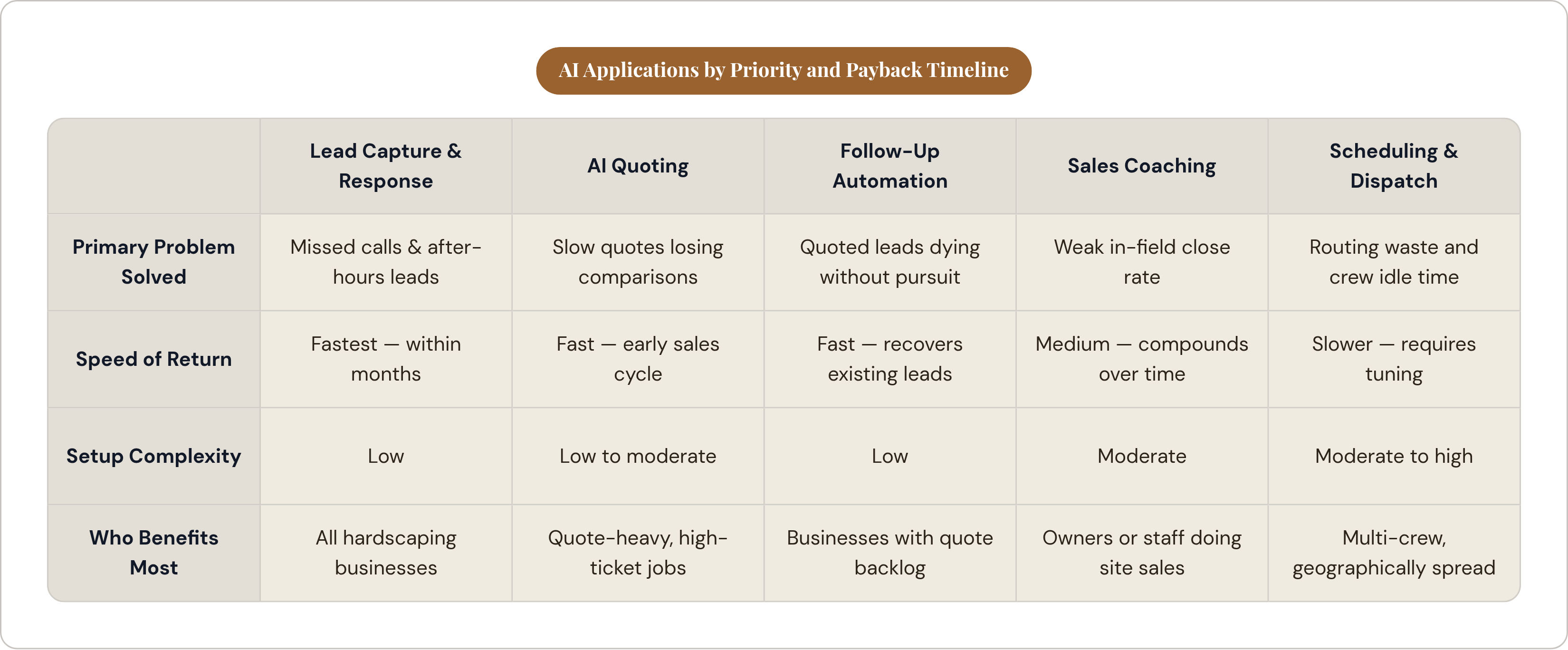
Sequencing matters because not all AI applications produce returns on the same timeline. Customer-facing tools, specifically lead capture and follow-up automation, typically show returns within the first few months because they recover revenue that was previously being lost without the owner even knowing it. Operational tools like scheduling and dispatch optimization take longer to tune but compound more deeply over time.
For a sub-million-dollar hardscaping business, the logical sequence is: AI lead capture and response first, because it has the fastest payback and the lowest setup complexity; AI quoting second, because it eliminates the primary delay in the sales cycle; and AI follow-up third, because it recovers leads that would otherwise die quietly after the initial quote. Each layer makes the previous one more valuable.
For businesses past early revenue milestones, AI sales coaching becomes high-leverage because the bottleneck has shifted from lead volume to close rate and average job value. More leads aren't the constraint. Converting the leads already arriving is.
The architecture mistake to avoid is adopting AI point tools that don't communicate with each other. A chatbot that doesn't update the CRM, a quoting tool that doesn't trigger follow-up, a scheduling system that doesn't connect to invoicing: this recreates the fragmentation problem in a new form, just with shinier software. You've upgraded the chaos, not solved it.
The right architecture is a unified system where lead capture, quoting, CRM, follow-up, scheduling, and post-job automation share data and trigger each other. The owner sees one dashboard. Decisions are made from a single source of truth rather than reconciled across disconnected platforms at the end of an already long day.
Most hardscaping businesses are already experiencing the problems AI tools address: missed leads, slow quotes, no follow-up, scheduling waste, hiring friction. For most owners who do that accounting honestly, the number of leads currently being lost may be larger than expected. And it compounds every week.