Retargeting Campaigns for Remodeling Company Websites
How to use visitor behavior to serve smarter ads and close more remodeling leads.

Retargeting is a tracking and re-exposure system. A small piece of code, a pixel or tag, sits on the company's website. When someone visits, it fires silently and records behavioral signals: which pages they viewed, how long they stayed, whether they started filling out a contact form and then abandoned it. No personal information is collected. The visitor stays anonymous. But the ad platform that served the pixel now knows how to find that browser or device again.
Later, when that same person is scrolling Instagram or watching a YouTube video about kitchen cabinet finishes, the platform recognizes them and serves an ad from the remodeling company based on exactly what they did during that first visit.
There are three varieties worth distinguishing early. Pixel-based retargeting follows site visitors using behavioral signals from that installed code. List-based retargeting uploads existing contact data, past client emails, unconverted leads sitting in a CRM, directly to ad platforms, which means reconnecting with known people without depending on pixel tracking at all. Search retargeting surfaces ads based on terms a person has typed into a search engine, even before they've visited the site. Local remodelers rarely need to go that deep, but it exists.
The meaningful distinction is this: prospecting targets strangers; retargeting targets people who already raised their hand, even if they didn't realize they were doing it. The audience is warmer from the start, which explains why retargeting consistently produces more efficient results per dollar than cold acquisition. A homeowner who spent four minutes on your bathroom remodel gallery is not the same person as someone seeing your name for the first time. Treating them identically is a waste of the most valuable asset you have, which is relevance.
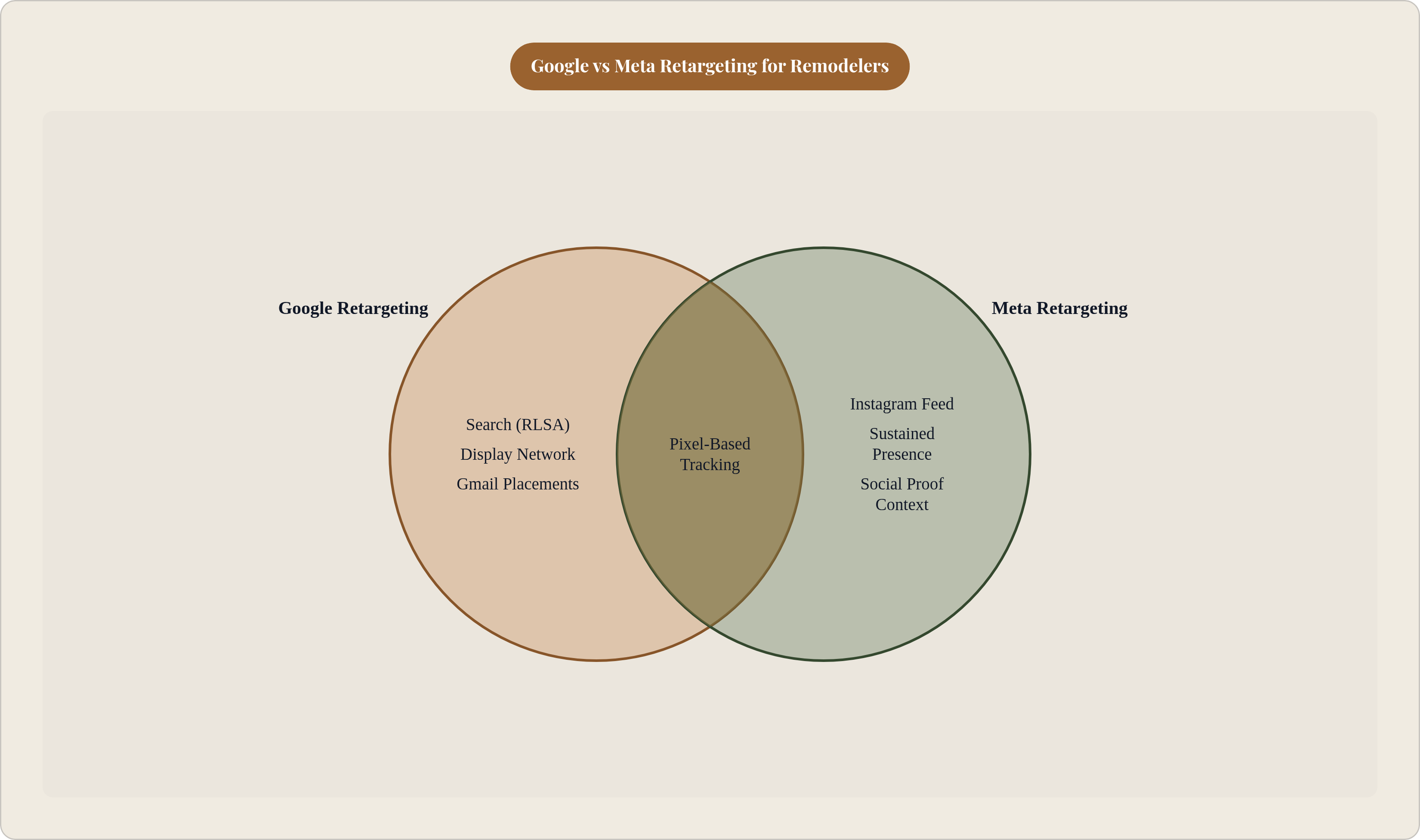
Google covers Search, Display, YouTube, and Gmail. Meta covers Facebook and Instagram. Each platform reaches the same homeowner in a different context and state of mind, which is why running retargeting across multiple platforms builds broader coverage than committing to any single channel. The prerequisite for all of it is that the tracking infrastructure exists before any campaign launches. No pixel, no retargeting. That setup step is not optional and should not be deferred while you figure out the rest.
How to Segment Remodeling Audiences So Ads Match Where Each Homeowner Actually Is
Not every website visitor deserves the same ad. A homeowner who spent four minutes in your kitchen remodel gallery is in a fundamentally different headspace than someone who landed on the homepage and left in ten seconds. Treating them identically wastes money and, more critically, wastes relevance, which is the only mechanism that makes retargeting work in the first place.
Segment by intent, and be specific about what each tier actually tells you.
Service-page visitors navigated to a specific project type: kitchen, bathroom, deck, basement, addition. They told you exactly what they're thinking about. A homeowner who spent real time on your bathroom remodel page should see bathroom project photography in every subsequent ad, not a generic brand message that could belong to any contractor in a fifty-mile radius.
High-engagement visitors spent meaningful time on the site or moved through multiple pages. Their dwell time signals genuine curiosity even without a form submission. They're a stronger opportunity than a single-page bounce, and they warrant different messaging.
Abandoned form fillers are among the warmest prospects in the entire pool. They started the process of reaching out and stopped. That's demonstrated intent, and it warrants the most direct follow-up of any segment. Something interrupted them, not disinterest.
Past clients and unconverted leads are a separate category entirely. Uploaded via CRM or email list, these are known contacts rather than anonymous visitors. They're appropriate for seasonal outreach, referral prompts, or re-engagement when someone who got an estimate two years ago is finally ready to move forward.
Segmentation also governs how long you follow someone. A single-page visitor might fall out of the audience after a few weeks. Someone who nearly submitted a form warrants several months of follow-up, because remodeling decisions genuinely take that long. The homeowner who decides in week nine simply never saw another ad if the window was cut to thirty days. Match the audience window to the actual consideration timeline, not to an arbitrary expiration date built for a product with a two-day purchase cycle.
Running Retargeting on Google: Display, Search, and YouTube for Remodelers
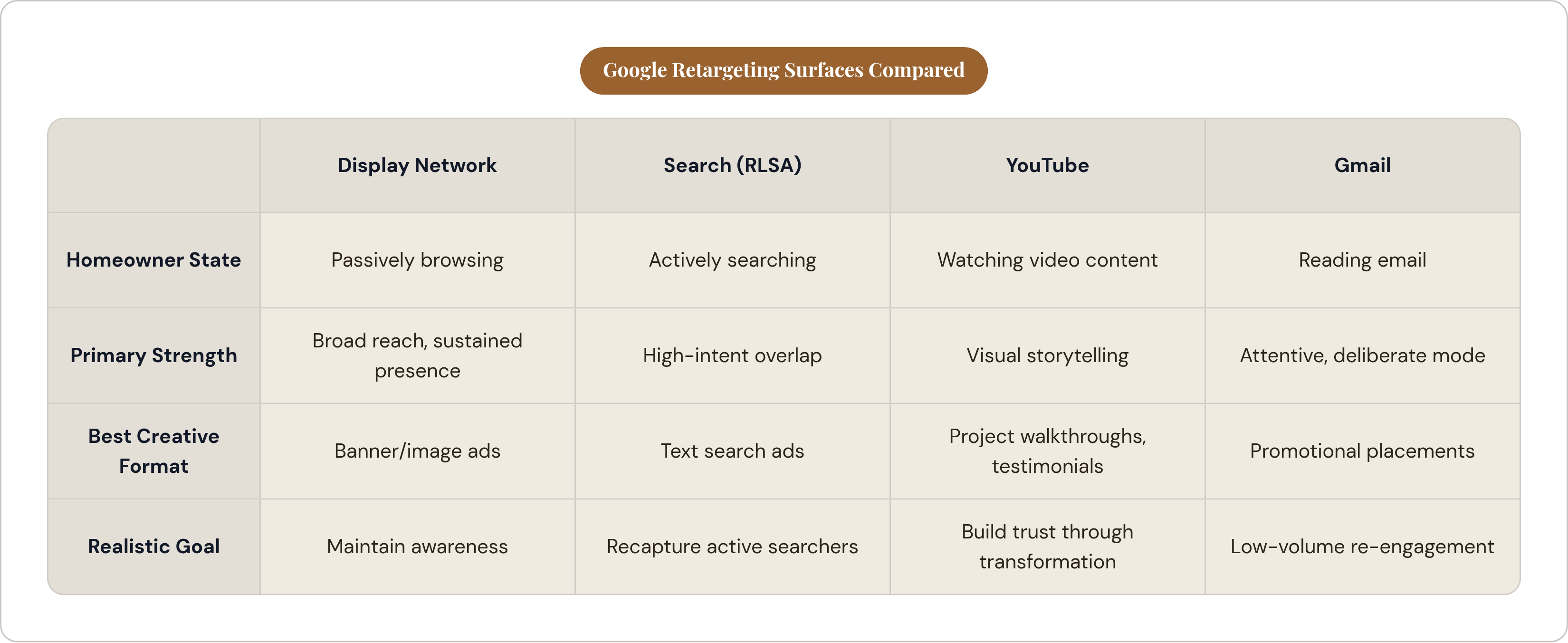
Google's advertising ecosystem offers three meaningfully distinct retargeting surfaces, and each one catches the homeowner in a different state of mind.
Google Display Network places image and banner ads across a broad swath of the web: local news sites, recipe blogs, weather apps, home design publications. When a past site visitor is reading about kitchen tile trends or checking the weekend forecast, a Display ad from the remodeling company appears in the margins. The reach is wide; the intent is ambient. Display is built for maintaining presence during the long consideration window. It is not built for driving immediate calls, and expecting it to do that will lead to disappointment.
Search remarketing, through what Google calls Remarketing Lists for Search Ads (RLSA), operates differently and is underused by most remodelers. It lets you bid more aggressively when a past site visitor searches relevant terms again. This person already knows your company and is currently, actively searching for what you do. That intersection of prior familiarity and live search intent is about as qualified as a prospect gets. Bidding harder for that specific overlap costs more per click and is worth every cent.
YouTube retargeting surfaces video ads to past visitors while they watch unrelated content. For remodeling companies, this format earns its place in a way that banner ads cannot. Project walkthroughs, before-and-after reveals, client testimonials on camera — these translate to video in a manner that a 300x250 banner image simply cannot replicate. Homeowners in the research phase respond to video because it conveys the actual character and quality of the work. Showing a transformation is more persuasive than describing it.
Gmail placements appear in the Promotions or Social tabs of past visitors' inboxes. Volume is lower, but a homeowner reading email is in a more deliberate, attentive mode than during passive social scrolling.
One practical note: setting up Google retargeting requires a Google Ads account with the remarketing tag installed and audience lists built before any campaign launches. Build that setup time into the project plan. Dynamic remarketing through Google can automate the pairing of project-specific imagery with the right audience segment once the system is running, which substantially reduces the manual burden of creative management.
Using Meta Retargeting to Build Familiarity and Trust During the Long Consideration Window
Meta reaches past site visitors in a social context, and that changes the entire job the advertising needs to do. A homeowner scrolling Instagram is not in search mode. They are not looking for anything. The ad has to earn a moment of attention inside a feed competing for that attention from every direction, and then do something useful with that moment.
On Meta, the objective is sustained presence: keeping the remodeling company visible and credible across the weeks or months while the homeowner deliberates. That timeline is longer than most advertisers are comfortable funding. But it mirrors how remodeling decisions actually get made. Homeowners don't call a contractor the day they start thinking about a kitchen renovation.
Short client testimonial videos carry social proof directly into a social environment, which is exactly where social proof belongs. Before-and-after project carousels are visually immediate and make the quality of the work concrete in a way that a written description cannot. Calls to action on Meta work better when they match the browsing mindset: "See our recent kitchen transformations" lands differently than "Get a free quote today" for a homeowner who is still five weeks away from being ready to call anyone. Asking for commitment before trust is built tends to produce silence.
Meta's pixel enables the same behavioral segmentation discussed earlier. A visitor who browsed the deck-building page should see deck project photography on Instagram. That specificity is available to any remodeler willing to build the audience segments correctly on the back end. Most don't bother, which is why most retargeting on Meta feels generic and easy to ignore.
Meta functions as a reinforcement layer. Its strongest role is keeping a homeowner who already knows the company engaged over time. It is not a primary conversion channel, and trying to use it as one misunderstands what the platform is for in this context.
What Creative and Messaging Should Look Like at Each Stage of the Homeowner's Decision
Creative is where strategy either lands or evaporates. The right message shown to the wrong audience is nearly as wasteful as a generic message shown to everyone, and in retargeting, you have enough information about each segment that there is no excuse for generic.
Early consideration visitors, those who browsed broadly without landing on a specific service page, need credibility above all else. Portfolio imagery, years of experience, service area, licensing, third-party review ratings: these establish that the company is legitimate and worth returning to. This is not the moment for a hard pitch. A homeowner in that early stage who receives a "Call today for a free estimate" ad hasn't been given enough reason to act on it yet.
Service-page visitors have already self-identified by project type. A homeowner who spent time on the bathroom remodel page should see bathroom photography, bathroom testimonials, and messaging that speaks to that specific renovation. The specificity signals that the advertising is paying attention to them rather than broadcasting at them.
High-engagement visitors have demonstrated enough interest to receive a direct call to action. A free consultation, an estimate request, a scheduling prompt: these are appropriate here. These visitors have moved past initial browsing and are closer to a decision than their silence suggests.
Abandoned form fillers need something different entirely. Not urgency, not a promotional offer, just a low-friction, human invitation to continue: "Still thinking about your project? We'd love to hear about it." Direct, warm, no pressure. The pressure is what made them abandon the form to begin with.
On visual assets: real project photography outperforms stock every time in this category. Homeowners evaluating a contractor are evaluating craftsmanship, and the portfolio is the most persuasive creative asset available. Before-and-after formats work because they make the transformation legible and concrete. Video, even short walkthroughs shot on a phone, builds a more dimensional sense of the company's work than any static image can.
Ad fatigue is a real operational hazard. A small retargeting audience seeing the same creative on a loop will start to tune it out, or worse, resent it. Rotate assets consistently and set frequency caps. A homeowner who is mildly annoyed by your ads has not become a better prospect.
Budget Allocation and Realistic Expectations for a Remodeling Retargeting Program
Retargeting is a support layer, not the primary acquisition engine. The budget should reflect that distinction honestly.
The single most important variable in determining how much to spend is audience size. A remodeling website with modest monthly traffic produces a small retargeting pool. Pouring significant budget into a small pool drives up ad frequency without expanding reach, which exhausts the audience quickly and wastes money. Budget should scale proportionally with traffic volume. If the site is not generating enough visitors to build a meaningful retargeting audience, the traffic problem needs to be solved first. Retargeting a thin audience more aggressively does not compensate for thin traffic.
A practical multi-platform structure distributes retargeting spend across Google Display and RLSA for broad coverage and search-moment recapture, Meta for sustained social presence during the consideration window, and YouTube where strong video assets exist. YouTube earns its allocation for higher-value projects where visual storytelling genuinely moves the decision. For a company running a $30,000 average kitchen renovation, a thirty-second project walkthrough on YouTube is not an extravagance.
Because remodeling sales cycles extend across weeks and sometimes months, retargeting campaigns need to run long enough to be present when the homeowner reaches a decision. Sustained, lower-intensity presence over an extended period will consistently outperform a burst approach that exhausts itself before the homeowner is ready to act.
Track return visits from retargeted audiences, estimate form submissions attributed to retargeting, cost per lead compared to cold prospecting, and booked jobs traceable back to retargeted visitors. Cost per lead from retargeting is frequently lower than from cold prospecting because the audience has already self-selected by visiting the site. Quantify that efficiency in monthly reporting. It justifies the sustained investment and gives the budget conversation something to stand on beyond intuition.
Preparing for a Cookieless Environment Without Dismantling What Works Now
The traditional backbone of pixel-based retargeting is the third-party cookie, and that backbone has been under genuine pressure for years. Safari and Firefox have restricted third-party cookies significantly. Google reversed its plan to eliminate them in Chrome in 2024, but that reversal does not close the conversation. The direction of travel is worth watching regardless of any single platform's current timeline.
The remodeling companies that will retain the most retargeting capability as this environment shifts are the ones with well-maintained first-party data: past client email lists, unconverted leads in a CRM, form submitters who never booked, contact lists from direct mail campaigns or trade events. This data belongs to the company. Browser policy changes do not reach it.
List-based retargeting, uploading contact lists to Meta Custom Audiences or Google Customer Match, does not depend on third-party cookies at all. It works from CRM data you already control. A remodeling company with a clean, organized, exportable contact database has a retargeting capability that no browser update can directly touch. That's a reason to treat CRM hygiene as a marketing priority rather than an administrative chore that gets deferred to slow weeks that never come.
Contextual targeting is another cookieless-compatible approach: placing ads on content thematically related to home renovation rather than following specific users across the web. Less precise than behavioral targeting, but it still delivers ads to a relevant audience without requiring individual-level tracking.
Platform-native server-side solutions, including Meta's Conversions API and Google's enhanced conversions, offer tracking more resilient than browser-based pixels because the data flows through the company's server rather than the visitor's browser. Implement these now. The companies that delay will retrofit them under pressure later; the ones that move early will transition with far less disruption and data loss.
How AI-Powered Follow-Up Closes the Gap Between Retargeting Clicks and Booked Estimates
Retargeting brings a warm prospect back to the website. What happens after they submit an estimate request determines whether that campaign investment produces a booked job or a dead lead.
Homeowners researching remodeling projects typically contact more than one company. Response time is a direct competitive variable, and the gap between a retargeting-driven form submission and the first human response is where a meaningful share of recaptured leads disappear. Remodelers who run solid retargeting campaigns and then respond to form submissions the next morning find that two of the three companies on that homeowner's list have already called.
AI-powered tools address this gap directly. Automated text and email responses can acknowledge an inquiry within minutes, regardless of when the form was submitted. AI chatbots can handle initial qualification: collecting project details, confirming location, answering basic questions about the process, and scheduling consultations without requiring any staff availability. AI voice agents can engage homeowners who prefer to call rather than fill out a form, capturing those leads in real time rather than routing them to a voicemail that sits unreturned until morning, Wonderly, a revenue-share AI platform for remodeling and hardscaping contractors that unifies marketing, sales, and operations in a single system, deploys these agents as part of its core contractor stack.
For remodeling companies without dedicated sales staff, which is most of them, this matters. A lead that receives a prompt, relevant response is far less likely to move on to the next contractor on the list before anyone has had a chance to make a case.
CRM integration is essential here. Retargeting-sourced leads should be tagged distinctly so the company can trace booked jobs back to their origin. Without that attribution, the ROI of the retargeting program stays opaque, and budget decisions get made on instinct rather than evidence.
Where Retargeting Fits in a Remodeling Company's Broader Marketing Stack
Retargeting is an amplification mechanism. It cannot function without traffic to retarget, and companies that want it to solve a lead generation problem it was never designed to solve will be disappointed by what they find.
The traffic sources that feed the retargeting program are what make or break it. Google Search and Local Services Ads bring high-intent visitors who are actively seeking a remodeler. Local SEO and a well-maintained Google Business Profile deliver organic visitors who found the company without any paid spend. Direct mail, yard signs, postcards, and community sponsorships prompt homeowners to search the company by name and land on the site. Each inbound source contributes to the retargeting pool. A diverse acquisition mix produces a larger, more varied audience, which supports a more robust retargeting program over time.
The compounding effect here is real: stronger top-of-funnel acquisition produces a larger retargeting audience, which makes retargeting more efficient, which converts more of the original traffic investment into booked jobs. Retargeting sits at the intersection of every other marketing effort the company runs, recapturing value from traffic those efforts already paid to generate.
For remodeling companies that have invested in building an inbound presence, whether through paid search, SEO, social content, or offline channels, retargeting is what prevents that investment from evaporating between the first visit and the eventual decision. For a category defined by long consideration cycles and high transaction values, a systematic follow-up program pays for itself. The only version that doesn't work is the one that never gets built.