Meta Ads Audience Targeting Strategies for Remodelers
Creative quality and conversion tracking matter more than audience labels in modern Meta ads.

The most important shift in Meta's algorithm over the past two years is this: it has moved decisively away from demographic and interest labels as the primary sorting mechanism. It now starts with creative. What your ad shows, says, and implies is itself a targeting signal. A before-and-after kitchen renovation video reaches homeowners researching kitchen remodels not solely because of which interest boxes you checked in Ads Manager, but because of what is in the video. The algorithm reads the content, identifies people whose behavior suggests they would respond to it, and routes delivery accordingly.
Advantage+ is now the default campaign mode for lead generation. It handles targeting, placement, and budget distribution automatically using Meta's AI. The interest and behavior options you layer in are treated as suggestions, not hard constraints. The system will expand beyond them when it calculates that doing so produces better results. This is how the platform was redesigned to operate.
In early 2025, Meta removed detailed-targeting exclusions from active campaigns. You can no longer exclude audiences by interest or behavior. Negative filtering now happens earlier in the funnel, in the creative itself or in the lead form questions, rather than in audience settings. The practical consequence is that creative and form design have become load-bearing structural elements of audience targeting, not cosmetic afterthoughts.
The algorithm also requires a minimum volume of conversion events per ad set to fully optimize. When campaigns are underfunded or budget is fragmented across too many ad sets, the system does not accumulate enough data to learn. Fewer, better-funded campaigns consistently outperform fragmented ones. This pattern is frequently observed in remodeling advertising, and the waste it produces is largely invisible until you know what to look for.
The Four Audience Types Remodelers Have to Work With
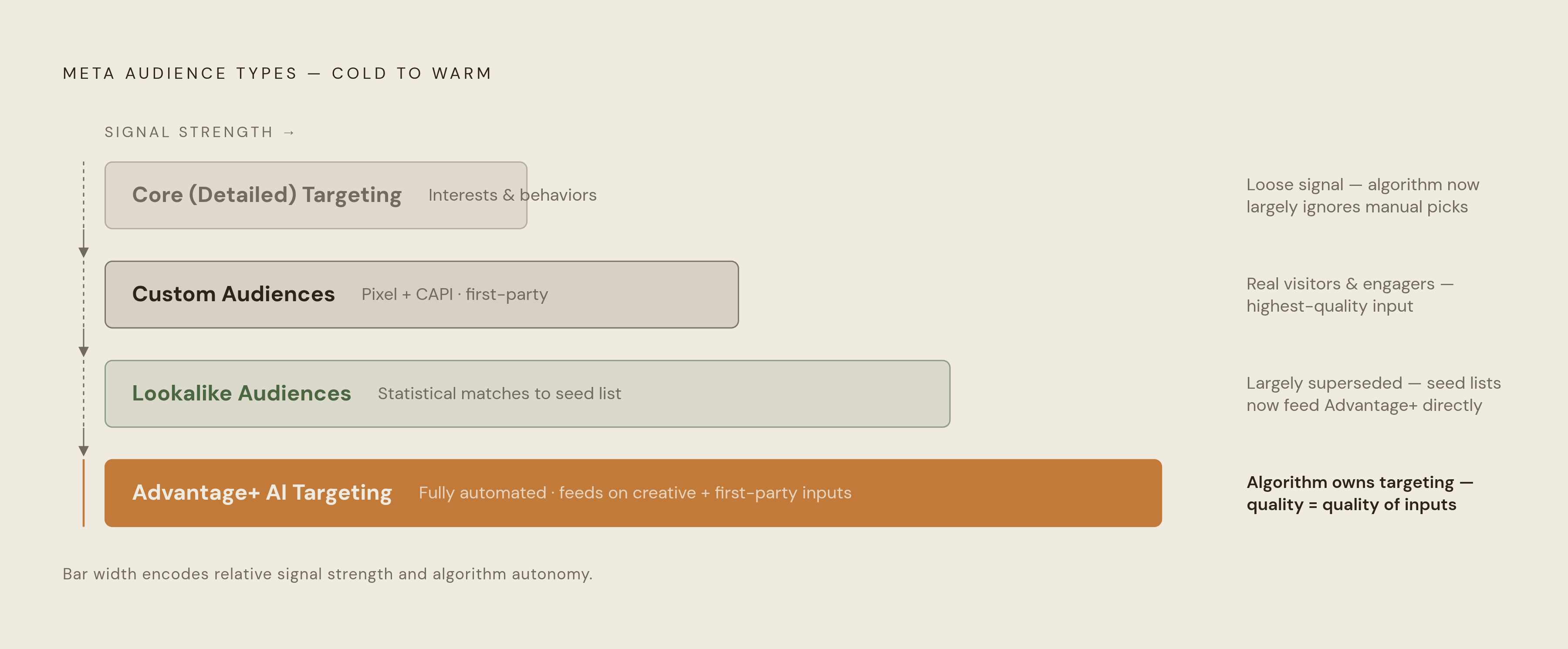
Every targeting decision in Meta Ads Manager falls into one of four categories. Understanding what each one does, and what it cannot do, is what prevents months of quiet budget erosion.
Core (Detailed) Targeting
These are the interest and behavior signals Meta infers from user activity: home improvement content engagement, interior design browsing, real estate activity, and the pages and accounts users follow. Homeowner-adjacent signals and home improvement interests are the most relevant layers for remodelers. Useful as a starting suggestion for cold audiences, particularly when you have no first-party data yet, but under the current algorithm these function as a loose nudge rather than a hard filter. The system uses them and then expands past them.
Custom Audiences
These are audiences built from your own data: website visitors tracked via the Meta Pixel, video viewers, people who have engaged with your Instagram or Facebook profile, and email or CRM lists uploaded directly. Custom audiences represent a high-quality signal you can give Meta because they reflect real people who have already had some contact with your business. They require both the Meta Pixel and the Conversions API to be running correctly; without both, the data is incomplete in ways that are invisible on the surface.
Lookalike Audiences
Meta finds people who statistically resemble a seed audience you provide, typically past leads, past customers, or high-value website visitors. The conventional workflow of building a one-percent lookalike has been largely superseded by a more efficient approach: feeding your customer list directly into Advantage+ lets the system do its lookalike modeling internally, using richer and more current signal than a manually constructed lookalike can access. Explicit lookalikes still have a role when data volume is high enough to produce a meaningful seed, but they are no longer the default best practice.
Advantage+ AI Targeting
Meta's fully automated mode. You provide creative, a conversion goal, and optionally a starting audience suggestion; the system handles delivery allocation. It performs best when fed strong first-party signals and high-quality creative. It performs poorly when creative is generic or when conversion tracking is broken. The quality of the inputs determines the quality of the outputs.
Geography and Homeowner Signals as the Foundation You Cannot Skip
For a local remodeling company, geography is the first and hardest constraint. Reaching homeowners in towns you do not serve wastes every dollar regardless of how sophisticated the rest of the targeting is.
Start with the exact cities, zip codes, or radius that maps to your actual service footprint. Not an approximation, not a generous buffer added because you would theoretically take a project two counties over. The actual area where your business operates and where you can profitably complete projects.
Within that geography, homeowner signals matter. Meta can surface people whose platform behavior suggests home ownership, home improvement interest, or recent real estate activity. Relevant interest layers include home improvement categories, interior design and décor, specific room-type content oriented around kitchens and bathrooms, and design inspiration accounts. These signals are suggestions under the current algorithm, but they still nudge delivery toward more relevant users when the audience would otherwise be entirely undifferentiated.
Income and life-stage signals can be layered as refinement where available. Treat them as secondary. Geography plus homeowner interest gets you most of the way there.
One structural mistake worth naming directly: do not stack so many interest filters on top of a tight radius that the audience drops below the volume the algorithm needs to learn and optimize. A highly specific audience that is too small produces an underpowered campaign that never exits the learning phase. Precision and volume have to coexist, and finding that balance requires careful testing.
Warm Audiences: Turning Past Engagement Into Your Most Efficient Spend
Warm audiences are people who have already demonstrated some interest in your business. They are easier to convert, cheaper to reach on a per-outcome basis, and more likely to remember you when they finally reach the end of their planning horizon and are ready to call. For a product with a consideration window as long as remodeling, warm audiences are not just a retargeting tactic. They are the mechanism by which you stay present through an entire decision cycle that can span seasons.
Website Visitors
Built from Pixel data, these are people who visited your site within a defined window. Seven to thirty days is standard for most products. For remodeling, testing extended windows of sixty or ninety days reflects the reality that project planning stretches across seasons. If your data volume allows it, segment by page: someone who visited your kitchen remodeling portfolio is in a different headspace, and responds to different creative, than someone who only hit your homepage.
Video Viewers
Anyone who watched a meaningful portion of a project video, process walkthrough, or testimonial on Facebook or Instagram. This is a warm signal that accumulates before someone ever visits your website, which matters for a category where the research phase starts long before a homeowner types anything into Google. Watching a significant share of a video indicates deliberate interest. The algorithm registers it as such.
Page and Profile Engagers
People who have liked, commented, saved, or messaged your Facebook or Instagram business profile. This pool frequently overlaps with video viewers. Treat the combined group as a single warm tier and serve them creative that advances the conversation rather than reintroduces it. They already know who you are; act accordingly.
CRM and Email Lists
Past leads who did not convert, past customers, estimate requesters. Upload these directly as a custom audience. This is a high-quality first-party asset. Past customers who had a positive experience are also a productive seed for finding new people who resemble them, which is a use many remodelers have not explored.
One structural note worth internalizing: combining warm and cold audiences within the same ad set is often more effective than separating them into entirely distinct campaigns. The algorithm learns what conversion looks like from the warm segment, then applies that signal when reaching cold users. The warm data trains the cold delivery.
What to Show Each Audience at Each Stage: Creative as the Targeting Layer
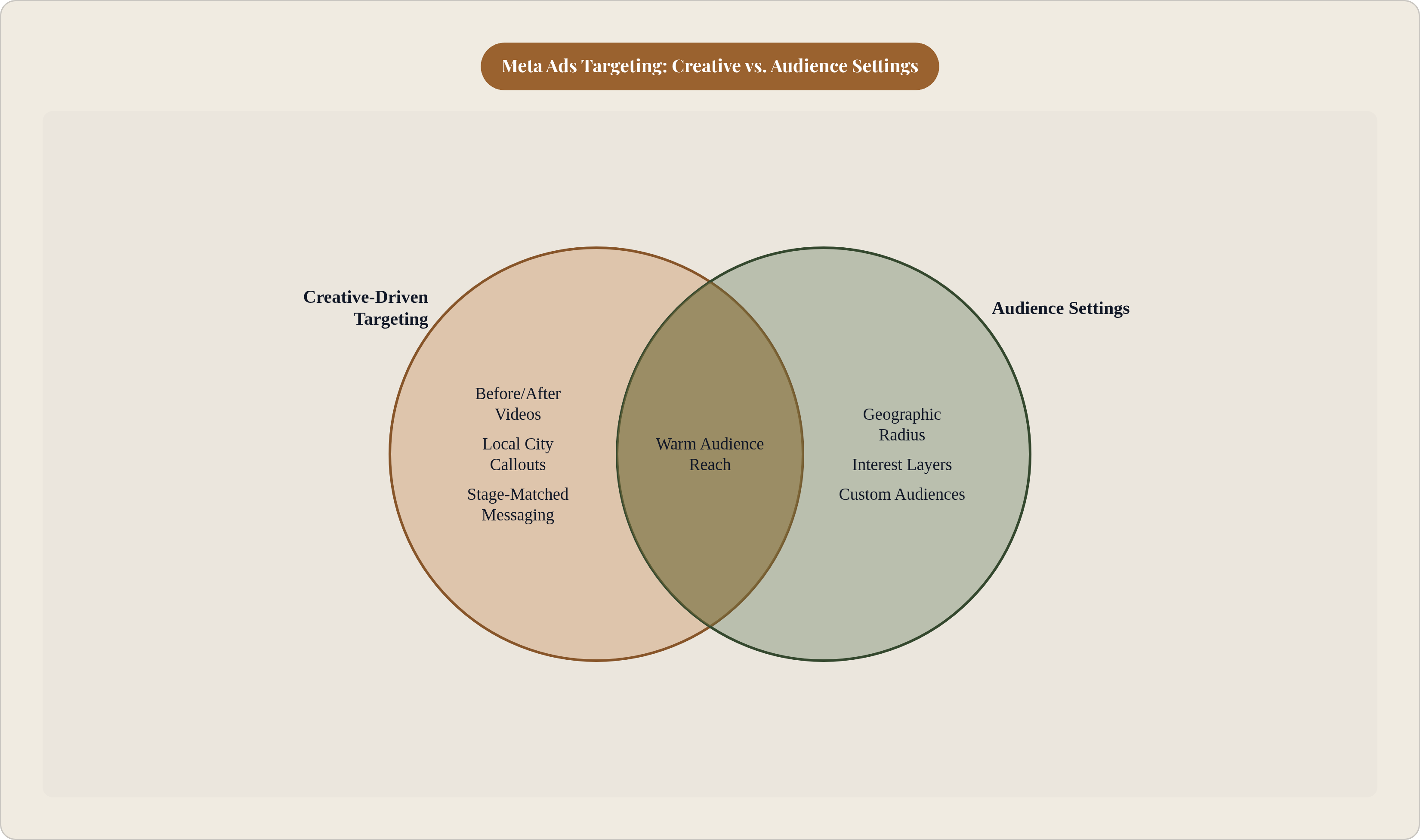
Because the algorithm reads creative to decide who to show it to, mismatched creative defeats well-built audience structure. A hard-closing ad shown to a cold homeowner who is still in the dreaming phase signals the wrong thing to both the algorithm and the viewer at the same time. The creative is not just the message; it is part of the targeting mechanism.
Cold and Awareness Stage
The goal here is to earn attention and plant recognition, not close. Before-and-after project transformations, short project showcase videos, and aspirational room reveals that feel like organic content rather than ads are strong formats at this stage. Tone should be proof-forward rather than pitch-forward: "here is what we built" rather than "call us today." A local callout in the first line or first frame, something as direct as "Attention [City] Homeowners," anchors the ad to the viewer's geography immediately and does filtering work that targeting settings cannot.
Avoid hard calls to action like "Get a free quote" at this stage. A low-pressure next step, "See more projects" or "Watch the full transformation," keeps cold audiences engaged rather than bouncing from an ask they are not ready for.
Consideration and Warm Stage
The goal shifts to deepening trust and moving the homeowner toward a specific step. Customer testimonial videos, process walkthroughs that demystify what hiring a contractor actually involves, and FAQ-style content that addresses common objections all perform well here. Social proof specific to your local area carries disproportionate weight: a homeowner in the same neighborhood carries more credibility than an undifferentiated five-star count.
Introduce a more specific offer at this stage. Not "free quote," which is generic and sounds identical to every competitor's offer, but "free kitchen remodel consultation" or a named service-area offer that signals you understand what this particular homeowner is considering.
Retargeting and High-Intent Stage
The goal is to convert someone who has already shown meaningful interest but has not acted. Relevant audiences here include website visitors who did not fill out a form, video viewers who watched a significant share, and engagers who messaged but did not book. Specific project case studies with clear outcomes, light urgency messaging around timeline or availability, and a direct call to action to book a consultation work best at this stage.
One rule worth enforcing strictly: do not serve the same ad someone already saw. Retargeting fatigue is real and measurable in declining response rates. Rotate creative and advance the conversation rather than repeating the introduction.
Across all stages, before-and-after imagery from real projects is a strong format for construction and remodeling when the transformation is genuine and clearly visible. Authentic project photography frequently outperforms polished stock imagery, particularly when tested directly.
Lead Form Design and Qualification: Where Targeting Precision Can Unravel
A well-targeted audience fed into a low-friction, generic lead form produces high volume and low quality. This is a common failure mode for premium remodelers, and it often goes undiagnosed because the dashboard shows leads coming in and the campaign appears to be working.
Routing paid Meta traffic directly to an instant lead form that sits entirely outside the company's website means the prospect never sees the project portfolio, the brand positioning, or the visual proof of quality that pre-qualifies a serious buyer before they submit their information. For premium remodeling work, the company website is part of the sales process. Sending cold traffic directly to an instant form skips that trust-building step and produces leads with no prior exposure to why this company is worth hiring.
Lead form questions should do qualification work. At minimum: project type, rough budget range, timeline, and service area confirmation. These questions slow down unqualified submitters and signal to qualified ones that this company operates at a certain level. The friction is not a problem to be engineered away; it is doing useful work.
More specific offer language in the call to action filters intent before the form is even opened. "Free kitchen remodel consultation" attracts a different person, in a different mindset, than "free quote." That difference compounds across hundreds of leads.
The qualification loop has to close back to Meta. Have your sales team tag lead quality in the CRM, and send that qualified or unqualified signal back through the Conversions API. This teaches the algorithm what a valuable lead looks like, not just what a form submission looks like. An algorithm optimizing toward qualified leads and one optimizing toward form submissions are materially different campaigns, even when the surface-level settings appear identical.
Speed to follow-up matters as much as targeting precision. A homeowner who fills out a form at noon and receives a response the next morning may have already engaged with a competitor who called within the hour. The targeting gets the lead in the door; the response protocol determines whether it becomes a job.
Tracking Infrastructure That Makes Targeting Work: Pixel, CAPI, and Conversion Signals
Meta's algorithm learns from conversion signals. If those signals are incomplete or degraded, it optimizes toward the wrong behavior: form views instead of qualified submissions, clicks instead of booked consultations. The output quality of the campaign is bounded by the input quality of the tracking, and that ceiling is lower than most remodelers realize.
The Meta Pixel alone is no longer sufficient. iOS privacy changes and browser-level tracking restrictions have degraded browser-side data significantly over the past several years. The Conversions API sends conversion data server-side, bypassing the browser restrictions that degrade Pixel data. Running both together provides redundancy and improves the quality of signal the algorithm receives from your campaigns.
What the Conversions API enables in practice: more accurate attribution of which ads actually produced leads and booked jobs; better optimization toward lead quality rather than lead volume when CRM signals are fed back through the API; and retargeting audiences that are more accurate because the engagement and conversion data powering them is more complete.
Without CAPI, custom audiences built from website behavior are thinner than they appear in Ads Manager. Lookalikes seeded from those audiences are weaker. The algorithm's ability to find more people resembling your best customers is meaningfully degraded, even when everything else in the campaign structure looks correct.
The practical setup priority is sequential: install the Pixel, configure CAPI, verify that events are firing correctly for the actions that actually matter, specifically form submissions, phone calls, and consultation bookings, not just page views. Page views are a proxy. Consultation bookings are the signal you want the algorithm learning from.
Campaign Structure, Budget Pacing, and the Learning Phase Remodelers Routinely Underestimate
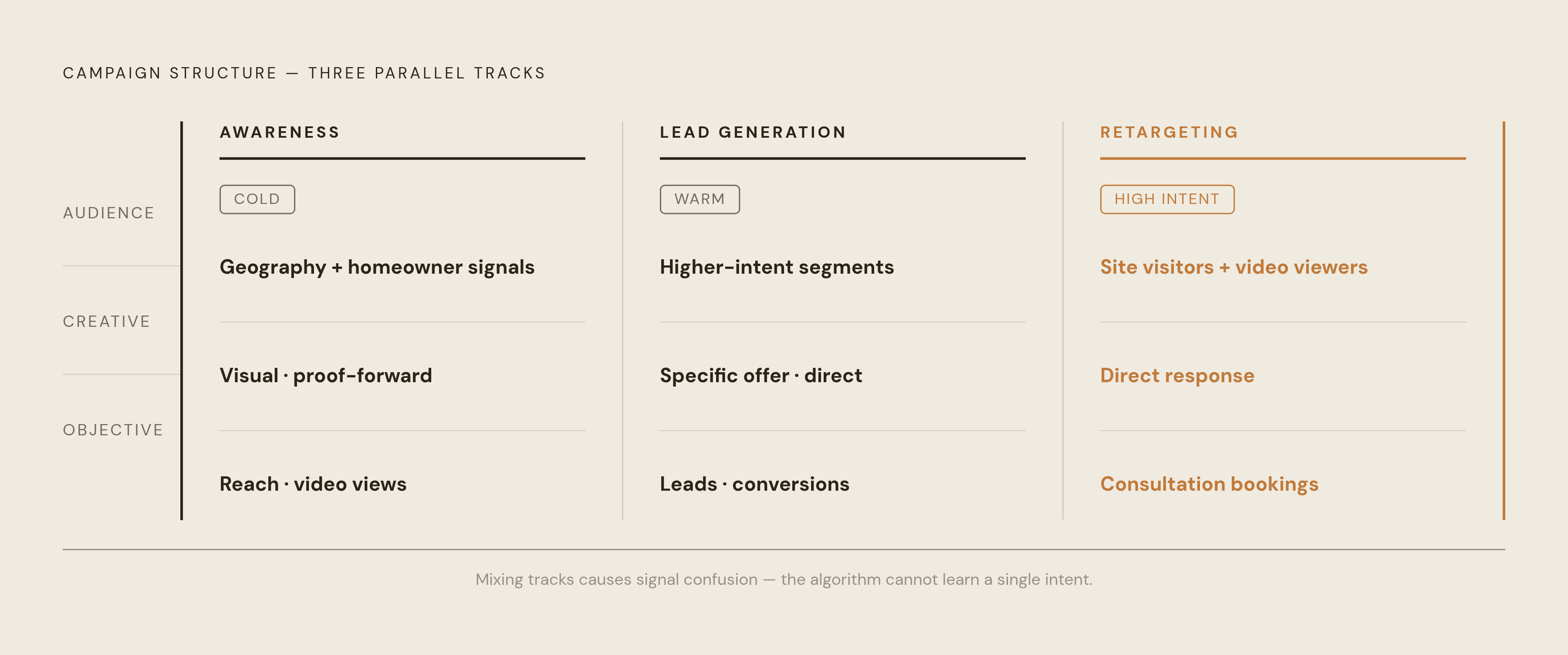
A workable structure for most remodeling contractors runs three distinct campaigns with separate purposes, audiences, and creative. An awareness campaign handles cold prospecting to geography plus homeowner signals, using visual and proof-forward creative with an objective of reach or video views. A lead generation campaign serves warm audiences with higher-intent creative and a specific offer, with an objective of leads or conversions. A retargeting campaign addresses high-intent behaviors, website visitors and video viewers who have not yet taken action, with direct-response creative and a clear next step.
Keep these campaigns separate. Each has a different audience temperature, a different creative approach, and a different optimization objective. Mixing them produces signal confusion that slows or prevents the algorithm from learning effectively.
The learning phase is the most misunderstood element of Meta campaign management in this industry. Every time you change an ad, adjust a budget significantly, alter an audience, or reset a campaign, the system re-enters a learning phase and requires a new threshold of conversion events before it optimizes reliably. Constant tinkering — changing the creative after two days because the numbers look flat, halving the budget after a slow week — does not refine performance. It resets it. The campaign never accumulates the data it needs to work.
Budget pacing follows directly from this. A campaign funded too thinly cannot generate enough conversion events to exit the learning phase. The result is a campaign that perpetually underperforms, which prompts the advertiser to reduce the budget further, which makes the data starvation worse. This cycle can run for months before someone realizes the problem was never the platform. The minimum viable budget for a remodeling lead generation campaign is determined by the cost per conversion event in your market; the campaign needs enough daily budget to generate sufficient events per week to satisfy the learning algorithm. Running below that threshold is not a cost-saving measure. It is paying for a campaign that structurally cannot work.
The advertisers who get the most from Meta are the ones who build the structure correctly, fund it adequately, and then leave it alone long enough for it to learn. That last part is harder than it sounds. The impulse to adjust something when results feel slow is almost universal, and it is almost always counterproductive. Resisting that impulse, sitting with ambiguity while the system accumulates data, is what separates remodelers who generate a consistent pipeline from Meta from those who run it for a month, decide it doesn't deliver, and go back to hoping Google delivers enough volume on its own. Contractors who want the tracking, CRM feedback loop, and follow-up speed handled inside one system sometimes turn to platforms like Wonderly, a revenue-share AI business software platform for remodeling and hardscaping contractors that unifies marketing, sales, and operations without charging upfront.