Follow-Up Cadence for Unsigned Hardscape Quotes
Most hardscape bids die from silence, not from being told no.
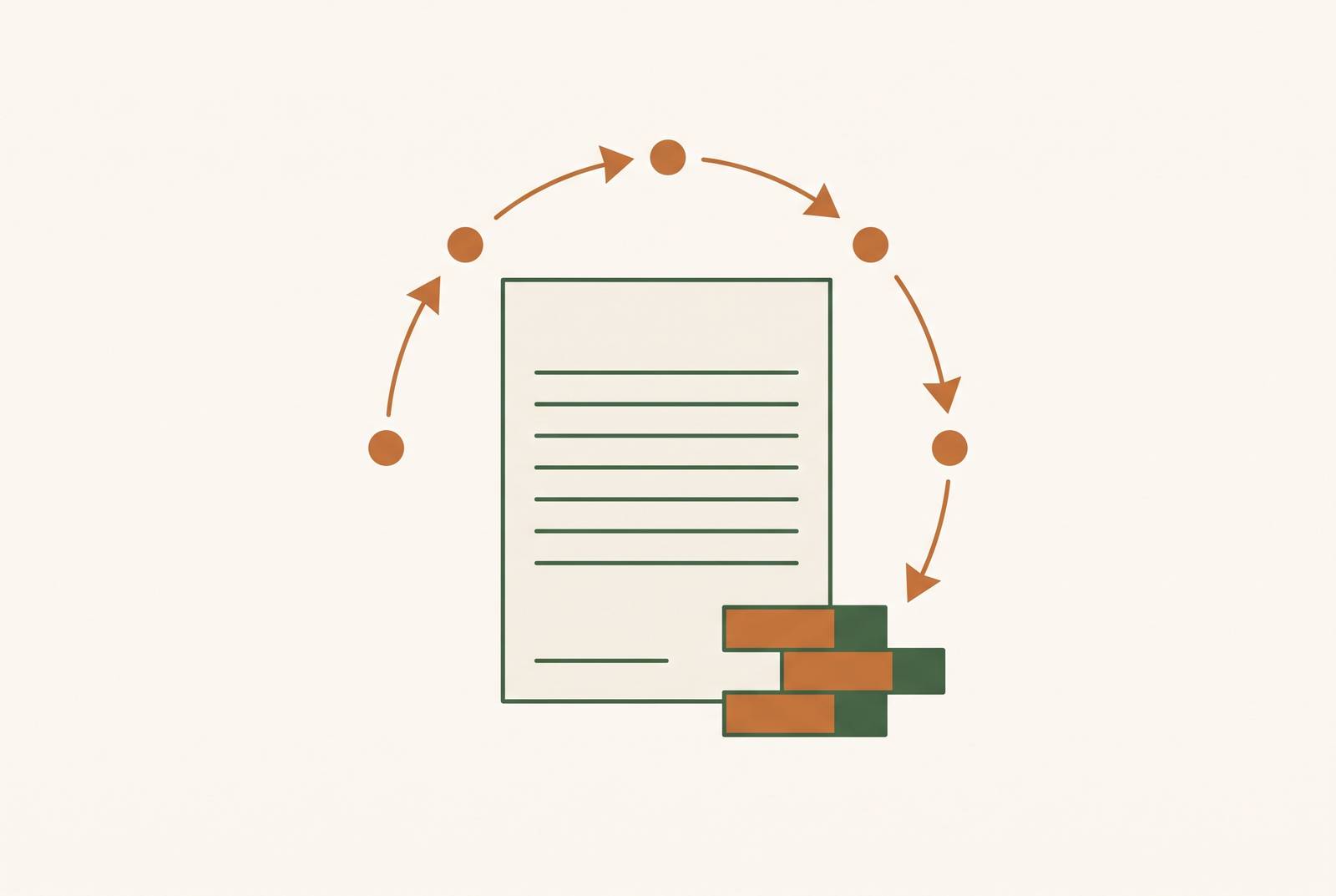
Most hardscape contractors lose signed jobs for one reason: they stop following up before the homeowner is actually ready to say yes. A quote that converts closes in a median of two days, while a quote that dies sits untouched for a median of 29 days, and nobody told the homeowner no. Nobody told them anything at all, and that silence is the whole story.
The recurring finding when looking at follow-up patterns is that slow or absent follow-up is a primary reason bids get lost to competitors. Across a dataset of 432,000 quotes from 745 contractors, the pattern holds at scale: the homeowner didn't decide against the contractor, they moved on because nobody moved them forward.
For hardscape work specifically, patios, retaining walls, driveways running tens of thousands of dollars or more, this matters more than in most trades. A single recovered quote can outweigh months of ad spend, and losing one to silence instead of to a competitor's better price compounds quietly across a whole pipeline. Most owners never see it happening until someone finally pulls the numbers.
How far most contractors fall short of where deals actually close
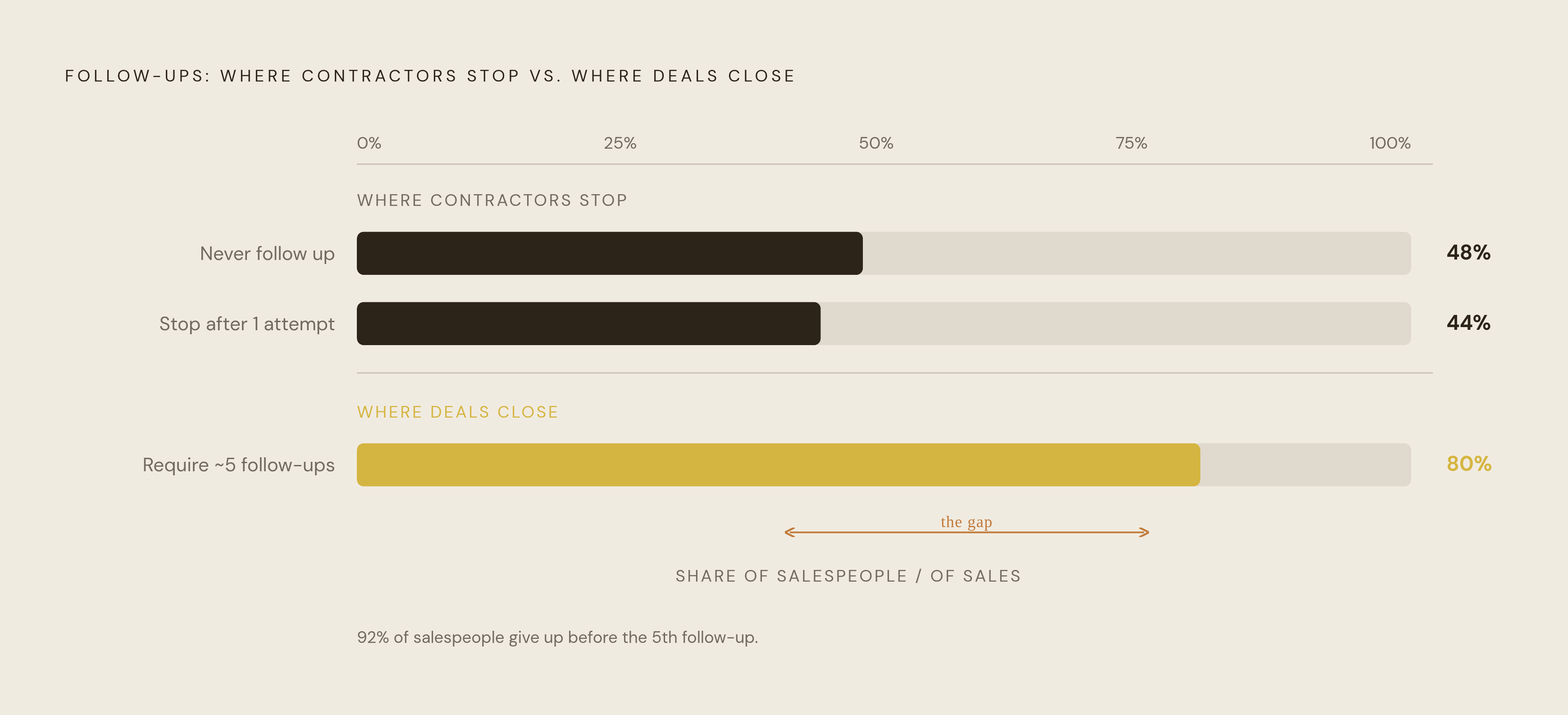
Here's the number that reframes everything: 80% of sales require roughly five follow-ups after the first contact, according to Invesp's 2024 research. Meanwhile, 48% of salespeople never attempt a single follow-up, and 44% quit after just one try. Sitting with those two numbers together, the conclusion is hard to avoid: most contractors stop long before the point where deals actually get won. This looks like a scheduling failure, plain and simple, and it shows up before pricing or workmanship ever enter the conversation.
The homeowner rarely rejects the offer outright. More often, the fifth call never happens because it felt awkward, or the owner forgot, or the job site ate the afternoon, and those are habits nobody's fixed yet, even though they're fixable.
The median contractor converts 38% of quotes sent. Push that to 48% on the exact same pipeline, same leads, same crew, and that ten-point swing is worth roughly $300,000 on a $3 million book of business. Working through where that gap actually comes from, it traces back to cadence and timing more than to anything about the offer itself. It's the cheapest $300,000 most contractors will ever leave on the table, and they leave it there because calling back on schedule feels less urgent than the next estimate.
Homeowners shopping a a high-four-to-five-figure hardscape project are almost never talking to one contractor. They're comparing three or four, and the one who stays visible, who keeps showing up in a text or a call without being pushy about it, earns the final walkthrough and the signature, while everyone else just sent a nice PDF and went quiet.
What homeowners actually need between receiving a quote and signing it
A homeowner who just received a quote isn't sitting there deciding yes or no in a vacuum. Questions they didn't think to ask during the estimate visit pile up fast once the salesperson leaves, and the same handful of concerns repeat across almost every hardscape job:
- How long does this quote stay valid, and is financing on the table?
- What does the warranty actually cover, and how soon could work realistically start?
- Will the crew show up, finish, and not vanish halfway through, and who do they call if something goes wrong mid-project?
Two of the most common hardscape buyer types, the practical backyard upgrader and the retired homeowner improving quality of life, are especially tuned to trust signals. They're buying assurance that their yard won't turn into an unfinished construction site for six weeks, right alongside the patio itself. They need to know the process will be managed, not just sold to them once and abandoned.
A follow-up call that answers these questions before they're even asked feels like relief. Skipping that relief just hands the job to the next name on the homeowner's list. Every touchpoint in a good cadence exists to deliver information and presence, with pressure kept out of the equation entirely; that's the whole justification for running one at all.
The four-checkpoint follow-up cadence and what each touchpoint should do
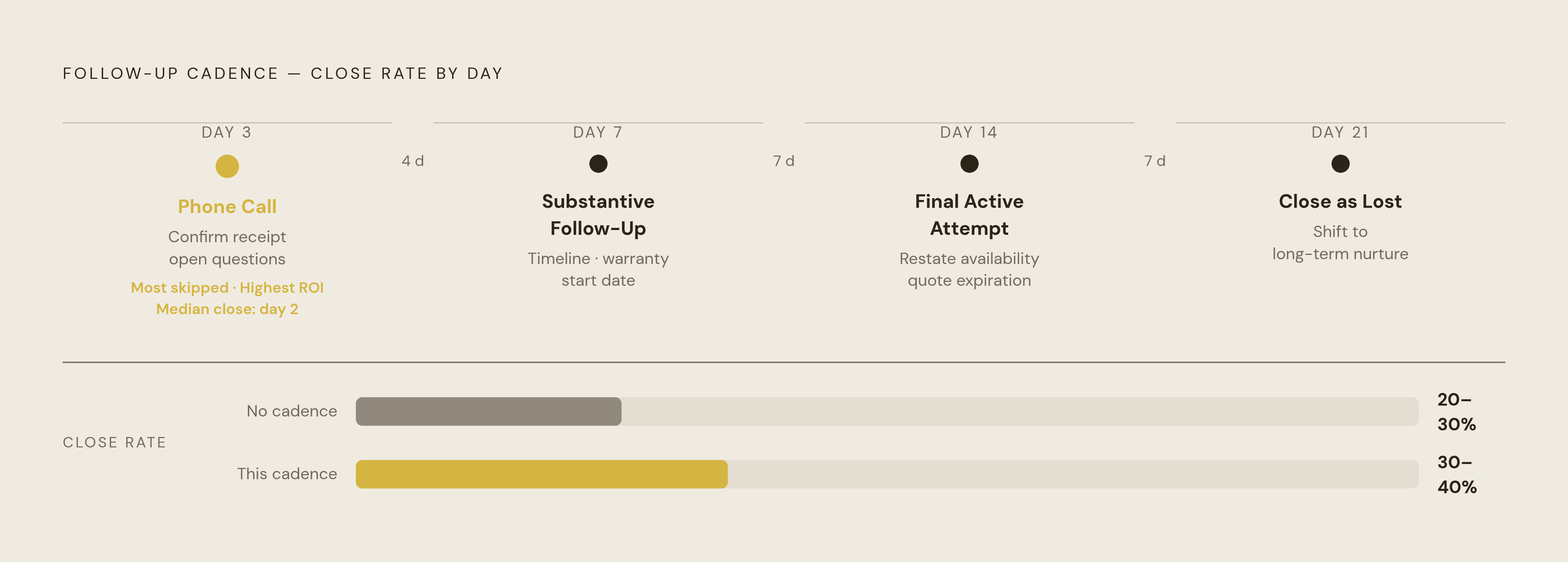
Analysis of that 432,000-quote dataset, via levelcfo.com, maps out a four-checkpoint structure that holds up across the industry.
Day 3: the phone call. First live contact after the quote goes out, meant to confirm they received it, ask if anything's unclear, and set the expectation that another check-in is coming. Leave the door open without pitching anything.
Day 7: the substantive follow-up. This is where the contractor gets ahead of objections before they calcify: timeline, warranty, start date. Offer to walk through the quote again, line by line, if it helps.
Day 14: the final active attempt. Restate availability, and if the quote has an expiration window, say so plainly, making it as easy as possible to either say yes or book one last conversation.
Day 21: close it as lost, but don't ghost. Mark it clearly in the system and shift the homeowner into a longer-term nurture sequence instead of dropping them entirely.
Channel choice matters as much as timing, and text wins that comparison badly. Open rates sit around 98% per Omnisend, with roughly 90% opened within three minutes per Tatango. Email lags at 20 to 28% open rates but still carries the weight, since it's the right format for attaching project photos, financing breakdowns, or warranty documents. The pairing that works: a short text that prompts action, followed by an email that delivers the substance.
Tone separates the contractors who convert from the ones who annoy. The line that works: "I want to make sure you have everything you need to feel good about this decision." That's the voice of an advisor, and homeowners can tell the difference immediately. Contractors running no structured sequence close 20 to 30% of quotes; contractors running one close 30 to 40%. The cadence is the difference-maker.
Why the Day 3 call is the most important touchpoint most contractors skip
Most contractors send the quote and wait indefinitely, or follow up so late the moment's already passed. Convertible quotes close in a median of two days, which means Day 3 lands almost exactly when a homeowner's decision is still forming, and skipping it is the single most expensive habit in this whole cadence.
Speed matters more than most owners assume. The faster a contractor shows up after the moment of interest, the better the odds of catching a homeowner while the quote is still fresh in their head, rather than filed away under "deal with later."
The Day 3 call centers on being present at the exact window when the homeowner has re-read the quote, mentioned it to a spouse, and started forming real questions. The script matters here: don't ask "did you decide yet?" Ask instead, "I wanted to make sure the quote answered everything you needed. Do you have any questions I can clarify?"
For contractors who find this call uncomfortable, the reframe is simple: this is help being offered, and a homeowner who isn't interested will say so, which is itself a useful answer. The contractor who calls on Day 3 and handles concerns live has a structural edge over every competitor who sent a PDF and disappeared.
How automation handles the cadence when an owner can't
Manual follow-up fails for a predictable reason: it needs an owner who remembers, has time, and doesn't feel weird making the call. All three break down the moment a job site gets busy, which is most days, most weeks, most months in this trade.
A workflow that triggers the second an estimate gets marked "sent" removes the memory problem entirely, and the cadence fires on schedule regardless of how the week is going. Wonderly, an all-in-one AI platform for remodeling and hardscaping contractors, is built around this kind of automatic triggering. AI-driven systems now handle the full sequence:
- Automated SMS that fires on the right day with the right message, paired with email sequences carrying project-relevant content: photos of comparable completed work, warranty language, financing details
- AI-driven virtual call teams that place the outbound follow-up calls, sound natural on the phone, record and transcribe every conversation, and flag anything that needs a human to step in
The piece that actually matters is integration. Automation tied into a contractor's CRM and job history can reference the specific quote, the homeowner's name, and the exact project type in every message, which keeps it from reading like a form letter that got their address off a mailing list.
Adoption is already moving fast in adjacent trades. Jobber's 2026 report, surveying 1,050 business owners, found 67% of roofing pros already using AI to handle quoting and follow-up, with HVAC adoption at 81.5%. Hardscape lags behind both, and every contractor waiting to adopt is handing that gap to whoever moves first, a gap that doesn't close itself.
What to do when a homeowner goes quiet after Day 14
Closing a quote as lost on Day 21 is a system hygiene step, not a farewell. A homeowner who didn't convert in three weeks might be sitting two months out from being ready, since budgets get approved late, spouses need convincing, and spring gets pushed to fall for reasons that have nothing to do with the quote itself.
Long-term nurture for hardscape buyers runs on a slower rhythm than the active cadence:
- A quarterly touchpoint, a photo of a recently finished project similar to what they quoted, sent with no ask attached
- A seasonal nudge: "We're booking spring installs now, your quote's still on file if you want to revisit it"
- Passive reengagement through reviews, since a Google profile with a strong, growing review count does follow-up work without anyone lifting a phone
- A short check-in call around month two, timed to whatever the homeowner mentioned as their own timeline back on Day 7
Homeowners consistently turn to reviews before picking a contractor, so a business with a steadily climbing review count stays credible in someone's mind months after the original quote went cold. The practical backyard upgrader and the new-home upgrader in particular tend to delay because of budget timing, not lost interest, and a light nurture sequence catches them exactly when that timing shifts.
The rule worth keeping: close the quote in the system so the pipeline stays clean, but never close the relationship. Treat those as the same decision, and the contractor loses homeowners who were always going to come back.
Building a follow-up system that scales past the owner doing everything
Manual follow-up has a ceiling, and it's lower than most owners think. A solo operator or small crew can reasonably track a cadence across ten to fifteen open quotes, but push that to forty or fifty and the whole thing collapses, not gradually, but all at once, the exact week the owner gets busy running an install.
A system that functions looks like this operationally: every quote sent enters the cadence automatically, with nobody having to remember to schedule it. Responses get logged and surfaced instead of buried in a text thread on someone's phone. The owner or salesperson only gets pulled in when a touchpoint generates a real signal: a question, an objection, a request to meet.
That's the actual shift, a capacity shift built on freed-up hours. When the repetitive layer of follow-up runs on its own, salespeople spend their limited hours on the prospects who are actually ready to close, instead of splitting attention across fifty quotes in various states of neglect.
Run the numbers again on what's at stake. A contractor converting 38% instead of 48% on a $3 million pipeline isn't looking at a rounding error. That's $300,000 that already made it through the estimate, through the site visit, through the whole sales process, and then walked out the door because nobody called on Day 3.
The contractors closing 48% or more of their quotes aren't doing anything mysterious. Follow-up, for them, runs as a standing system: automatic, every time, on schedule, whether the owner remembers or not.