Onsite Appointment Booking Rates for Hardscape Inquiries
Fast response and smart filtering turn hardscape leads into booked appointments.
Onsite booking rate for hardscape inquiries comes down to two things: how fast a contractor responds, and how well they filter, before anyone ever sets foot on the prospect's driveway. Zip code, competition, and weather get blamed constantly, but they're rarely the actual cause. The contractors who treat speed and filtering as a system book more visits with buyers who were already sold before the truck showed up.
What "onsite booking rate" actually measures and why it varies so widely across similar markets
Booking rate is the share of inbound hardscape inquiries that turn into a confirmed, kept onsite appointment. It's a scheduled visit that actually happens, distinct from a maybe, and distinct from a "let me check my calendar and call you back."
Two contractors working the same fifteen-mile radius, quoting similar patio and outdoor kitchen jobs, can post wildly different booking rates. Market conditions get blamed first, and that's usually the wrong place to look. Response speed, qualification depth, and the friction sitting between inquiry and calendar slot are things a contractor controls directly, every single time.
The math is why this deserves obsession rather than a shrug. At five-figure to well-into-the-tens-of-thousands ticket sizes, a small bump in booking rate swings revenue out of proportion to the effort behind it. A contractor running 80 leads a month doesn't need a better sales pitch to move the needle. A few more kept appointments a month, at that ticket size, reshapes the whole quarter.
Two distinct failures get lumped together constantly, and they call for different fixes. Some inquiries never get contacted at all, lost at the top of the funnel before anyone tries. Others get contacted, but the conversation never turns into a scheduled visit, lost somewhere in qualification. A high no-show rate downstream of a "successful" booking is usually a third signal hiding inside the second: whatever qualification happened before the appointment was too thin to hold the prospect's commitment.
How response time collapses booking rate before a contractor ever speaks to a prospect
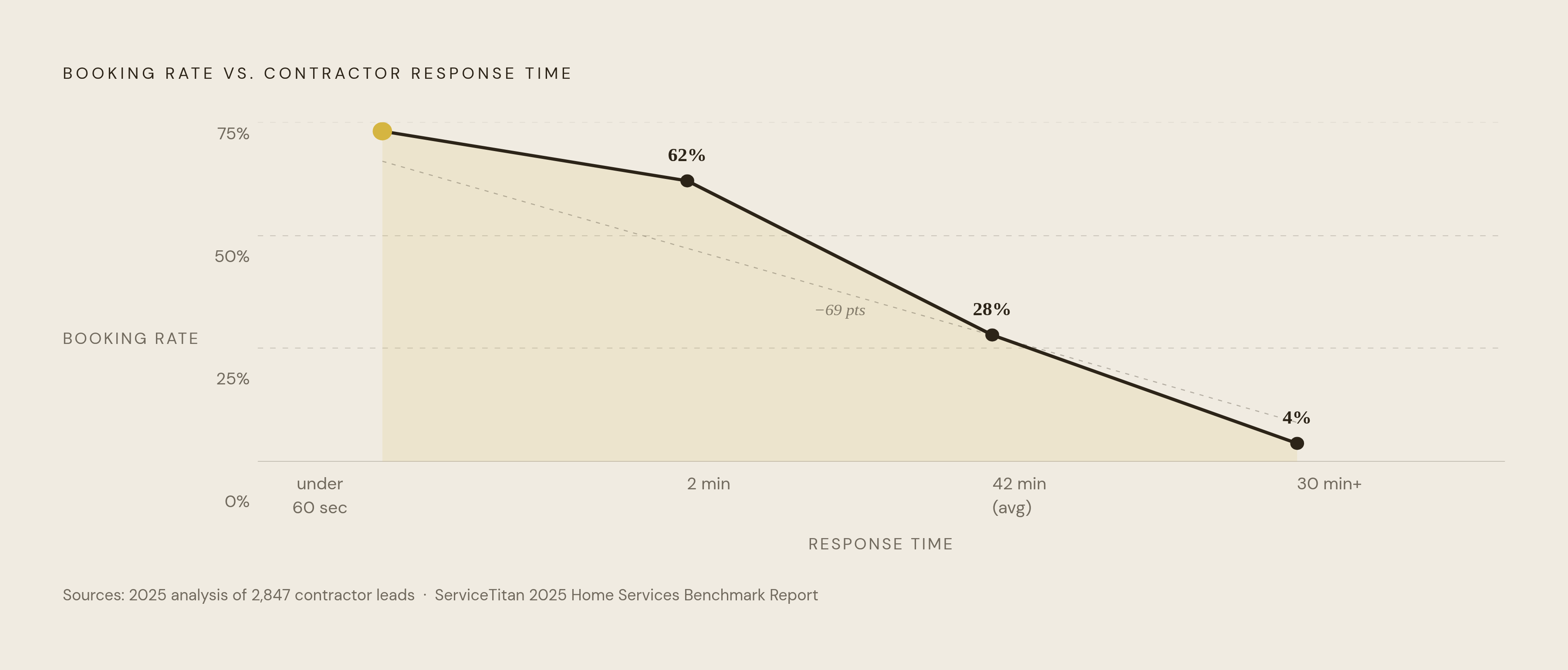
Here's the number that should reorder every contractor's priorities: text responses under 60 seconds hit a 73% appointment booking rate, according to a 2025 analysis of 2,847 contractor leads. Responses after 30 minutes, on those same leads, fell to 4%. That's not a slope, it's a cliff, and most contractors are standing at the bottom of it without knowing it.
This is what's happening on the buyer's end, and why the cliff exists. Someone fills out a hardscape inquiry form because they want a patio, a retaining wall, an outdoor kitchen, and they've got two or three other contractor tabs open at the same time. There's a short window where that intent runs hot, which is the window Wonderly, an all-in-one AI platform for remodeling and hardscaping contractors, is built to capture. Whoever responds first with something credible usually ends the search right there; HubSpot's 2024 Sales Trends Report found 78% of consumers buy from the first company that responds to their inquiry, full stop, regardless of category.
Most contractors never get near that window. Hatch's analysis of more than 132,000 HVAC speed-to-lead campaigns in 2024 found only 12% of contractors respond within 5 minutes, and the single most common response bucket was 1 day, at 37% of contractors. Nearly a quarter never respond at all, quietly declining their own leads by default.
Now the part that turns this into a dollar figure. ServiceTitan's 2025 Home Services Benchmark Report found contractors who respond within 2 minutes convert 62% of leads, against 28% at the industry-average 42-minute response time. For a business running 80 leads a month, that gap works out to $381,000 in lost annual revenue. A contractor with genuinely strong qualification, but a slow response clock, is losing most of its bookings before qualification ever gets a chance to run.
Why automation alone doesn't solve the response problem (and what the right stack looks like)
The obvious fix, bolt on a chatbot, doesn't actually close the gap. Chatbot-only responses carry a 14% lower conversion rate than human responses, even when the bot replies instantly. Trust is the harder half of the problem, and trust doesn't automate well.
The combination that works is narrower than most contractors expect: an instant automated acknowledgment, paired with personalized human follow-up inside 5 minutes. Teams running that hybrid see 34% higher conversion than either pure automation or pure human response on its own. Speed opens the door; a person closes it.
Automation should stick to a short, specific list of jobs, and nothing beyond it:
- Send an instant acknowledgment text or email confirming the inquiry landed
- Push out a pre-qualification intake form before a human joins the thread
- Cover after-hours gaps so a lead doesn't sit untouched until 9am
- Route the lead to the right person, with context already attached
Reading hesitation, answering a design question that needs judgment, building the trust a buyer needs before committing to a high five-figure project: that work needs a person, every time, no exceptions. Asking automation to do a human's job because it's cheaper is the mistake worth naming.
The pre-qualification filter: what to ask before an onsite visit is ever offered
Serious buyers don't mind five minutes on an intake form. Unqualified prospects self-select out the moment direct questions about budget and timeline show up, and that's the filter doing exactly what it's built to do.
Three questions carry almost all the weight. Budget range comes first, not an exact figure, just a realistic band that confirms the inquiry fits the contractor's project-size lane. Timeline is second: "when are you hoping to start" separates someone with a real window from someone browsing Pinterest with no urgency behind it. Scope is third, a short project description that reveals fast whether this fits the contractor's actual service mix or is a mismatch dressed up as a lead.
Geography deserves its own screen, run in parallel with the other three, not folded into them. Collecting the address upfront lets a contractor enforce a service radius, often somewhere around 20 minutes, before an estimator's whole day gets committed to a drive that never should have happened. Out-of-radius inquiries get declined or referred out immediately, since accepting them anyway just delays the waste by three days.
Done right, this filter produces a scope like a high five-figure patio and outdoor kitchen job, where the buyer has already disclosed budget and real intent. The vague "just curious about pricing" contact clogs a pipeline without ever converting, and no amount of follow-up skill fixes a lead that was never qualified to begin with.
There's a failure mode on the other side worth naming directly: push the intake form too far, with too many fields or a tone that reads like a loan application, and genuinely qualified buyers get discouraged before they finish it. The target is the minimum number of questions needed to confirm budget, timeline, and geography, kept tight rather than expanded into a full project brief.
The payoff is real. Best-in-class systems convert a properly filtered pool into a close rate of roughly six in ten estimates, according to Digital Contractors, against an industry-average close rate of roughly one in four. That gap traces back to how the pool got built, far more than to anything that happens on the driveway.
What happens to the leads that don't book immediately (and why most contractors abandon them too soon)
Roughly half of all inbound leads aren't ready to buy the moment they inquire. That's just how high-ticket purchases work: people research before they commit, and a large backyard renovation doesn't get decided on one phone call.
According to InsideSales.com, 63% of leads who weren't initially ready eventually convert, provided they go through a real nurture process, and nurtured leads make 47% larger purchases than leads who got no follow-up at all.
Most contractors give up on this pool way too early, and here's exactly what that abandonment looks like: one unreturned call, then silence, no structured sequence beyond the first attempt. A "not ready yet" gets logged and treated, functionally, like a "not interested," which it almost never is. That's the mistake worth calling out directly, because it's the single most avoidable one in this entire funnel.
Fixing it doesn't take complexity. A check-in text or email at a defined interval, two weeks out, then a month out, keeps the door open without turning pushy. Seasonal framing works as a natural trigger too: "spring booking windows are filling up" gives a dormant lead a real reason to respond now instead of never. Sending photos of recent completed work does the same job passively, keeping the contractor top of mind until the buyer's timeline finally catches up to their interest.
This loops straight back into booking rate. The contractors posting the highest sustained numbers aren't just winning today's fast-moving inquiries; they're also converting last quarter's unbooked leads, the ones competitors already wrote off and stopped calling.
How to set a booking rate target and track it as an operational metric
None of this requires new software to start. Track total inbound inquiries a month, across calls, form fills, texts, and referrals, and track total confirmed onsite appointments completed, not scheduled, completed. Divide one by the other, monthly. Even a rough version of this number exposes exactly where the pipeline is bleeding, usually faster than a contractor expects.
A couple of benchmarks help with orientation. Specialized appointment services report booking 15 to 25 appointments a month per client, a reasonable floor for a contractor running active marketing. The close-rate gap between a filtered pool (roughly six in ten) and the industry average (roughly one in four) shows what a well-built booking list is actually worth, in dollars, not just percentage points.
Two leading indicators predict where booking rate lands before the month even closes. Median response time to new inquiries is the first: above 5 minutes, speed is almost certainly the primary leak, and it's worth ruling out before diagnosing anything else. Qualification dropout rate is the second, the share of people who start an intake form but never finish it. A low completion rate usually means the form runs too long, or the questions push too hard, too early.
The single highest-leverage decision a contractor can make is treating the gap between inquiry and first response as a managed service-level agreement, with clear accountability, rather than leaving it to best-effort courtesy. Real accountability means one specific person, or one specific automation layer, owns every lead landing inside a defined response window, with no shared inbox and no "whoever sees it first."
Contractors who run booking rate as an actual operational metric stop blaming the market when the pipeline runs thin. They find the exact step that's leaking, and they fix that step. That's the whole difference between a contractor who scales past the industry average and one who plateaus right at it, wondering why the phone stopped ringing.