CRM and Estimating Integration for Hardscape Companies
Connecting estimates and CRM closes profit leaks hardscape companies don't see until invoices land.
A contractor runs crews for a week on a patio job that looked profitable on the quote. Materials got ordered, labor got logged on a clipboard or a separate app, and the invoice went out at the end of the job. Only when the final numbers get tallied does the owner see that actual margin ran half of what the estimate promised. That gap between what was quoted and what was earned is the subject of this piece: when CRM and estimating run as separate systems, hardscape contractors lose margin at every handoff, not just hours of office time.
A lead sits in one system while a quote gets built somewhere else. Material costs never attach to the job record. Nobody sees the profit number until the invoice is already sent and the job is closed. That's the mechanical path margin takes when it leaks, and it happens on nearly every job where the tools don't talk to each other.
Design-build and hardscaping projects run gross margins between 25% and 40%. That range is why a misquoted material tier or a few hours of unbilled labor represents real money, not a rounding error. A patio job priced at the high end of that range can slide to the low end, or below it, from a handful of untracked costs that nobody flagged in time to fix.
Fragmented tools are the deeper cause: when the pieces of a job's financial picture live in separate systems, nobody can see the real margin until the invoice is already sent. Most hardscape owners estimate profit on feel: quote the patio, spend on materials, assume the job made money. Labor overruns and uncaptured material costs erase that margin quietly, and the owner finds out weeks later, on an invoice, with no way to go back and recover what was lost. The rest of this piece traces where that leak starts, where it compounds, and what closes it.
How a fragmented tool stack prevents hardscape contractors from seeing their own numbers
The cause of margin leakage in most hardscape businesses has nothing to do with estimating skill or crew performance. The information a business needs to manage profit lives in at least three places that don't talk to each other: a contact database, a quoting spreadsheet or standalone estimating tool, and an accounting package that receives data too late for anyone to act on.
Every handoff between those systems is a place where something breaks. A measurement gets retyped wrong moving from the site visit to the quote. A material cost never gets attached to the job record. A scope change a crew lead mentions in passing never makes it into the paperwork, and the extra work goes unbilled because nobody wrote it down.
Running separate tools for measurement, quoting, time tracking, and accounting puts a hardscape office in the same fragmented pattern that shows up across knowledge work generally, where workers juggle a large number of disconnected applications daily just to do one job. In a hardscape business, that means per-job cost tracking lives in one place, satellite measurement in another, billing in a third, and crew routing in a fourth, each one blind to what the others know.
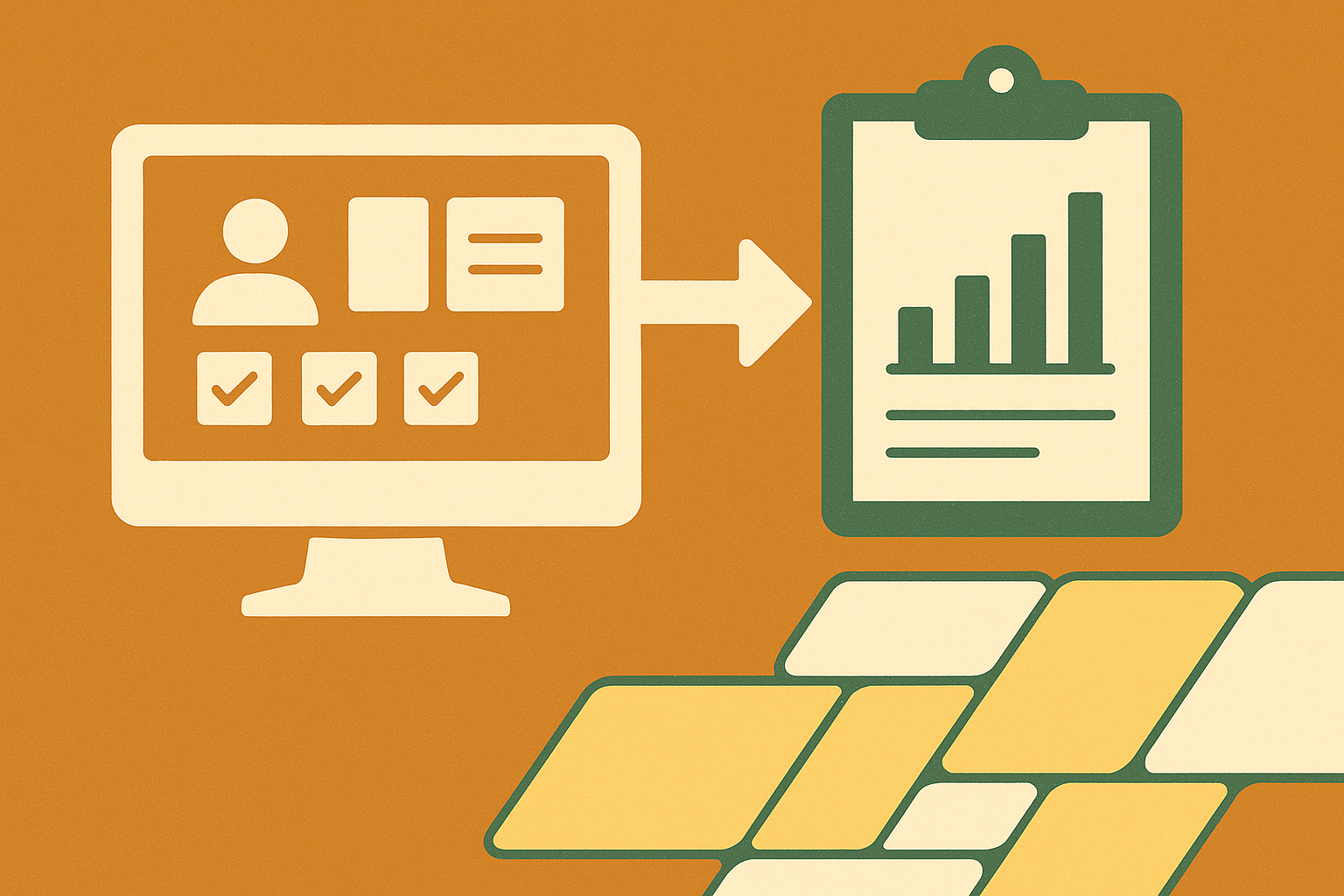
A platform built specifically for the trade removes the broken syncs, the conflicting contact statuses, and the double data entry that a fragmented stack produces by design. The estimate a homeowner signs becomes the scheduled work. The scheduled work generates the photo record. The photo record feeds the cost report. One record moves through the business instead of four records that have to be reconciled by hand.
Stack cost matters here too. Published pricing comparisons show that stitching together separate tools for CRM, estimating, scheduling, and billing costs more in total than a single platform built to handle that full workflow, which typically starts well below what the combination runs. The case for a connected system is also a cost comparison that favors one bill over several.
Lead Response Speed Is Where the Revenue Loss Starts
Whether a hardscape project converts at all is decided before the estimate exists. It's the connection between lead capture and quote delivery, and the gap most contractors leave open here gets measured in hours that cost them jobs.
Firms that respond to leads faster qualify them at dramatically higher rates than firms that wait. Research from Harvard Business Review, studying 2,241 U.S. companies, found that firms contacting leads within an hour were 7 times more likely to qualify them than firms that waited even 60 minutes longer. Research from MIT and InsideSales.com found that responding within 5 minutes makes a firm 21 times more likely to qualify a lead than waiting 30 minutes. The conversion gap doesn't widen gradually. It widens sharply in the first hour after a homeowner reaches out.
Most hardscape and landscaping businesses aren't built to respond that fast. The lead comes into one system. Someone has to manually pull property details, build a quote in a separate tool, and send it, a process that in a manual workflow eats most of a workday by the time it's done. By the time the quote lands in the homeowner's inbox, that homeowner has often already gotten a faster response from a competitor.
Closing that gap takes a specific sequence running without manual handoffs. A lead comes in through the CRM, whether from a web form, a phone call, or a homeowner using a self-quote tool. Satellite property measurement pulls square footage automatically, so no site visit is required to produce a preliminary number. AI estimating generates a draft quote from that measurement and attaches it to the customer record already created at lead capture. The quote reaches the homeowner while the conversation is still live, not a day later after the moment of interest has cooled.
What satellite measurement and tiered pricing do to hardscape quote accuracy and close rate
Hardscape estimating carries two problems that generic contractor software doesn't solve. Measurement requires knowing the area before pricing can happen at all, and every project carries at least three legitimate material options at different price points. A single-number quote is always wrong in one direction or the other: it either underprices the job or leaves upgrade revenue sitting on the table unclaimed.
Satellite measurement solves the first problem directly. QuoteIQ's MapMeasure Pro feature lets a hardscaping company measure patio areas, driveway dimensions, walkway lengths, and retaining wall linear footage from satellite imagery before anyone sets foot on the property. The August 2026 release added a historical aerial imagery timeline, letting contractors scroll back through past imagery to see what existed on a property before previous owners modified it, which helps clarify scope disputes before they start. Pre-measured square footage arrives at the consultation already built into a preliminary quote, so the contractor spends less time measuring and more time closing.
Tiered pricing solves the second. QuoteIQ offers four estimate types on every plan: Standard, Quick, Options, and Package. Options Estimates present multiple services a customer can choose from for a natural upsell path, and Package Estimates present tiered service packages where the contractor names and prices each tier, the Good/Better/Best structure applied directly to paver and stone selection. That tiered structure is a documented sales mechanic in home improvement generally: shifting from a single price to three priced tiers moves the homeowner's decision away from a yes-or-no choice and into a choice of which tier fits their budget, removing the ultimatum that a single price forces.
The integration point that makes this matter: when the estimate gets built inside the CRM rather than in a separate tool, the homeowner's selection, the tier, the square footage, the add-ons, becomes the job record directly. Nothing gets retyped, and nothing drifts between what was quoted and what gets scheduled for the crew.
Closing the Gap Between What Was Quoted and What Was Actually Spent
Winning a hardscape job at a strong margin means little if labor overruns and untracked material costs eat that margin during installation. Without job costing connected to the original estimate in real time, a contractor has no way to see the problem until the job gets invoiced, at which point there's no time left to recover it.
The mechanism works by subtraction, tracked live as costs are incurred. Total contract price, minus labor pulled automatically from time tracking at hourly rates, minus materials and expenses as they get logged, equals real-time profit, displayed as a margin percentage directly on the job record. Labor pulls from time tracking without anyone entering it by hand. Paver pallets, aggregate, and subcontractor costs attach to the job as they're incurred, not weeks later from a stack of receipts. A margin bar on the active job tells the owner whether the job is still running inside the estimate while the crew is still on site, not after the invoice has already gone out.
Hardscaping carries specific exposure to this kind of execution-phase loss. Weather delays extend labor hours past what the estimate accounted for. Material prices shift seasonally, so a pallet of pavers priced into the estimate in March can cost more by the delivery date in June. Scope creep is common on design-build projects, and without a connected cost record, the added work a crew performs on site never makes it onto an invoice.
Design-build and hardscaping margins running 25% to 40%, well above recurring maintenance work, raise the stakes on getting this right. A margin band that wide rewards accurate cost tracking more heavily than a mow-and-go lawn care business ever would, because the dollar swing on a single misjudged patio job is large enough to matter to the bottom line directly.
Automated Follow-Up: The Third Integration Point Most Hardscape Contractors Leave Disconnected
A hardscape estimate a homeowner doesn't sign on the spot isn't lost automatically. It becomes lost when nobody follows up, and manual follow-up is usually the first task to fall off a busy installation business's list once crews are in the field and the office is handling five other things at once.
Automated follow-ups triggered by estimate status, whether a quote has been sent, viewed, or left unsigned, recover a share of pending quotes that would otherwise go cold. None of it requires the contractor or office staff to track and chase each one by hand. The sequence runs on its own, keyed to what the homeowner has actually done with the quote.
When the estimate lives inside the same system as the customer record, the follow-up sequence already knows the homeowner's name, the project scope, the quote amount, and the date of the last communication. The message that goes out is built from that context, not a generic nudge that could apply to any customer on any job.
The same automation extends past the close. Review requests, maintenance plan offers, and referral asks trigger off invoice payment, turning a closed hardscape job into a source of future revenue without anyone on staff having to remember to ask for the review or pitch the maintenance plan weeks later.
The integrated workflow end-to-end for a hardscape company running it correctly
Picture the full sequence running as one system: a lead arrives, whether through a web form, a phone call, or a homeowner using a self-quote tool, and the CRM creates a customer record automatically the moment it comes in. Satellite measurement pulls the property's square footage right away, and an estimate draft builds from that measurement, priced across concrete paver, premium paver, and natural stone tiers before anyone has driven to the site.
An Options Estimate goes out to the homeowner with e-signature built in. The homeowner reviews the tiers, selects one, and signs, and that selection becomes the job record immediately, with nothing retyped and no gap between what was quoted and what gets scheduled. The job record carries the quoted price, the material tier, and the square footage forward, and job costing begins tracking labor hours and material costs against that number the moment installation starts.
A margin bar updates in real time as the job runs. The owner sees a labor overrun developing or a material cost spike hitting before the job closes out, while there's still time to adjust the schedule or have a conversation with the crew. When the work wraps, an invoice generates straight from the job record, and an automated follow-up sequence fires on its own: a review request, a maintenance plan offer, a referral ask, each one timed to the moment the invoice gets paid.
No step in that sequence asks a contractor to move data between systems by hand. The same record that started as a lead ends its life as a cost-tracked, invoiced, followed-up job, sitting in the same database the whole way through. The revenue effects compound in order: faster quote delivery raises the close rate on warm leads, tiered presentation raises average project value, real-time job costing protects margin while the crew is still on site, and automated follow-up recovers pending quotes and generates repeat business without anyone having to chase it manually.
Evaluating Whether a Platform Delivers Integration or Just Markets It
Most CRM platforms claim integration somewhere in their marketing. The real test has nothing to do with whether the tools happen to be sold by the same vendor. It comes down to whether the estimate a homeowner signs becomes the job record automatically, whether labor costs pull from time tracking without someone entering them by hand, and whether follow-up sequences trigger on their own from estimate status.
A contractor evaluating a platform should ask whether satellite measurement lives inside estimate creation itself, or whether it sits off to the side as a separate step that still needs to be copied into the quote by hand. The same question applies to tiered pricing: does the platform generate Good/Better/Best options as part of building the estimate, or does the contractor have to build three separate quotes and present them manually. Job costing deserves the same scrutiny, since a system that requires someone to re-enter labor hours or material receipts after the fact isn't delivering real-time visibility, no matter what the sales page calls it.
Follow-up automation is worth testing directly before signing a contract, checking whether a quote that sits unsigned for three days triggers a message on its own, and whether that message references the actual project and quote amount rather than reading like a form letter sent to every lead in the system. Finally, a contractor should ask what happens to a job record at every stage, from lead to signed estimate to active job to paid invoice, and confirm that it's the same record moving through the system rather than four separate records a staff member has to reconcile by hand. A platform that passes all four of these tests is delivering integration in the sense that actually protects margin. One that fails them is still asking a hardscape business to do the reconciling work itself, just with a nicer interface sitting on top of it.