Job Costing Structure for Hardscape Projects
Skipping any cost layer before quoting almost guarantees underbidding on hardscape work.

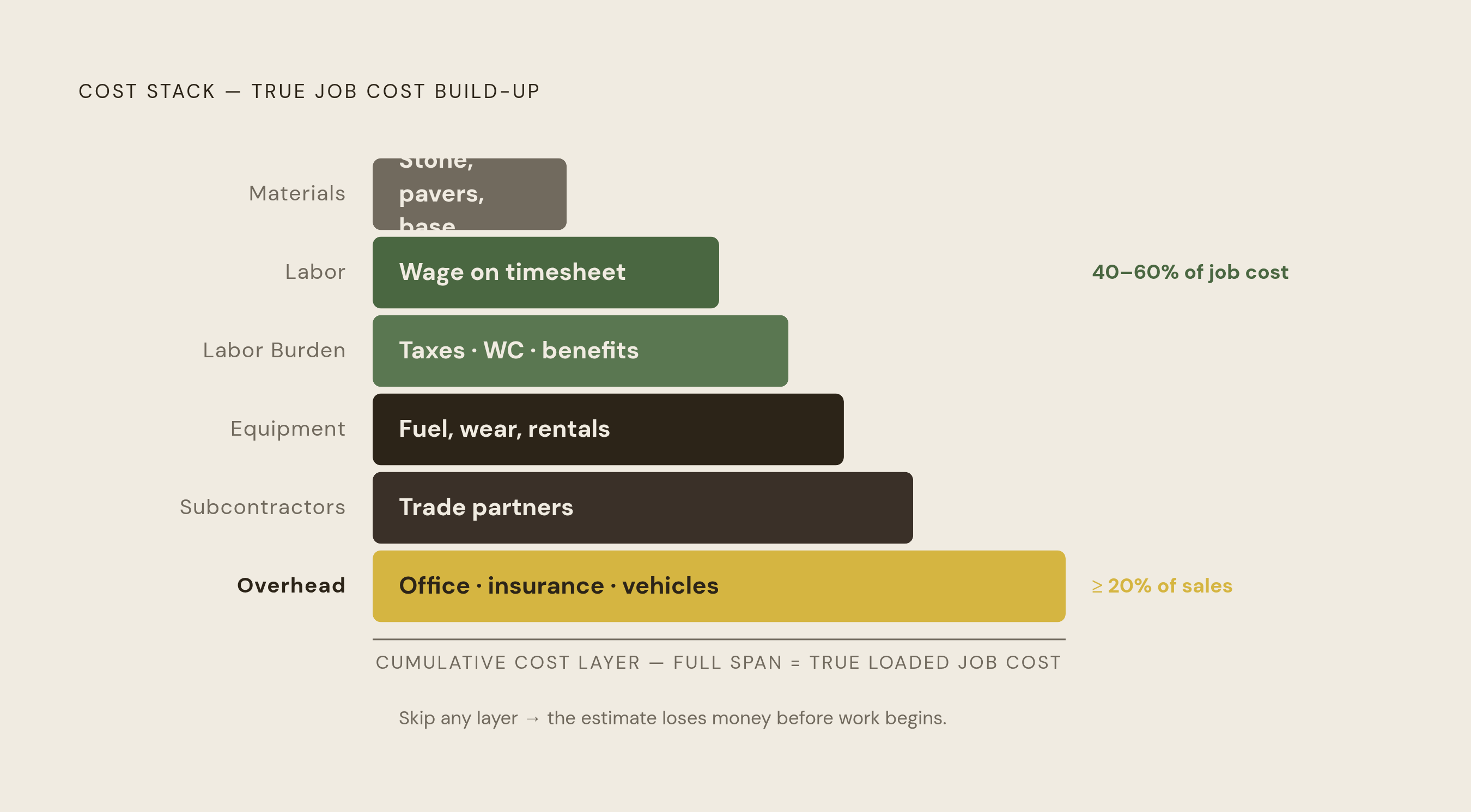
Hardscape pricing breaks down at one point, almost every time: someone skips a cost layer before the number ever hits a quote. Materials, labor, burden, equipment, subcontractors, overhead. If someone skips one, the figure on the client's proposal is a guess wearing a suit. Get the sequence right, and the same job produces a number that actually holds up when the season closes.
The stakes are real money. Angi's 2026 data puts installed hardscape projects between $5,000 and $18,000 on the low end, while Techo-Bloc's 2026 Landscaping Costs report puts the average project closer to $55,000. That gap is where underbidding lives, and it's rarely a pricing problem. It's a structure problem: contractors quote off gut feel, forget permit and demolition costs that can run $200 to $10,000 (per Angi), skip labor burden entirely, and never allocate overhead down to the job level.
Workyard's analysis of 280 contractor discovery calls found that 45% of construction businesses still manually re-enter time data into payroll or accounting software. That single habit produces most job costing errors in the trade, as the Workyard analysis of manually re-entered time data shows. A miscoded crew hour on a multi-week paver install or retaining wall build goes undetected until the job closes, and by then the loss is already baked in. Nothing fixes that retroactively.
What follows is that sequence, laid out the way it actually needs to get built, in order, before an estimate leaves the building.
Materials: the cost layer contractors think they know but often undercount
Material cost swings hard by product type, enough to double or triple an estimate depending on what gets specified. Material costs shift dramatically by product type, with pavers, natural stone, poured concrete, and concrete block all landing at very different price points per square foot. A paver patio quoted at the low end of that range and one quoted in premium stone aren't the same job, even at identical square footage.
Techo-Bloc's 2025 Contractor Survey backs that up: a mid-range paver patio ranges from $8,500 to $27,000 installed, and that spread reflects how much material selection and site conditions can move the final number. Selection matters as much as square footage. Sometimes more.
What actually gets missed is smaller than that. Adhesive, base aggregate, sand, the extra pavers bought to cover cuts and waste, these get purchased a little at a time across a dozen jobs and never get coded to any one of them specifically. They evaporate into "supplies," and nobody notices until the supplies line is bigger than it should be.
The fix isn't complicated, just hard to hold onto under deadline pressure: measure quantities before quoting, then log actual materials at the point of purchase and tie them to the job number immediately. Not at the end of the week, and not when the receipt turns up in a truck cupholder. Every purchase needs a job number attached before the paper trail goes cold.
Labor: the highest-variance cost and the one most likely to be reconstructed from memory
Labor is where the money actually moves. Techo-Bloc's 2026 report puts crew billing rates between $50 and $120 per hour, depending on specialization and region. A general two-person landscaping crew runs $50 to $65 an hour. Skilled hardscape installation climbs to $50 to $120. Design and consultation work can hit $75 to $150 or more.
For most residential landscaping operations, labor represents 40% to 60% of total job expense. That makes it the largest cost category on the sheet and, not coincidentally, the one most likely to be wrong.
Crews work multiple jobs in a single day, and without daily time entry logged by project, hours get reconstructed from memory at the end of the week. Nobody remembers exactly when they left job two and started job three on a Wednesday three days ago, so the number that gets written down is a guess dressed up as a timesheet.
The math on that guess compounds fast. A crew running 45 minutes over on several visits in a week racks up roughly 6 hours of untracked labor. That loaded-rate leakage runs to roughly $210 weekly, which crosses $10,000 over a season. That's a truck payment, gone, because nobody logged time the day it happened.
Regional variance adds another layer on top. Regional variance means labor rates differ meaningfully by market, and tight labor markets are pushing wages up further across the board, which makes accurate tracking worth more every year, not less. The rule here is not complicated: crew leaders enter time by project, daily, before recall degrades. That's a structural requirement, not a nice-to-have.
Labor burden: what the hourly rate on the timesheet doesn't include
The wage written on a timesheet is not what that hour actually costs the business. Burden sits on top of it, a real cost that lands on the business whether anyone accounts for it or not.
Burden includes payroll taxes (FICA, FUTA, SUTA), workers' compensation insurance, the slice of general liability attributable to the crew, and paid time off, sick leave, or any benefits offered. That difference does not appear on the pay stub. That difference appears on the P&L eventually, whether the contractor planned for it or not.
Techo-Bloc's published billing rates, that $50 to $120 per hour range, already bake in overhead, equipment, insurance, payroll taxes, and profit. A contractor quoting below those rates without separately accounting for burden isn't being competitive. That contractor is pricing at a structural loss and won't find out until the season's numbers come in light.
Pulling a median wage figure off a job board and building the labor line straight off that number leaves the estimate missing a real chunk of true labor cost before the first paver gets set. Burden has to get calculated and folded into the hourly rate at the estimating stage, not allocated later once the invoice is already sent. By then it's a loss with a name attached to it.
Equipment: proportional cost allocation for owned and rented machinery
Equipment cost belongs on the job that used it, not buried in general overhead. If a skid steer runs three days on a retaining wall install, that job carries its share of the fuel, the wear, the maintenance. Simple as that.
Two categories, tracked two different ways. Rented equipment is easy: it's a direct cost, tied to the job, invoiced and done. Owned equipment takes more work, because it needs an internal rate, fuel plus a proportional share of maintenance, repair, and depreciation, applied per day or per hour of actual use on that specific job.
Hardscape carries real exposure here. Paver saws, plate compactors, excavators, skid steers, these machines all have genuine per-day costs, and those costs disappear into the business if nobody codes them to a job. Permits, demolition, and land grading can add $200 to $10,000 by Angi's numbers, and the machine doing that work needs to show up on that job's cost sheet, not smeared across a year of operations where nobody can trace it back.
An internal daily or hourly rate for owned equipment, applied the same way a rental invoice would be, makes that cost visible per job instead of letting it get absorbed into "just how the business runs."
Subcontractors: a direct cost that can silently absorb the project's margin
Hardscape work pulls in specialty subs constantly: electrical for outdoor kitchens and lighting (code compliance typically requires a licensed electrician), irrigation, drainage, structural engineers for anything beyond a basic retaining wall. Those costs belong entirely to the project that needed them.
Margin disappears quietly when a sub invoice lands after the job has already closed out and gets coded to general expense instead. The job looks more profitable than it actually was, and nobody catches it, because the number that would've flagged the problem never got attached to the right project. It repeats, invisibly, job after job, until someone finally reconciles a full year and can't figure out where the margin went.
Protecting margin here means locking sub quotes in before the estimate goes final, marking those costs up appropriately (coordination and liability carry real cost, not just the sub's invoice), and logging every sub invoice against the job the moment it arrives. Full backyard remodels that combine hardscape, deck work, lighting, and irrigation regularly cross $35,000, and at that scale there are usually several subs involved, each one a margin risk if the tracking isn't precise.
The rule is clean, and it should stay clean: any check written to a third party on behalf of a specific project is a direct job cost.
Overhead allocation: the cost layer that can't be ignored and can't be guessed
Overhead is everything required to keep the business running that doesn't tie to one job: insurance not tied to a specific project, the office, vehicles, software subscriptions, owner salary, marketing, accounting. That cost is constant, and it has to land somewhere on every job, not just the convenient ones.
At least 20% of a landscape contractor's total sales typically goes toward overhead. Contractors who under-allocate that figure aren't underbidding occasionally, they're underbidding systematically, and the shortfall thins the margin on every job, not just the unlucky ones.
Two common ways to allocate it exist, and they don't behave the same. A flat percentage markup on direct costs is simple to apply, but it risks undercharging labor-light, material-heavy jobs while overcharging the opposite kind. Allocating based on labor hours instead ties overhead recovery to the resource the business actually deploys, which fits hardscape better, since crew hours drive schedule capacity. The labor-hours method is the one that holds up under scrutiny; the flat-percentage method is the one that quietly loses money on the jobs that need protecting most.
SynkedUP forces the operator to calculate a true baseline hourly rate from total business expenses before any estimate gets built. That mechanism catches underbidding at the source, because overhead recovery gets enforced at the estimate stage, not patched together after the job's already done. Overhead allocation has to live inside the rate structure used to build every estimate, so each job contributes its share before the client ever sees the number.
Cost sequence and margin visibility by project type
Once all six layers, materials, labor, burden, equipment, subs, overhead, are actually in place, the job cost report starts answering a better question. It stops being "what did this job cost?" and becomes "what does this type of project reliably earn?"
That answer varies more than most contractors assume. One research example put hardscape installations at 18% profit against just 8% on basic maintenance contracts. A gap that size should change where a contractor spends marketing dollars, and it should change what minimum job size gets accepted.
Large, multi-week jobs, retaining walls, outdoor kitchens, full hardscape builds, need weekly tracking rather than a reconciliation at job close. A project trending over budget at week two is still recoverable. The same problem discovered at the final walkthrough is already a closed loss. Some job costing tools, SynkedUP among them, show estimated versus actual net profit and labor progress in real time rather than waiting for job close, catching the problem while there's still time to act on it instead of just recording it afterward.
That kind of visibility does specific things for a contracting business. It sets minimum project sizes that actually protect margin, and it flags which crew configurations consistently beat their estimates, so those crews and setups get repeated on the next bid instead of left to chance.
Hardscape's weight in the mix backs this up. It regularly eats 40% to 60% of a full-yard budget while covering less than 30% of the physical area. That concentration means hardscape carries more revenue and more margin risk than any other category in a typical landscape business, and it should get tracked accordingly.
Software tools that enforce the cost structure rather than just record it
Software that records costs after the fact and software that enforces the cost structure before an estimate leaves the building are not the same product, even when they sit in the same category. For hardscape, only the second kind protects margin at scale, because by the time a tool is just recording history, the pricing decision has already been made and the loss is already locked in.
QuoteIQ offers built-in job costing on its Pro plan at $149.99 a month. It calculates true profit per job automatically, revenue minus tracked labor minus logged expenses, and bundles in an AI estimator, satellite measurement, and QuickBooks sync.
SynkedUP runs $399 a month on its Standard tier and is built specifically for hardscape and design-build operators. It forces the baseline hourly rate calculation described above before any estimate gets built, offers real-time job costing across all plans, and includes GPS-stamped time tracking on its Pro plan along with automated payment collection. The platform continues to add capabilities across plan tiers.
LMN by Granum, on its Professional plan at $648 a month, delivers real-time job costing and fits established landscaping companies that need production budgeting and overhead recovery built for the landscape trade specifically.
Jobber's Grow plan starts at $349 a month (per Workyard) and pairs job costing with GPS routing, a solid generalist pick for maintenance-route operators who also take on hardscape work.
Aspire runs custom, enterprise pricing built for commercial landscape contractors above $1M in revenue, with tiers scaled to contractor revenue size, delivering real-time production dashboards with unlimited users.
Workyard charges $6 to $13 per user monthly plus a $50 base fee, and its strength is GPS-verified labor cost tracking that flows straight into job cost reports, the strongest option specifically for field labor data.
Yardbook is free, with genuinely full-featured expense tracking and invoicing rather than a stripped-down teaser tier, a reasonable fit for solo operators on day one, before per-job profit reporting becomes the priority.
None of these is the right answer across the board. Each one fits a different stage and a different kind of operation, and picking the wrong tier for the business's size wastes money in the other direction.
Building the quoting habit that the cost structure requires
None of this works as a one-time setup. The six-layer structure, materials, labor, burden, equipment, subs, overhead, has to become the habit behind every estimate, applied on the small jobs with the same discipline as the big ones.
That means measuring materials before quoting, not after. It means crew leaders entering time daily, by project, while the day is still fresh in their heads, not reconstructed from memory on Friday afternoon. It means burden gets built into the hourly rate before that rate ever touches a quote, and sub costs get logged against the job the moment the invoice lands, not weeks later when the paperwork finally surfaces.
Overhead recovery has to sit inside the estimating rate itself, not get reconciled after the season closes. On multi-week jobs, the numbers need checking weekly, because a budget problem caught in week two is a conversation with the crew. The same problem found at job close is a number on a loss report, with nothing left to do about it.
Contractors who build this habit stop quoting off feel. They quote off a structure that tells them, project by project, exactly where the margin lives and exactly where it doesn't.
Sources
- Landscaping Costs USA: 2026 Overview | Techo-Bloc
- How Much Does Hardscaping Cost? [2026 Data] | Angi
- Best Landscaping Job Costing Software 2026 | Top 8
- Best Job Costing Software For Landscaping Businesses (2026)
- 2026 Landscaping Costs: Project & Material Price Guide
- How Landscape Job Costing Reveals Your Most Profitable Work
- Job Costing for Landscapers: How to Know Which Projects Actually Make You Money
- synkedup.com