Closeout Documentation and Final Walkthrough Process for Hardscape Jobs
Structured closeout secures faster payment and protects contractors after handoff.

Closeout is where hardscape jobs make or lose money, and most contractors treat it like an afterthought instead of a phase with its own discipline. A structured closeout process secures final payment faster, limits how much warranty exposure a contractor carries after handoff, and turns a finished patio or retaining wall into the next signed contract.
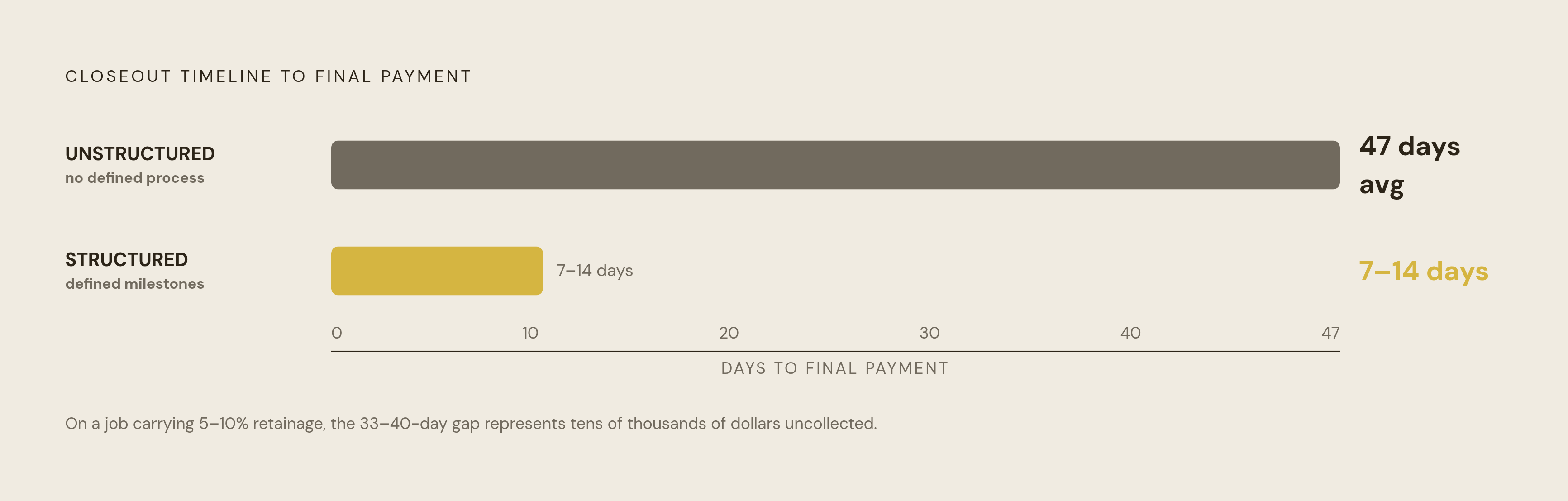
Construction Industry Institute data cited by blog.tasktag.com puts a number on the cost of skipping this discipline: unstructured closeouts delay final payment by an average of 47 days. A structured process compresses that window to 7 to 14 days. On a job carrying 5 to 10% retainage, that gap is not a paperwork nuisance. It's tens of thousands of dollars sitting uncollected while a crew has already moved on to the next address.
What closeout means for a hardscape contractor, and when it starts
Most contractors think of closeout as something that happens on the last day. Most contractors think of closeout as something that happens on the last day, and treating it that way is why so many jobs stall at the finish line.
Procore and documentcrunch.com define closeout as the formal phase where every contractual obligation gets verified as complete, the owner is equipped to actually use and maintain the space, and everyone involved, GC, subs, suppliers, gets paid. That's four distinct milestones, not one event:
Substantial completion is the point where the space is usable for its intended purpose. This starts the warranty clock and typically triggers retainage release.
Punch list resolution covers whatever deficiencies got flagged at or after that substantial completion walk.
Final completion happens once every punch item is closed, every document is delivered, and the final payment application goes in.
Administrative closeout runs in the background for another 30 to 90 days: lien waivers, warranties, project file archiving.
Hardscape doesn't have a "commissioning" phase the way mechanical systems do. There's no equipment to power on and test. But it does demand documentation of material condition, drainage performance, and compaction at the moment of handoff, and Seasonal and environmental conditions (rain, temperature, ground moisture) directly affect how compaction reads at turnover. A patio inspected after three dry days looks different than one inspected the morning after a storm.
That means closeout prep has to start during construction, not after it. Collect product data sheets and manufacturer warranties as materials arrive on site, not two weeks later when the box is gone. Photograph base layers, drainage lines, and edge restraints before they're covered by pavers or backfill. Track approved substitutions in writing, the moment they're approved, not from memory later. Keep a running list of known deficiencies as they are identified during the walkthrough, so nothing gets rediscovered at the final walk for the first time.
The internal punch walk: what to fix before the client ever arrives
Send a lead or superintendent through the entire finished job before the owner ever sees it. This step gets skipped more than any other part of closeout, and it's the cheapest insurance in the whole process.
The goal is simple: catch what the crew should have caught. A missing polymeric sand joint, a surface drip line on a wall cap, an edge restraint that's lifted half an inch. Anything obvious that ends up in the owner's memory as "the thing they missed" belongs on this list, found by the contractor, not pointed out by the client.
Run through the specifics during this walk:
- Surface levelness and joint consistency across the paver field
- Edge restraint condition, checking for lifting along borders
- Retaining wall alignment, cap seating, and drainage outlet clearance
- Grading direction at every hardscape perimeter, confirming water moves away from structures
- Full cleanup: sand, gravel, cut-off scraps, staging debris, all gone
- Restoration of any disturbed lawn, beds, or adjacent surfaces
Photograph everything during this walk too, not just the problems. A dated photo record of the completed condition, joint by joint, wall by wall, is the contractor's defense if a claim surfaces months later that damage happened after turnover. Soil settles, freeze-thaw cycles move pavers, and without a baseline, an owner can reasonably (or unreasonably) assume the contractor is responsible for something that happened well after the crew left.
Walking into the client meeting with zero surprises does something for trust that no sales pitch can replicate. It tells the owner the contractor is running quality control on their own terms, not scrambling to react to whatever the client's eye happens to catch first.
Running the final walkthrough: documentation in real time, not after the fact
The formal walkthrough with the client is where most of the closeout value gets built or lost, depending on how items get documented in the moment.
Walk every finished element together: the patio field, walls, walkways, steps, drainage points, any lighting or water features installed. For each item flagged, write down a description, attach a photo, name who's responsible for the fix, and set a deadline right there. Vague notes turn into arguments three weeks later. Specific notes don't.
There's also a distinction that has to get made in real time, not sorted out afterward: deficiencies are the contractor's obligation, owner preferences and scope additions are not. If a client decides mid-walk that they'd rather have a different paver pattern, that's a change order conversation.
Specificity is the whole game here. Projul's closeout guidance uses "fix bathroom tile" as the example of a punch item that invites disagreement, because it says nothing about what "fixed" looks like. The hardscape version of that mistake is just as common. Compare it to "re-set lifted 4x8 Holland paver at the northwest corner of the patio field, second row from the border." One of those descriptions can be verified as done. The other can be argued about forever.
Order the punch list by priority: safety issues first, then functional problems like drainage or structural concerns, then cosmetic items last. Issue the list in writing within 24 hours of the walkthrough, and get the client to acknowledge it in writing before anyone touches a tool to fix it.
Set a firm deadline for punch list completion at the walkthrough itself. Tasktag.com's 2026 guidance points to 14 days as the threshold: past that point, delays usually trace back to sub availability, scope creep, or unclear completion criteria, not bad luck. If a job runs past that window, that's a signal to fix the contract language before the next project, not to just push through this one and hope it doesn't happen again.
Photograph and date every resolved item as it closes out. Then, before the final payment application goes anywhere, get a signed punch list completion acknowledgment. A verbal "looks good" from the client means nothing if a dispute comes up later.
The closeout document package a hardscape job should produce
Closeout documents have to work for two different readers. The owner needs enough information to actually manage and maintain what got built. The contractor needs proof, on file, that the work met the standard it was supposed to meet. Procore's closeout documentation covers both audiences, and the distinction matters because a document package built only for one audience fails the other.
A complete hardscape closeout package includes:
- Signed punch list completion acknowledgment. Written owner sign-off that every item is resolved. This is the gate final payment sits behind.
- Contractor workmanship warranty letter. Issued by the GC, specific to the scope actually performed, covering defects in workmanship for a stated period.
- Manufacturer product warranties. Compiled separately from the workmanship warranty: pavers, wall block, adhesives, sealers, any mechanical components like fire pit burners or lighting.
- Care and maintenance instructions. Joint sand replenishment schedule, sealer reapplication timeline, winterization steps, how to handle efflorescence, which cleaning products are safe to use. CSD Hardscapes and Elite Living Designs both build this into their standard closeout delivery.
- As-built documentation. Field photos of base depth, drainage routing, and buried elements, useful the day an owner wants to extend the patio or add a feature down the line.
- Lien waivers. Conditional final waivers submitted with payment applications, unconditional final waivers collected once payment clears.
- Final photos. High-quality documentation of the completed space, filed for the client record and also usable, with permission, for the contractor's own portfolio.
Deliver all of it digitally, in organized folders with clear naming. Procore's guidance notes that owners who can't find information easily tend to just call the contractor directly. A disorganized package creates more phone calls, not fewer. The whole package should land at or before final payment. Not two weeks after the check clears.
Warranty language hardscape contractors must get right, and wrong
The single distinction that matters most in any hardscape warranty is workmanship versus product performance, and blurring that line is where contractors accidentally take on liability they never meant to accept.
A paver that settles within the first year is a workmanship problem. That's on the base prep, the compaction, the install, and it's the contractor's responsibility to fix. A paver that discolors after a few seasons in the sun is usually a product issue, and the manufacturer's warranty is what applies there, not the contractor's. Loose warranty language that doesn't separate these two categories leaves a contractor holding the bag for things a material manufacturer should be covering.
Real-world structures show how this gets handled well. ScapeWorx runs a 7-year warranty on new hardscape installs, with the client required to notify within that window and ScapeWorx arranging repairs at no cost, though the warranty voids if the client brings in a contractor ScapeWorx hasn't approved. A-1 Land Care runs a 2-year limited warranty on labor, fire pit burners, and associated hardware, paired with a limited lifetime warranty on the wall blocks and pavers themselves, working primarily with Belgard, Oaks, Unilock, and Techo Bloc, each of which carries its own manufacturer lifetime warranty with its own terms.
Every hardscape warranty needs clear exclusions written in, not implied. That means soil movement or settlement not caused by improper base work, surface moisture retention after heavy rain on a surface that's draining exactly to spec, minor aesthetic shifts in a retaining wall that don't touch structural performance, and any damage from owner modifications or non-approved cleaning products.
The letter itself should follow a format like the one in tasktag.com's template: named project, named owner, a specific completion date, a list of what's covered, a list of what's excluded. "We stand behind our work" in an email is not a warranty, it's a sentiment, and it won't hold up when a dispute actually happens.
Hand the warranty over in writing at the walkthrough, not after a claim comes in. The contractor who hands it over proactively controls how the whole relationship gets framed. The one who only produces it once something breaks has already lost the argument before it starts.
Lien waivers and final payment: the sequence that releases the money
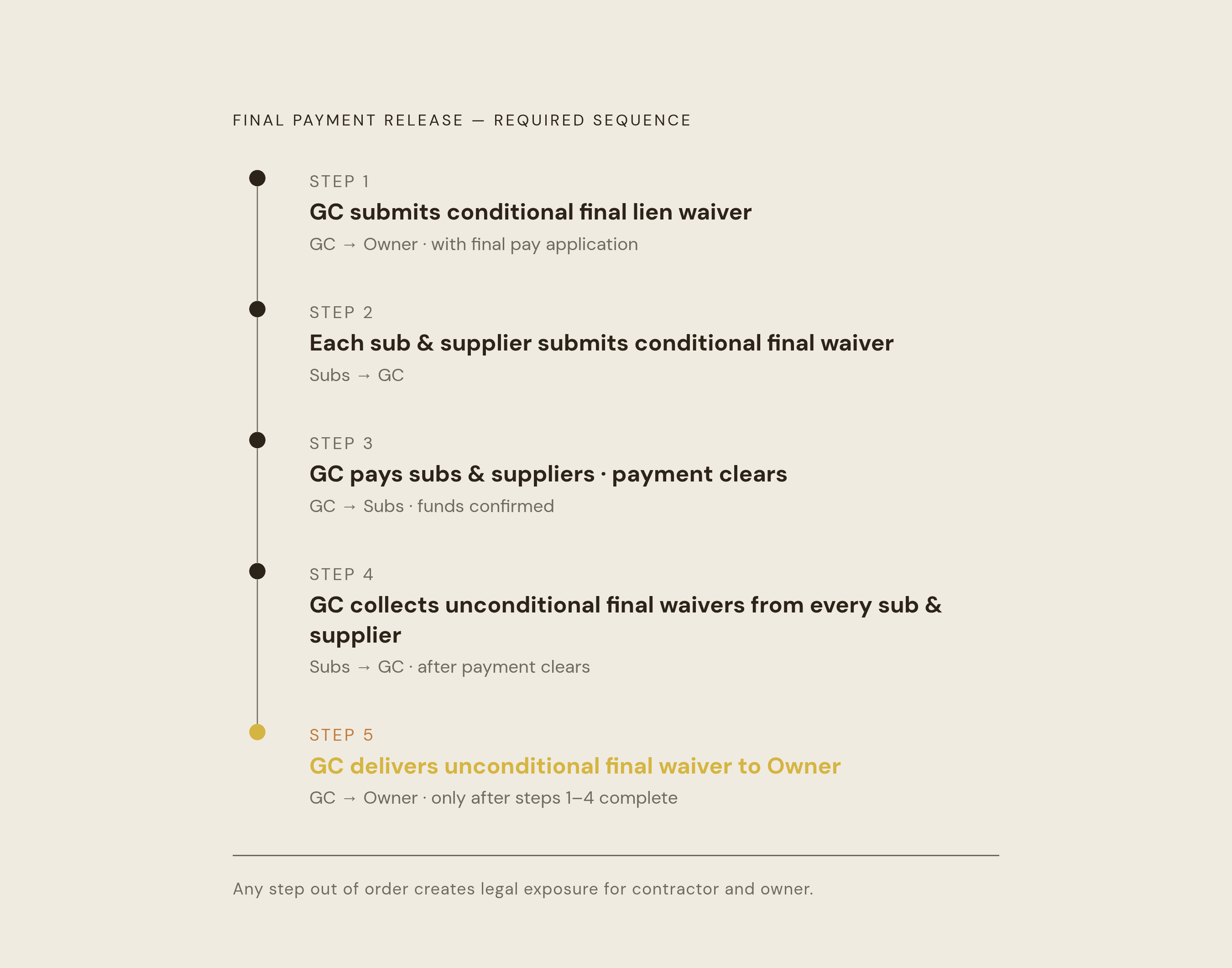
Lien waivers aren't a formality that can get shuffled around or skipped. Collecting them out of order creates real legal exposure, for the contractor and for the owner both.
The sequence runs in a specific order for a reason:
- The GC submits a conditional final lien waiver with the final payment application, waiving lien rights conditional on that payment actually clearing.
- Each subcontractor submits their own conditional final waivers with their pay applications to the GC.
- The GC pays subs and suppliers, and that payment clears.
- Unconditional final waivers get collected from every sub and supplier before the GC issues anything unconditional to the owner.
- The GC delivers an unconditional final waiver to the owner, only once final payment has actually cleared.
One subcontractor or one material supplier who drags their feet on an unconditional waiver can hold up the entire final release. That has to get chased down proactively during the job, not scrambled together after the fact when the owner is asking why the closeout is stalled. Before issuing that owner-facing unconditional waiver, confirm there are no outstanding preliminary notices or mechanic's liens sitting on the property.
The final invoice needs to spell out the math clearly: total contract value, every approved change order added in, all prior payments applied, the retainage amount, and the final balance due. Any ambiguity in that number gives an owner a reason to delay, and a structured closeout is designed to eliminate that delay.
That 47-day average versus the 7-to-14-day compressed timeline mentioned earlier is a paperwork problem. It's a paperwork problem. The contractors stuck at 47 days weren't gathering lien waivers and documentation as the job progressed. They were trying to assemble all of it after the crew had already left the site.
Turning the closeout moment into a referral and review trigger
A professional closeout package more than doubles the 12-month referral rate, 58% versus 24%, according to the NAHB Remodeler Client Satisfaction Survey 2025. That stat's primary attribution, a 2025 NAHB Remodeler Client Satisfaction Survey, couldn't be verified directly on NAHB's site, so it should be treated with some caution. But directionally, it lines up with something obvious about human behavior: people refer contractors they trust, and trust peaks right at handoff.
The client just walked the finished space and signed off on it. That's the emotional high point of the entire project. The contractor has just spent the last hour demonstrating organization and follow-through in front of them. Asking for anything, a review, a referral, feels natural at that moment in a way it never will again.
So ask. Hand over a QR code or send a direct review link within the hour, while the walkthrough is still fresh. Ask directly if they know anyone else planning a similar project. A specific ask beats a vague "feel free to refer us" every time, because vague asks are easy to forget and specific ones give the client something to actually act on.
Follow up within 48 hours with a project completion summary: what got built, what materials were used, what the warranty covers, what the maintenance schedule looks like. That document does double duty. It reinforces the professionalism the client just experienced, and it keeps the contractor's name sitting in a folder in that homeowner's inbox for years.
Stay in touch after that. A 30- or 60-day warranty check-in, initiated by the contractor before any problem appears, signals confidence rather than an obligation to respond to a complaint. A seasonal reminder, checking joint sand after the first winter, flagging sealer reapplication timing, keeps the contractor positioned as a long-term resource instead of a name that disappears the day the check clears.
Every clean closeout also produces a marketing asset. The final photo set, with the client's permission, belongs in the portfolio, on the website, in the next pitch to a prospective client standing in their own backyard trying to picture what's possible.
Building the closeout process as a repeatable system, not a per-job improvisation
None of this works as a checklist pulled out once a job is winding down. It works as a system built into the contract, the schedule, and the crew's habits from the first day materials hit the site.
That means defining, in writing, before the job starts: who runs the internal punch walk, what the punch list template looks like, what the 14-day resolution deadline means contractually, and which documents get collected during construction versus assembled after. The difference between the 7-to-14-day window and the 47-day average comes down to process, not circumstance. They just built the paperwork collection into the job instead of treating it as a scramble at the end.
Retainage, warranty exposure, and referral rate all trace back to the same root cause: whether closeout was designed as a phase with its own discipline, or left to whoever remembered to grab a photo on the way out. The contractors who treat the finish line with the same rigor as the foundation are the ones who get paid on time, carry less warranty risk, and turn every finished patio into the lead for the next one.
Sources
- Construction Closeout Process: 7 Steps, Key Docs & Tools
- Construction Closeout Checklist: Complete Project Closeout Guide (2026)
- Custom Hardscaping Mount Laurel NJ | Elite Living Designs
- csdhardscapes.com
- Construction Closeout Documents: What's Included & Why | Procore
- projul.com
- scapeworx.com
- a-1landcare.com