Seasonality Patterns in Hardscape Sales and Installation
Contractors who sell hardscapes in winter fill spring schedules on purpose.
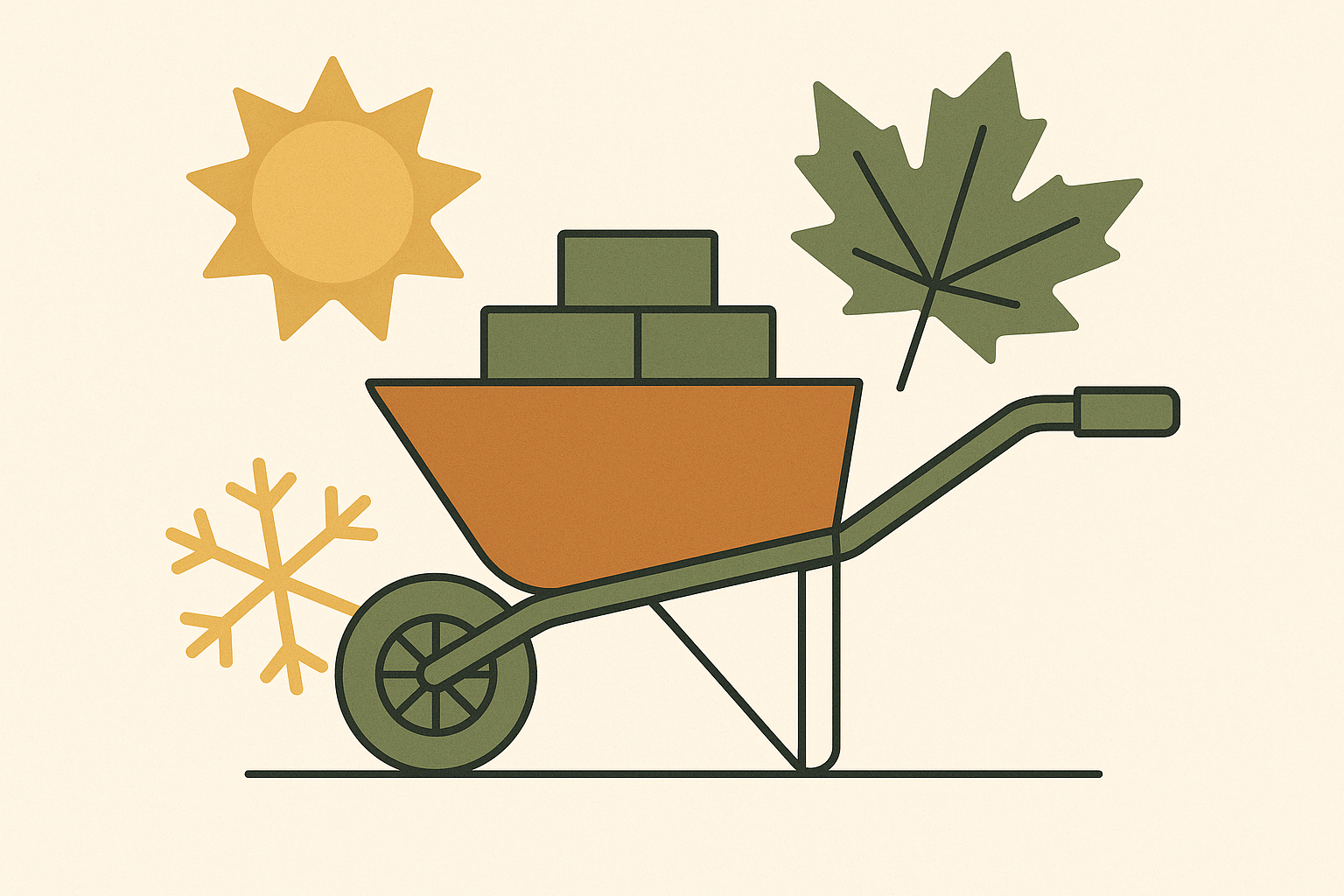
Hardscape demand runs on a calendar, and most contractors treat that calendar like it's random. That single mistake costs them every spring. Homeowners decide to build patios, retaining walls, and outdoor kitchens around predictable life moments and predictable months, and the contractors who plan around that rhythm shape demand instead of scrambling to meet it.
Three kinds of homeowners drive most of this market. There's the practical backyard upgrader on a mid-range budget who wants something functional, the retiree finally ready to enjoy a property owned for decades, and the new-home or legacy-home owner who wants the place looking finished before company shows up. Different reasons, same worries underneath: whether the homeowner can afford it, whether the contractor can be trusted, whether the work will hold up, and how much life will get disrupted while it happens. Those four questions decide when people pick up the phone and how long they wait before signing anything.
US demand for hardscaping products hit $4.4 billion in 2024, per the Freedonia Group, and residential work drove most of that growth. Homeowner timing sets the pace for the whole industry more than contractor availability does. This is a planned, budgeted decision, and planned decisions get researched for weeks before anyone signs anything. Demand shows up long before a shovel hits dirt. Most contractors only start paying attention once the shovel does, and that gap, the space between when demand actually starts and when contractors notice it, is the whole problem this piece is about.
What the annual cycle actually looks like for a hardscape contractor
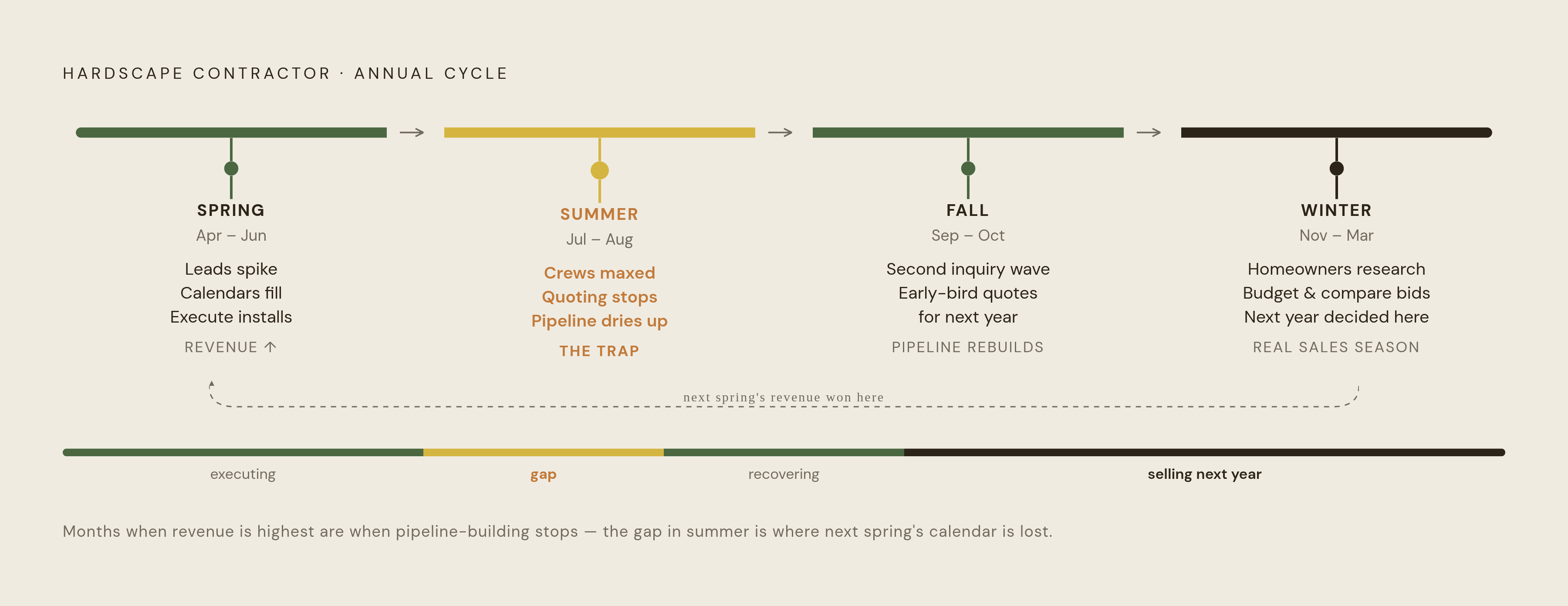
Spring, roughly April through June, is when everything hits at once. Leads spike, winter planners are ready to commit, and installation calendars fill up fast. Summer, July and August, is pure execution: crews are maxed out, and quoting drops off because nobody has time for it. That's the trap right there. Fall's pipeline and next spring's pipeline dry up quietly during the exact months everyone's too busy to notice them drying up.
Fall, September into October, brings a second wave. Homeowners who missed the spring rush start calling, and the contractors paying attention are already running early-bird quotes for next year. Then winter hits, and in northern markets, installation basically stops from November through March. In Sun Belt states that gap shrinks a lot, and those contractors run much closer to year-round.
That split shows up in adjacent trades too. Roofing contractors in the South report far stronger three-year growth expectations than those in the Northeast, and hardscape follows the same shape: real growth, crammed into a narrow window. Most contractors make the bulk of their money in about six months and stretch it through a slow half-year of insurance premiums, equipment loans, and a core crew kept on payroll whether there's work or not.
How spring arrives all at once and why that punishes the unprepared
Spring doesn't ease in up north. The ground thaws, conditions clear, and every job put off all winter wants to start on the same Tuesday. Contractors without a built pipeline get caught three ways at once: scrambling to quote while already juggling active jobs, taking lower-margin work just to fill schedule gaps, and losing any ability to sequence jobs in an order that actually makes sense.
Labor makes it worse. Only about two-thirds of the seasonal H-2B visas requested for 2025 got approved, which means a meaningful share of the workforce contractors were counting on simply isn't there when demand shows up. Crew capacity is a hard ceiling that winter pipeline-building can't remove.
Winter pipeline-building changes what a contractor can do with the crew already standing there. A contractor walking into spring with a confirmed backlog sequences jobs on purpose, allocates crews with intention, and turns down marginal work that isn't worth the margin. A contractor with an empty pipeline takes whatever shows up, full stop, no leverage to do otherwise. Leverage gets built months earlier and rarely shows up by luck in April. Equipment follows the same math: a fleet sized for an average week gets buried at peak, and rental gear only helps if the jobs renting it got scheduled weeks ago, not scrambled together after the fact.
The off-season is the sales season
October through February is where spring's signed contracts actually get won. Homeowners researching in winter are high-intent. They're budgeting, comparing bids, and reading reviews, doing the legwork nobody has time for once the phones start ringing in April.
Skipping the winter sales process means borrowing against April at a bad rate. A contractor running a real quoting process through winter picks up three things, and none of them show up unless the work gets done during the slow months instead of pushed off. Early-booking pricing nudges undecided homeowners to commit and fills the spring calendar before spring even arrives. Slower months leave room to walk homeowners through materials, sequencing, and realistic timelines, the kind of trust-building that turns a small patio quote into a full backyard redesign. And winter is when marginal jobs get qualified out early, so peak-season capacity goes toward work that's actually worth doing.
A hardscape company runs two businesses under one roof: design-build installs that behave like construction projects, and, for firms that offer it, maintenance work that behaves more like a subscription. One swings hard between fully booked and dead quiet. The other holds steadier. Managing both on purpose, instead of only paying attention to the busy half, is what separates steady growth from boom-bust. Sales work done in December doesn't show up on a revenue report until April, and that lag is exactly why so many contractors underfund it. Skip it, and the shortage shows up on schedule in April, when there's no time left to fix it.
What homeowners are actually doing while contractors are dormant
Home improvement planning doesn't sleep the way installation does. Homeowners are stuck indoors more in winter, and that's usually when browsing picks up speed. Searches for patio ideas, outdoor living projects, and hardscape contractors climb in late winter and early spring, well before anyone's ready to sign anything.
Here's the catch: a homeowner who gets a quote in February and doesn't hear back fast signs with whoever calls first by March. The gap between inquiry and decision keeps shrinking, because comparing five contractors from a phone screen takes ten minutes now, not an afternoon of phone tag. Across all three homeowner types, the same worries surface: can this be phased to fit the budget, is this contractor legitimate and will the work last, and how long is the yard going to look like a construction site. Answer those questions before they're asked, in the follow-up email, in the quote itself, on the first call, and the winter lead closes at a noticeably higher rate than it does for the contractor who sends a number and goes quiet.
How marketing spend should move with the calendar
Most contractors either spend the same amount every month or ramp up in spring, right when they're too slammed to answer the phone. Both waste money once you trace where the dollars land against when leads actually convert. Spend should move with the season, full stop, and this shouldn't still be a debate every January.
Late winter, January through March, is the highest-return window for Google Local Services Ads and local SEO, catching homeowners actively searching before spring competition gets loud. LSAs can be cost-effective against what a signed patio job is worth. Spring, April through June, is where Meta ads with neighborhood-level targeting earn their keep: they reach homeowners who aren't searching yet but get primed the moment a project goes up two doors down. Summer, with crews full, is the time to pull back on top-of-funnel spend and put the budget into nurturing existing leads and referral programs that stretch the pipeline into fall. Fall is for turning paid channels back on to catch the second inquiry wave and stake out early-bird positioning for next year.
Google Business Profile deserves its own mention here. It's free, it's the highest-leverage channel a local contractor has, and it needs upkeep every month of the year, no exceptions, no off-season. Direct mail earns its place too, because hardscape jobs are big-ticket and visible: a finished patio next door is a referral trigger on its own, and a well-timed postcard to the surrounding block catches that moment while it's still fresh.
Why quoting speed matters more in winter than in any other season
A homeowner reaching out in December is less urgent than one calling in April, but less urgent doesn't mean endlessly patient. The window's wider in winter; it still closes. Most contractors treat "wider" like it means "doesn't matter," and that's the wrong read.
The typical winter bottleneck looks like this: office staff are tied up with other tasks, the owner is quoting manually between everything else, and leads sit untouched in an inbox for days at a stretch. That delay does the real damage, not the season itself. AI takeoff tools, the ones that measure a property from satellite or drone imagery and build an estimate automatically, cut that process by 90% to 95% in time. For a contractor fielding 15 to 20 winter leads a week, that's the difference between quoting every single one and only getting to the ones persistent enough to call back twice.
Speed matters even more paired with actual substance. A homeowner who gets an accurate, detailed quote within 24 hours in January, one that answers the real budget and timeline questions instead of a placeholder number, commits before a slower competitor even picks up the phone. Voice AI and chatbot tools that field routine inquiries free up the contractor's time for the conversations that actually close deals.
Turning seasonal patterns into a year-round revenue plan
Contractors who outperform during peak season almost always treated the prior off-season as a building period. That pattern holds regardless of region or company size, and it's the single clearest predictor in this whole cycle.
A workable calendar looks something like this. October and November: review the season that just wrapped, figure out which project types made money, which ran over budget, and which customers sent referrals, then set next year's priorities off that. December and January: turn on lead nurturing, run targeted ads at winter researchers, start filling the spring quote pipeline. February and March: convert that pipeline into signed contracts, sequence jobs against crew capacity, lock in material orders before lead times stretch. April through September: execute, protect margins, manage capacity, and follow up with everyone who didn't commit back in spring.
The real question for any contractor is whether it grows with the market or stays flat, running the same reactive year on repeat. Staffing remains the one constraint no calendar fixes by itself; more than half of contractors surveyed by ServiceTitan in 2024 named staffing their top challenge, and the fix is recruiting sequenced ahead of the spring ramp, not emergency hiring in April.
A fragmented stack, separate apps for CRM, estimating, and scheduling, only deepens the off-season bottleneck, no matter how good any single tool in that stack is on its own. One system handling intake, quoting, follow-up, and scheduling closes the real gap: the shortage of time to run five separate tools at once.
The end state is simple to describe, even if it takes real work to get there. A contractor who walks into spring with a signed backlog, a sequenced crew schedule, and marketing already running has already decided what happens next. That decision got made back in December, while the rest of the market was still waiting for the phone to ring.