Overhead Cost Allocation Across a Hardscape Crew
Overhead costs buried in estimates rob hardscape crews of profit season after season.

A crew wraps a patio job, the client's happy, the pallets are empty, and the invoice goes out. Weeks later the bank account tells a different story than the calendar did. That gap comes from overhead that never got recovered. It's overhead that never got recovered because it was never calculated in the first place, just folded into a markup somebody guessed at years ago.
Labor and materials are the easy part of a bid. Everyone knows how to count hours and price stone. What gets missed is the cost of running the business itself, including the truck payments, the insurance premium, and the software subscription nobody remembers signing up for. Those costs are invisible on a job invoice, so contractors either ignore them or guess at them. Per SiteRecon's overhead guide, most contractors who miss their profitability targets aren't missing them because the crew worked slow or wasted material. They're missing them because overhead never got allocated correctly in the estimate to begin with.
The damage is quiet. Crews stay busy, trucks roll out every morning, the schedule looks full on the whiteboard. And still, the number in the account doesn't move. Season after season, the same pattern repeats, and the fix isn't charging more across the board. It's knowing, to the dollar, what overhead costs per hour of billable work, so every bid clears that floor before profit even enters the conversation.
Overhead in a hardscape operation
Overhead is any cost that keeps the business alive but can't be pinned to one specific job. Contractors can't allocate what they can't name, so the category needs a clean definition before any math happens.
Direct costs are crew wages for hours actually on that site, the pavers and base material for that patio, and a subcontractor hired for that specific project. Those get billed straight to the job. Overhead is everything else that has to be spread across every job the business runs: office rent, admin salaries, business insurance, equipment depreciation, vehicle upkeep that isn't tied to one site, software subscriptions, marketing, licensing fees.
Wages get counted, but payroll taxes, workers' comp, and the rest of the labor burden get left out. Those aren't optional add-ons. They're real costs that inflate what an hour of labor actually costs the business, and skipping them understates the true price of every job.
Not every overhead cost behaves the same way, either. Some costs sit still no matter what happens (rent, insurance, a loan payment). Others move with activity level. And a few, like a cell phone plan with a base fee plus overage charges, or a truck lease paired with fuel costs, have one foot in each camp. Those semi-variable costs need to be split into their fixed and variable pieces, or estimated on the conservative side, so they don't disappear into the wrong bucket. Industry benchmarks from NALP, cited in SiteRecon's guide, put overhead at roughly a fifth to a third (or more) of revenue for a landscaping company, and smaller hardscape operations often run higher than that because they haven't built the operational efficiency that spreads fixed costs thin.
The billable-hours trap: why paid time and productive time are not the same number
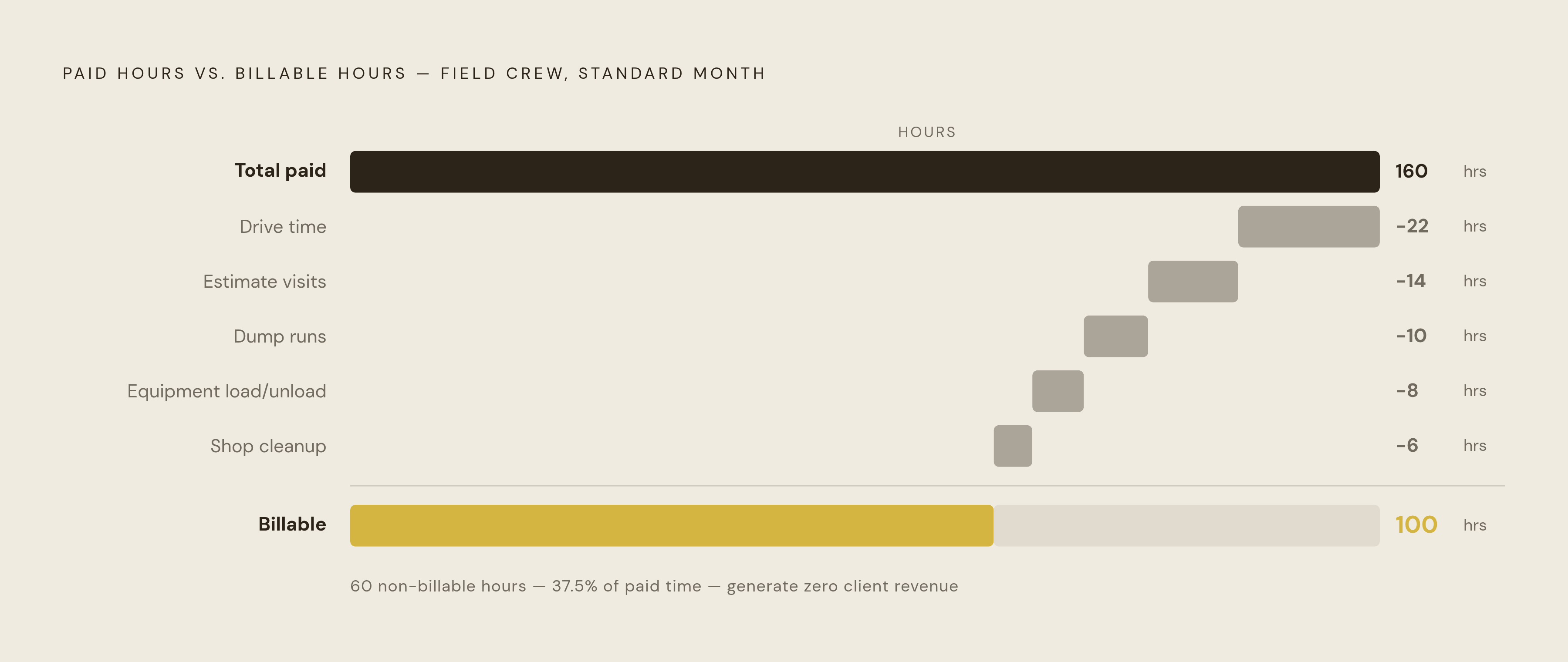
Treating every paid hour as a billable hour is the miscalculation that quietly wrecks more bids than bad pricing ever does. Do that, and the overhead rate comes out too low, because the hours that burn overhead without producing revenue never enter the equation.
Drive time between job sites, a site visit to scope an estimate, a dump run, loading and unloading equipment, cleanup back at the shop: all of it is paid time. All of it burns fuel and wages and overhead. None of it appears on a client's invoice. SiteRecon's overhead guide lays out a realistic version of this: four field staff working a standard month, but only a portion of those paid hours actually billable to a client. The productive total lands well below what a raw headcount times hours would suggest.
That gap between hours paid and hours billed is exactly where overhead piles up without ever getting recovered. The contractor is still paying for that time. It's just invisible in the pricing math unless it's built in on purpose.
Route density matters here for a reason that has nothing to do with convenience. Tight, clustered job sites cut down drive time, which raises the share of paid hours that convert into billable ones. Spread a crew across a wide territory, and that ratio collapses. Add seasonal reality on top: a slow mobilization week in early spring and a string of rained-out days shrink billable hours further while fixed overhead sits exactly where it was. The fix is straightforward but non-negotiable: build the overhead formula on actual historical timesheet data, not on what a full 40-hour week theoretically allows.
Running the overhead cost formula for a hardscape crew
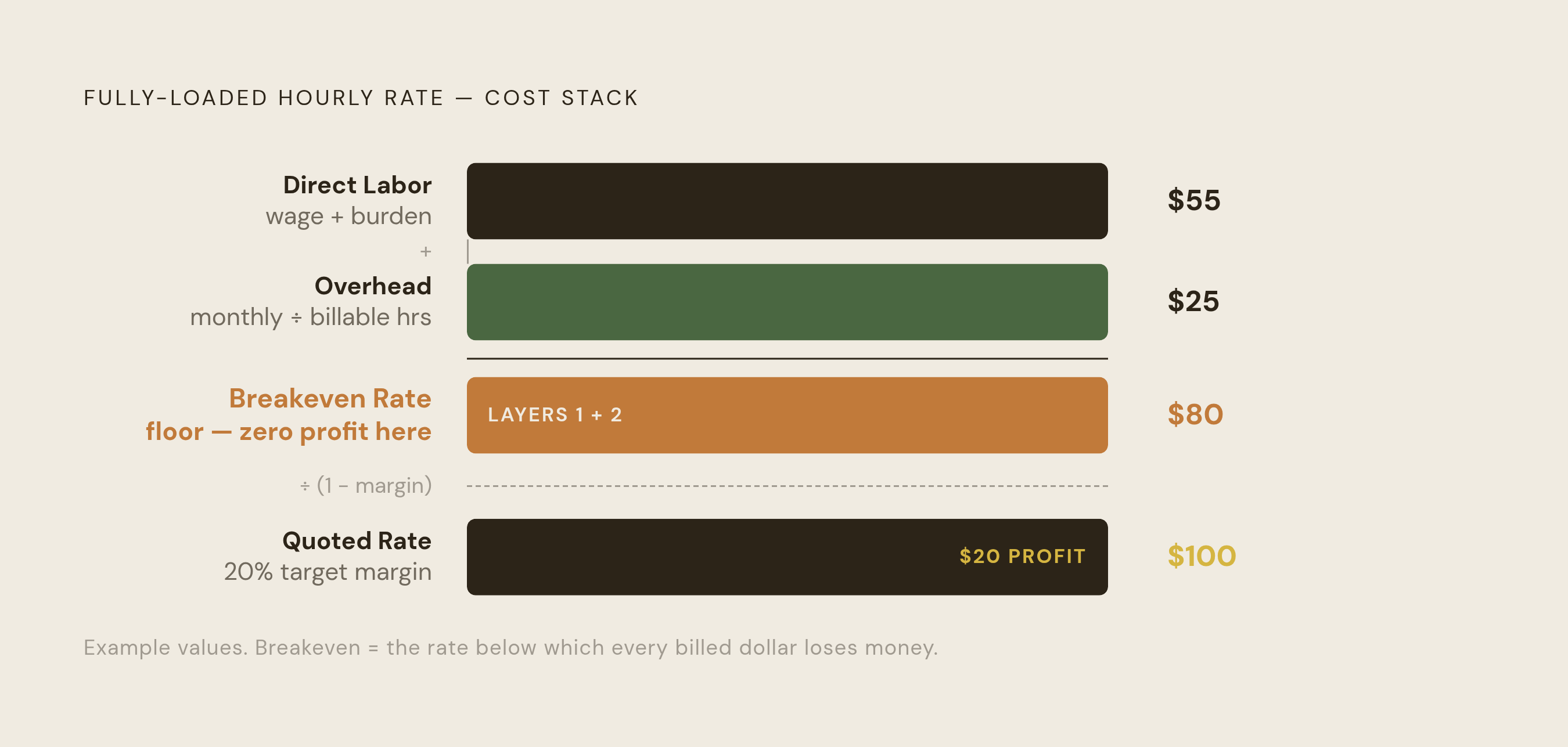
The overhead cost per man-hour comes from one formula: total overhead divided by total billable hours. Every bid has to recover that number before a cent of profit gets added on top.
Start by listing every overhead expense the business carries, being exhaustive about it, because small recurring charges add up fast across a season. Next, total those line items into one monthly overhead figure. SiteRecon's example rolls office rent, admin salaries, software subscriptions, fuel and maintenance, and insurance into a single monthly number.
Then figure out realistic billable hours: field headcount, multiplied by monthly hours worked, multiplied by the actual billable percentage, never the theoretical full utilization. Divide total monthly overhead by that billable-hours figure, and the result is the overhead cost per man-hour.
That number stands alone until direct labor gets added. Wages plus the full labor burden, payroll taxes, workers' comp, benefits, make up the direct labor cost per man-hour, and SynkedUp's cost-per-hour guide notes that the true cost of employment typically runs meaningfully above the base wage alone. Adding direct labor per man-hour to overhead per man-hour produces the breakeven rate: the floor below which every billed dollar actually costs the business money.
Profit gets layered on last, and getting that math wrong means underpricing every job it touches. Divide the breakeven rate by (1 minus the target margin), and SynkedUp's example shows how even a modest margin target pushes a breakeven number up to a noticeably higher quoted rate. NIP Group's pricing guide backs this into the full bid structure: Total Price equals Labor plus Materials plus Equipment plus Overhead plus Risk plus Profit, and overhead along with risk are the two pieces most bids leave out entirely.
Contractors who want to run this against their own numbers don't need to build a spreadsheet from scratch.
Hardscape-specific overhead items most contractors leave out of the calculation
The generic formula gets a contractor most of the way there. Hardscape work carries its own cost categories that fall through the cracks precisely because they don't look like "overhead" at first glance.
Equipment depreciation is one of them. Every hour a skid steer, trailer, or mower runs, it loses value, and that loss is a real cost, whether it gets folded into overhead or billed as a direct equipment charge per job. Leaving it unaccounted for means the business is quietly funding its own equipment replacement out of margin.
Wages for skilled trades matter too. Paver installers and operators running mini-excavators or skid steers command higher pay, and once the full labor burden is layered on, that number has to flow straight into the direct labor calculation, not get smoothed over with a generic hourly rate. That's part of why high-end design/build hardscape firms running serious equipment, mini skids, tilt-rotators, specialized trucks, charge toward the top of SynkedUp's benchmark report's 2026 industry rate range. Expensive equipment paired with a smaller crew means fewer billable hours available to absorb overhead, so the rate has to climb to compensate. Techo-Bloc's 2026 report and NIP Group's pricing guide both place hardscaping and technical design/consultation work at the premium end of hourly rates industry-wide.
Then there's the stuff that feels too small to matter: marking paint, fabric pins, disposal bags, a bag of compaction sand for topping off a base. Individually, none of it moves the needle. Across a full season, NIP Group flags these consumables as exactly the kind of cost contractors forget to build into their pricing, and the total adds up.
Indirect labor deserves its own line, too. Loading the truck, driving to site, cleanup at the end of the day, none of it is billable to the client directly, but all of it is real paid labor. Skipping it in the bid means it comes straight out of margin. Hardscape work also carries more liability exposure than routine mowing or mulching, and pricing a retaining wall install at the same overhead rate as a lawn cut means the contractor is quietly eating that extra risk instead of charging for it.
Turnover belongs on this list as well, even though it rarely gets treated as an overhead line item. Seasonal crew turnover in landscaping runs high, and Stealth Agents' 2026 staffing report finds that replacing a worker costs a firm a substantial share of that worker's annual salary in recruiting and onboarding. That expense is overhead. It just tends to get absorbed silently instead of counted.
Overhead burden as a crew scales, and the trap of premature overhead growth
Overhead as a share of revenue isn't a fixed number. It shrinks as a business scales well, and it can balloon fast when a contractor builds out the infrastructure of a bigger company before the revenue is there to support it.
NALP benchmarks cited in SiteRecon's guide put overhead at closer to two-fifths of revenue for smaller operations, largely because they haven't reached the operational efficiency that larger crews have. Bigger operations tend to bring that number down toward the broader industry range of a fifth to a third. That difference comes from spreading fixed costs over more billable hours. It's about spreading fixed costs over more billable hours.
The premature overhead trap occurs when a contractor at an early revenue stage signs a bigger shop lease, buys a new truck for every crew member, and hires office admin staff, all before the job volume exists to support it. The overhead recovery markup on every bid then climbs past what the local market will bear, and the contractor prices themselves out of jobs they'd otherwise win, all while carrying costs they can't yet justify.
Fixed overhead doesn't care what season it is. Rent, insurance, and admin salaries don't shrink during a slow month, so during any seasonal dip, that same fixed cost gets spread across fewer billable hours, and the per-hour burden spikes exactly when cash flow is already tightest. The safer sequence lets variable overhead, crew size, equipment, grow with confirmed revenue, and holds off on fixed overhead, the shop, the office staff, until the billable-hours base can absorb it without pushing rates above what the market will pay.
LMN's financial benchmark breakdown, cited in SiteRecon's guide, breaks overhead spending into categories like non-billable labor, rent and utilities, insurance and licensing, vehicles and equipment, and software and admin tools. Mapping actual spending against those categories is a fast way to spot where overhead has crept up faster than it should have.
None of this happens in a vacuum, either. Techo-Bloc's report points to a tight labor market, rising material costs, import tariffs, and supply chain disruption as cost pressures already getting passed on to consumers through higher prices industry-wide. Market rates are climbing. But that only helps the contractors who've actually run their own overhead numbers. Riding a rising market rate without knowing the breakeven floor is still guessing, just at a higher price point.
Translating the per-hour overhead rate into an actual job bid
A calculated overhead rate only matters if it actually makes it into every estimate. Not tacked on as an afterthought markup at the end, but built into the cost structure of every man-hour on the job from the start.
NIP Group's pricing guide lays out the complete formula: Total Price equals Labor plus Materials plus Equipment plus Overhead plus Risk plus Profit. Overhead sits in that equation as its own line item, calculated and added, not guessed at as a percentage tacked on afterward.
Putting it into practice is direct: take the per-man-hour overhead rate calculated earlier, multiply it by the estimated man-hours for the job, and add that dollar figure as its own line alongside direct labor and materials. A patio install estimated at a set number of man-hours, run through that same overhead rate, produces a specific dollar amount that belongs in the bid before profit is even discussed.
Materials need the same discipline. NIP Group recommends locking in supplier pricing before quoting a job, then adding a waste factor sized to the scope of the work, so material costs don't quietly eat into the margin overhead was supposed to protect. Get the sequence right, overhead calculated, labor burdened correctly, materials locked and padded for waste, and the bid stops being a guess dressed up as a number. It becomes a floor the business can actually stand on, with profit built on top of it instead of hoped for underneath it.