Which Zip Codes Punch Above Their Income Level for Hardscape Spend
Home equity and stay-put behavior drive hardscape spending more than income alone.
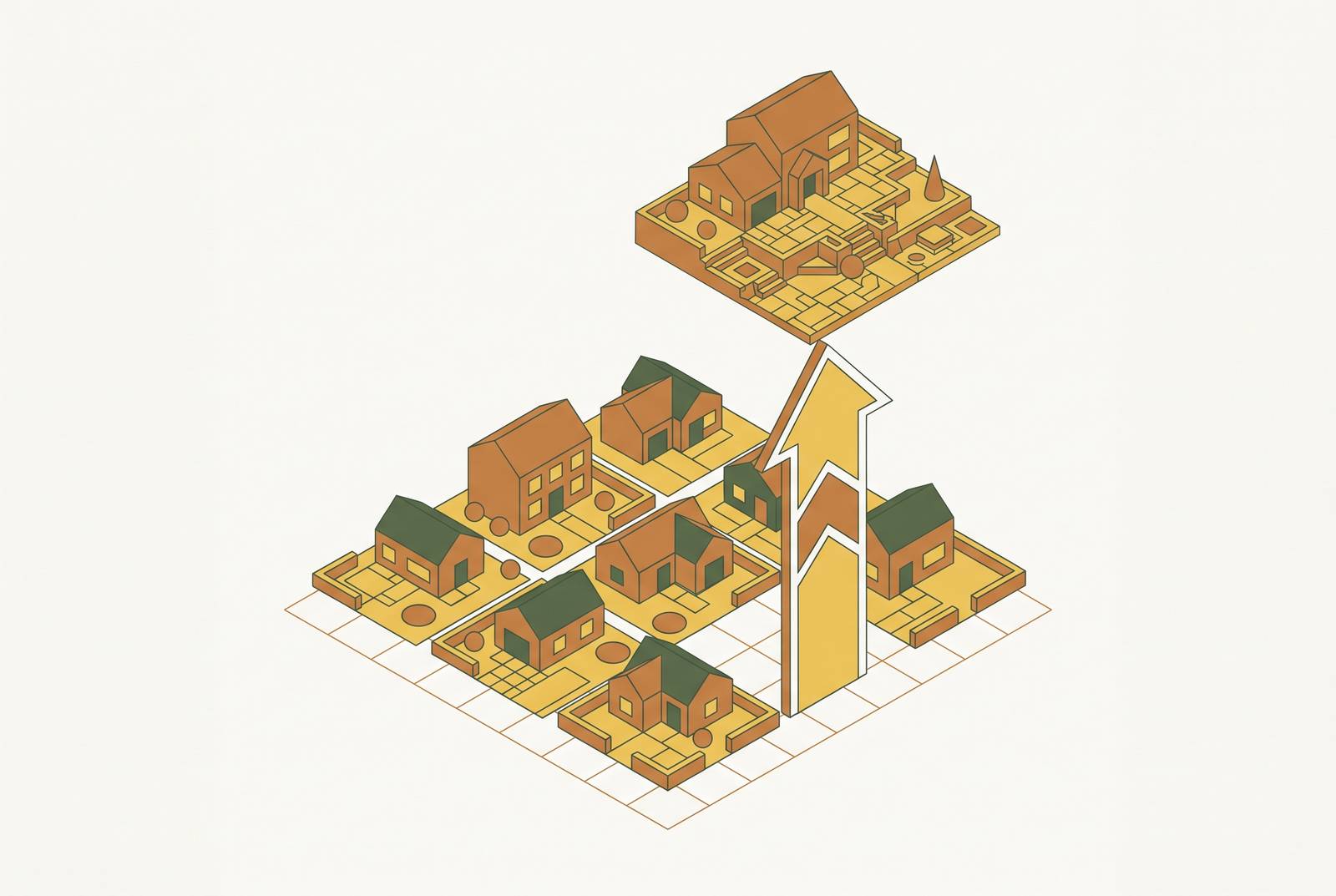
The ZIP codes that punch above their income level for hardscape spending are not simply the richest. They are places where homeowners have equity, room to build, and strong reasons not to move. For contractors, the message is plain. Look for prospects based on home value and whether owners are staying put as well as household income, then build the sales systems needed to win that work.
Why income alone is a poor map for hardscape demand
Median household income measures earnings. Sorting ZIP codes by that number puts the wealthiest places first, but it leaves out what makes an improvement worth buying. A household can afford the work without having much reason to do it.
Ultra-wealthy households also divide their budgets differently. Lifestyle, staff, risk management, and investment take large shares, while housing takes proportionately less than it does for middle-class homeowners. Fisher Island and Atherton represent wealth, but wealth alone does not make a neighborhood the best market for a mid-range hardscape pitch. It is useful to ask which households have both the means and the reason to put substantial money into the property they already own.
The mechanism: trapped equity and stay-put behavior, not discretionary luxury spending
For many homeowners, the reason starts with the cost of moving. Selling means giving up a low-rate mortgage, and the cost of financing the next home makes buying much more expensive than staying. The move-up calculation no longer works as it once did. An outdoor living project becomes a substitute for relocation, adding usable space without the disruption of a full interior addition. The purchase is not simply a splurge.
That is the trapped equity mechanism. The owner has substantial value in the current home, but realizing it through a sale would mean accepting a worse housing situation. Improving the property offers a reason to stay and a place to direct spending instead. Equity helps explain how owners can afford to invest, and their choice to stay put helps explain why they want to. Neither signal says as much on its own as the two do together.
The Harvard Joint Center for Housing Studies’ Improving America’s Housing 2025 shows that middle-aged homeowners spend more on improvements on average, which reflects differences in their income and who lives in their households. That gives contractors reason to look beyond the ultra-wealthy buyer, though it does not show which ZIP codes spend the most on hardscape. Broad regional improvement spending also needs care. Owners spending substantially on improvements are concentrated in the West and Northeast, while the above-income hardscape opportunity described here is inland and mid-tier.
What the "punches above income" ZIP archetype actually looks like
The fieldable profile combines four traits, namely high home equity, income modestly above the U.S. median, slow turnover, and suburban lots with room for hardscape. Together, those traits describe an owner who can support a substantial project and expects to use it. The lot matters because the financial case needs a physical outlet. A homeowner’s willingness to invest cannot create space that the property does not have.
Sewell, NJ (08080) is a useful anchor. A typical home lists in the low-to-mid four-hundreds, and household income covers that purchase with a standard down payment and meaningful cushion to spare. Livonia, MI (48154) provides another version of the pattern. Its household income covers the area’s median listing price with the deepest affordability cushion among 2026’s top 10 hottest ZIP codes. These are examples of the asset-rich, income-moderate profile, not a comprehensive ranking of hardscape spending.
The pattern is not confined to those two places. The Southern region has a large share of the hardscaping market, supported by suburban expansion, favorable climate, and outdoor living activity in Texas, Florida, North Carolina, and Georgia. SBC Outdoor Services’ 2026 report describes a mix of properties, from row-home patios in Baltimore to half-acre lots in Howard County and newer builds in Loudoun and Fairfax. The task is to recognize the right neighborhood conditions within a service area, rather than treating an entire region as one buyer type.
Why the ROI argument works in these ZIP codes but breaks in others
There is a ceiling on this opportunity. The underlying home value must support the project cost, or the resale argument weakens even when the owner wants the work. Zonda’s Remodeling 2025 Cost vs. Value Report shows that a new composite deck returns a strong share of its cost at resale. That does not mean a high-end yard will return its investment in a neighborhood of modest homes. A useful improvement and a recoverable investment are related, but they are not the same promise.
The practical filter is whether local home values can absorb a substantial project. Moderate income, meaningful equity, and supporting property values make a stronger prospect than moderate income and equity alone. In a depressed market, an owner may feel equity-rich without having a sound case for the full proposed spend. That mismatch can turn interest into a long sales conversation that stalls or closes below the intended ticket. Contractors should use neighborhood values to qualify the ZIP before leaning on the argument that the project adds real value and usable space to a home the buyer plans to keep.
Project ticket sizes in these ZIP codes justify building real sales infrastructure
Once a ZIP passes that filter, contractors should take its leads seriously regardless of where it ranks by income. Techo-Bloc’s 2025 contractor survey puts the average hardscape project in the tens of thousands of dollars. A medium paver patio costs several thousand dollars to install, and complete outdoor living projects in Minnesota’s South Metro often cost well into five figures, with larger builds costing more. These are substantial purchases, even when the household making them does not sit near the top of the income table.
Losing even a small fraction of inquiries to slow replies can mean a material revenue loss. One recovered after-hours project lead can carry more value than a week of lower-value maintenance work. That makes response and sales infrastructure part of the economics of serving these ZIP codes. The opportunity is large enough to warrant a disciplined process.
The process also needs to fit design-build work. A maintenance funnel built mainly to generate calls is not enough for a buyer weighing a major outdoor project. This buyer needs a portfolio, pre-qualification, and follow-up suited to a longer decision. One large patio job can be worth more than a hundred small mowing inquiries.
How fast lead response determines whether a contractor captures the demand these ZIP codes generate
The first test of that system comes when the homeowner reaches out. An owner who has chosen to improve rather than move may already be ready to book a conversation. A slow reply gives another contractor the chance to engage first. Accurate ZIP targeting cannot recover that advantage after the prospect has moved on. Finding demand and answering it are separate jobs, and both have to work.
The home-service response pattern described in the brief is blunt. Businesses lose a significant share of inbound leads after the five-minute window, while average first responses take hours. Lead-to-booked rates at the industry average are well under half, while automated best-practice response times are associated with rates that nearly double. Those are broader home-service benchmarks.
An automated response within seconds should therefore be the first step in the sales process. It needs to connect to the portfolio, qualification, and longer follow-up that a substantial project requires. Otherwise, a fast first message merely moves the bottleneck further down the line. AI-assisted operations matter here when they help close that gap between inquiry and sustained follow-up.
Marketing channels that reach equity-rich suburban homeowners efficiently
With response in place, acquisition can follow the ZIP profile. Google Ads and LSAs reach active searchers in the target areas. For hardscape, a modest monthly Google Ads budget can produce consistent results in most markets, with relevant keywords carrying a moderate national cost per click. One booked project can cover a month of ad spend.
Direct mail and door-hangers serve a different part of the same market. They can reach selected ZIP codes without competing in an advertising auction, including homeowners who match the tenure-and-equity profile but have not searched yet. Yard signs also have a place in that local mix. These channels make sense because the geographic filter comes first.
Organic visibility and AI search help the plan work over the longer term. Hook Agency offers AI search optimization at a standalone monthly rate or a reduced add-on rate for existing SEO clients. AI search is part of Comrade’s landscaping program. Those offerings establish AEO/GEO as a distinct service contractors can consider. For this strategy, its role is to build longer-term authority in the target ZIP codes while paid search and direct outreach address nearer-term demand.
A strong portfolio helps a homeowner judge whether a contractor fits the project, and a longer follow-up sequence supports a purchase that is not a routine maintenance booking. Each channel should feed that same process. Otherwise, tighter geographic targeting only sends better prospects into a sales system built for the wrong kind of work.
Putting it together: how a contractor builds a ZIP-level prospecting system
Start with a map of the service area. Find ZIP codes where home values are high compared with median household income, owners have stayed a long time, and lots have room for hardscape. Then use the home-value filter to check whether the equity in those homes can support the cost of a project. Sewell and Livonia are templates for recognizing conditions. The useful map is the one that identifies those conditions locally.
Next, align the channels with the homeowner’s stage. Use Google Ads and LSAs for people already searching in those ZIP codes, and direct mail and yard signs for matching households that have not begun a search. Build AEO/GEO presence for longer-term authority. Give those who show interest an automated response within seconds, a site that puts the portfolio first and pre-qualifies prospects, and follow-up that fits the design-build sales cycle.
A locally rooted contractor’s advantage is specificity. A national campaign does not bring the same local precision to recognizing where equity, tenure, property values, and lot size line up. Jobber’s 2026 Home Service Trends Report found that businesses with high confidence are far more likely to use AI than those with low confidence. That link shows that a divide in how these businesses work is already taking shape. In high-ticket work, the weight of each lead makes that divide consequential.
The opportunity is available to any contractor willing to build the map and the systems behind it. Size alone does not provide a better reading of local demand. A smaller operator can prospect more precisely by understanding why homeowners invest, then being ready when they act. The competitive window is to put that combination to work before ZIP-level intelligence and disciplined response become standard in the local market.