Retainage and Payment Schedule Structures for Hardscape Contracts
Milestone-based draws and state retainage caps protect contractor cash flow.

If you copy retainage structures from commercial construction, you get payment terms that do not fit residential hardscape work. The right structure for most hardscape jobs is a milestone-based draw schedule with a tightly defined final payment, not a running percentage withheld across months. The rules differ state by state, and several of them changed in 2024 through 2026.
How retainage in hardscape differs from commercial construction
Retainage is money you have earned but do not receive, typically 5 to 10 percent of each progress payment, withheld until substantial completion. Substantial completion is the point when the work is sufficiently complete for the owner to occupy or use the project for its intended purpose without unapproved disruption. Look at a commercial project and the logic makes sense.
Commercial construction can run for months or years, and the payment chain goes deep. The owner holds retainage from the general contractor, the general contractor holds it from each subcontractor, and the subcontractor holds it from each sub-tier. Retainage accumulates across every pay application and releases only after punch-list resolution, final inspections, and lien waivers from every tier.
Residential hardscape work is different in almost every respect. A typical project runs weeks, not years. The payment chain is usually one tier: homeowner to contractor. The industry norm for hardscape and landscaping is a deposit, a midpoint payment, and a completion payment, not a running percentage withheld across every invoice.
The distinction matters most when a hardscape contractor works as a subcontractor on a larger commercial or municipal project. On that project, retainage flows down the chain. Whatever the owner withholds from the general contractor, the general contractor withholds from the subcontractor at the same rate. ConsensusDocs 750, the standard constructor-subcontractor agreement, creates a flow-through provision that prevents subcontractors from being subjected to higher retainage rates than the owner withholds from the GC. If the subcontract lacks that language, the contractor should add it before signing.
Why milestone-based draw schedules work better for most hardscape contracts
Construction payment schedules come in three formats. Milestone-based schedules trigger payment when a phase is complete. With percentage-based schedules, you get paid as you finish parts of the contract. Time-based schedules use monthly draws. Most residential hardscape work fits the first or second format, because the work moves in observable phases rather than in calendar increments.
A typical residential hardscape draw has a deposit at signing, a midpoint payment when major material or structural work is verifiably complete, and a final payment at punch-list sign-off. The structure ties money to events a homeowner can see: a patio base is poured, a wall is set, drainage is installed. That gives the homeowner confidence that money follows actual progress, and it gives the contractor a clear trigger for invoicing.
A payment schedule is not an invoice. It is part of the contract, agreed before work begins, and it defines the conditions for payment rather than just the amounts. If you set it early, client expectations exist before the first shovel hits the ground. If you pick triggers before work starts, there is little to argue about later. You can plan out payroll, materials, and subcontractors from it. The schedule must be incorporated into the written contract to be enforceable, a point the final section returns to.
Early draws should reflect actual costs incurred at that phase. You hold the final draw until punch list and lien waiver delivery, and that is your leverage to get formal sign-off. It works like retainage, but without the long hold period typical in commercial work.
Deposit limits by state: what contractors can legally collect at signing
Deposit rules are one of the most misunderstood areas of contractor law. Most contractors rely on trade norms, like a third up front, that are either unsupported by statute or directly contradicted by it. The penalties for violations are not theoretical, and the rules fall into four patterns.
California is the strictest. The deposit cap on residential projects is 10 percent of the total contract price or $1,000, whichever is less. A second pattern is the proportional cap. Maryland requires the contract to be signed before any payment is collected, and violations can constitute unfair practices with fee-shifting exposure.
A third pattern is no cap, but trust fund rules apply. Texas takes the same approach: misapplication of construction trust funds is a personal and criminal liability under Property Code Chapter 162. The fourth pattern is no cap, but a clock. Florida cares how long you sit on the money, not how much you collect.
Some states are widely cited online as having deposit caps, but no verified statute sets one. Virginia has no cap on contractor deposits, no matter what homeowner sites say. Progress payments need to match costs incurred at each phase, not exceed them.
Retainage caps and release deadlines across key states, including recent law changes
State retainage law shifted materially in 2024 through 2026, so contractors writing contracts today in several states are under rules that did not exist when most contract templates were written. California SB 61 took effect January 1, 2026. The enforcement mechanism is an automatic 2 percent monthly penalty on late retainage release, and it is non-waivable. The release deadline on private projects is 45 days after final completion. The critical carve-out: residential projects that are not mixed-use and are four stories or under are excluded from SB 61's private cap. Most residential hardscape work in California is not covered by the new limit.
New York's amended Prompt Payment Act took effect in December 2025. It requires retainage release at substantial completion, not final closeout, on private contracts above $150,000. Public projects carry 1 percent monthly interest on late retainage. Texas caps retainage at 10 percent on both public and private projects, with a release deadline of 30 days after acceptance on both. Texas applies automatic 1.5 percent monthly interest on late retainage with no contract clause needed.
Virginia caps retainage at 5 percent on both public and private projects, with a 30-day release deadline on both and automatic 1 percent monthly interest on late payment. Florida splits its regime: a 5 percent cap on public projects, a private market standard of 10 percent, a 30-day release deadline on public projects, and private release per contract. North Dakota allows up to 10 percent until 50 percent completion, then no additional retainage may be withheld. New Mexico banned retainage on most public projects and caps private projects at 5 percent.
In states with no private retainage statute, contract terms are the only rule. Where a statutory cap exists, exceeding it carries penalties. Alabama requires contractors who withhold a higher percentage from subs than the owner withholds from them to pay interest on the excess.
How step-down clauses and contract form choice affect when retainage is released
The contract a contractor signs at project start controls whether retainage steps down mid-project, when release is automatic, and how much discretion the owner keeps. The state law matters, but the contract language determines how the law applies to that specific job. Choosing the right language is a cash flow decision, not a legal formality.
With a step-down clause, retainage can start higher and then drop once the project passes a defined completion threshold, usually 50 percent. Step-down clauses can be negotiated into private contracts even in states where they are not statutorily required. Illinois and North Dakota mandate them by law, but any contract can include one.
Contract form choice matters for timing. The AIA A201-2017 uses discretionary language, saying the owner may release retainage, which gives the owner flexibility to delay release even after substantial completion. ConsensusDocs 200 uses similar discretionary language, giving the owner flexibility to reduce or release retainage, though it caps retainage after 50 percent completion. A contractor who does not read the retainage release language before signing may not realize they have given the owner discretionary hold authority.
The release clause should specify the exact trigger in plain language: certificate of occupancy, final lien waiver, or punch list sign-off. When a hardscape contractor works as a subcontractor under a general contractor, the flow-through provision means their retainage rate cannot lawfully exceed what the owner is holding from the GC, but only if the subcontract includes that language. If you sub under AIA or custom general contractor paper, check the language before you sign.
Defining release conditions that close out cleanly without disputes
Most payment disputes in hardscape do not arise from missing contract language about amounts. They arise because the contract never defined what complete means, leaving both parties to argue about it after the fact. Release conditions for the final draw and any retainage should be a specific checklist, not a single phrase. The checklist becomes the objective standard both parties sign off on. Typical release conditions for residential hardscape include punch list items complete and signed off in writing by the homeowner, final inspections passed where applicable, and final lien waivers delivered from any subs or material suppliers. The standard prerequisites are the same across the industry: punch list completion, final inspections, and lien waivers from every contracting tier.
Retainage is not the same as a holdback for disputed work. A disputed-work holdback targets a specific defect or backcharge. Mixing the two on an invoice delays release and creates bookkeeping errors that compound disputes.
Most states that mandate retainage release require it within 30 to 60 days of substantial completion or final acceptance. Where state law is silent, the contract term is the only deadline. The contractor should specify in writing how many days after the release checklist is satisfied the owner must pay.
Late payment provisions are the practical enforcement mechanism. In states where interest is not automatic, the contract must specify it or the contractor has no leverage. A retainage bond is an alternative to cash retainage on some projects. The contractor provides a bond in lieu of having funds held, which frees up working capital on larger or longer-duration work.
Mechanics liens as the backstop when retainage or final payment is withheld
A mechanics lien is the hardscape contractor's strongest legal tool when retainage or final payment is withheld, but only if filed within a strict deadline. Liens cover all unpaid amounts including retainage. They are not limited to unpaid invoices for work in progress.
The lien deadline typically starts at final completion or the last day of work performed, not when retainage becomes due. There is no cure and no extension. The only remaining remedies are breach of contract claims, which are slower and more expensive.
Contractors should track lien deadlines from the last day work was performed on site, not from the invoice date or the retainage release deadline. On financed projects, the construction lender tracks retainage separately from the draw schedule because retained funds change the capital still available. Lenders may add their own release conditions, such as independent inspection, before they release funds.
A demand letter that cites specific state statutes can get owners to release retainage without litigation. In states like California with its 2 percent monthly penalty under SB 61, and Texas with automatic 1.5 percent monthly interest, most owners in California settle within days once the automatic penalty is cited in a demand letter. Contractors should consult an attorney on lien procedures in their specific state before relying on them.
A working payment schedule structure for residential hardscape contracts
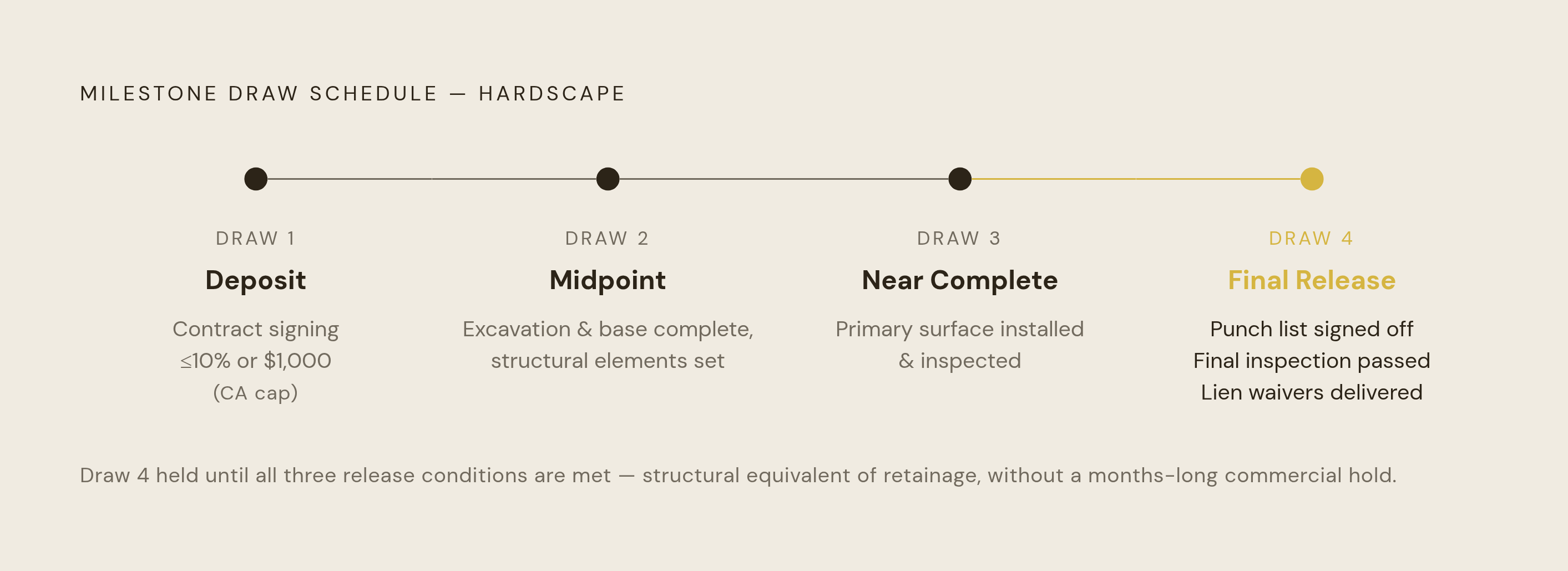
A well-structured hardscape payment schedule is not a retainage document. The schedule must be part of the signed contract, not a verbal agreement or a side email. It becomes enforceable only when incorporated into the construction agreement, and it should state that it is incorporated into and made part of the Construction Agreement dated with the contract date.
Draw 1 is the deposit at contract signing. In California that means 10 percent or $1,000, whichever is less. Draw 2 is the midpoint milestone, triggered by a verifiable phase completion such as excavation and base work complete or structural elements set. The amount should cover materials and labor costs incurred to that point.
Draw 3 is near completion, triggered when the primary hardscape surface such as pavers, concrete, or stone is installed and inspected. Draw 4 is final payment. It releases only after punch list sign-off in writing, final inspection passed where applicable, and lien waivers from any subs and material suppliers delivered. Hold it until the project is genuinely closed out.
Each draw should include payment terms in writing: invoice submission method, payment due within a defined number of days of invoice receipt, a late payment interest rate, and a work suspension right. When working as a sub under a general contractor, verify the flow-through provision before signing. The retainage rate applied to your work cannot lawfully exceed what the owner is holding from the GC in states with that rule.
If you use integrated business platforms, you can automate draw invoicing, milestone tracking, and payment follow-up. It protects both parties by removing ambiguity before work starts. Homeowners who understand the milestone logic are more likely to sign without negotiation, not less, because a clear schedule reads as a trust-building tool rather than a legal one.